Economics · Ch 12 — Employment: Growth, Informalisation and Other Issues
Participation of People in Employment
Participation of People in Employment
The worker-population ratio
The worker-population ratio is a key indicator used to study a country's employment situation. It tells us what proportion of the population is actively taking part in producing goods and services. A high ratio means a large share of people are engaged in economic activity; a medium or low ratio means a large share is not directly involved. Here 'population' means the total number of people living in a particular area at a given time.
How it is calculated
To find the ratio for India, divide the total number of workers by the total population and multiply by 100.
| Sex | Total | Rural | Urban |
|---|---|---|---|
| Men | 52.1 | 51.7 | 53.0 |
| Women | 16.5 | 17.5 | 14.2 |
For every 100 persons, about 35 (by rounding off the real figure of 34.7) are workers in India. In urban areas the proportion is about 34, while in rural India the ratio is about 35.
Why rural and urban ratios differ
Rural people have limited means to earn higher incomes. Many do not attend school or college, or drop out midway to join the workforce, and their economic condition rarely allows them to stay idle at home — so participation is higher. Urban residents, by contrast, are more likely to study in various institutions and can look for jobs that match their qualifications and skills, so a section of them stays out of the workforce while studying.
Work These Out
- Any study of employment must start with a review of the worker-population ratios — why?
- In some communities, even where men do not earn a high income, women are still not sent to work. Why?
Why fewer women work …
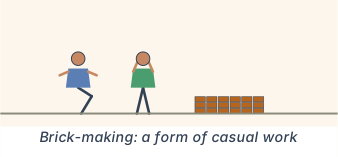
Drawn by us to help you understand the concept clearly, and verified to make sure it's accurate. For exams, practice from your textbook's own diagram.
Own-drawn recreation of NCERT Fig 6.2 (book p.96) — n …