Economics · Ch 12 — Employment: Growth, Informalisation and Other Issues
Self-Employed and Hired Workers
Self-Employed and Hired Workers
Why status of employment matters
The worker-population ratio tells us how many people work, but not about their status in society or their working conditions. Knowing the status of a worker within an enterprise reveals one dimension of the quality of employment — how attached a worker is to the job, and how much authority he or she has over the enterprise and over co-workers.
Three categories of workers
Think of three people in the construction industry — a cement shop owner, a construction labourer and a civil engineer. Their differing statuses give them different names:
- Self-employed: those who own and run an enterprise to earn a living, such as the cement shop owner. About 52 per cent of India's workforce falls here, making it the single largest category.
- Casual wage labourers: those casually engaged in the work of others — for example on farms or building sites — in return for a wage, such as the construction worker. They form about 25 per cent of the workforce.
- Regular salaried employees: those hired by a person or enterprise and paid wages on a regular basis, such as the civil engineer. They account for about 23 per cent of the workforce.
Drawn by us to help you understand the concept clearly, and verified to make sure it's accurate. For exams, practice from your textbook's own diagram.
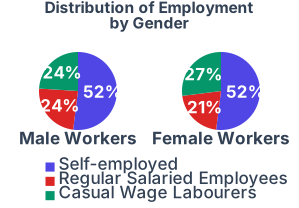
Self-employment is the largest single category for both men and women (52 per cent each). Casual wage work is the second-largest source for both, slightly more so for women (24% of men vs 27% of women); regular salaried employment engages a broadly similar share of men and women (around 23-24% …
Patterns by gender
Self-employment is the main source of livelihood for both men and women — about 52 per cent of the workforce of each, per Chart 6.1. Casual wage work is the second most important source for both, a little more so for women (24 per cent of men against 27 per cent of women). In regular salaried jobs, men and women are engaged in a broadly similar proportion — around 23-24 per cent of men and 21 per cent of women — so the gap between the sexes here is small.
Drawn by us to help you understand the concept clearly, and verified to make sure it's accurate. For exams, practice from your textbook's own diagram.
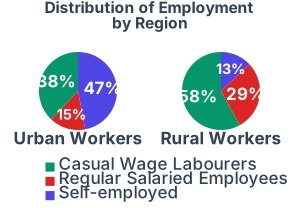
Self-employment and casual wage work are both far more common in rural areas than urban ones (self-employed 47% urban vs only 13% rural is the one exception the other way — most rural workers own and cultivate small plots, while towns lean far more heavily on regular salaried and casual wage work, since n …
Patterns by region
When we compare the distribution of the workforce in rural and urban areas, the self-employed and casual wage labourers are found more in rural areas than in urban areas — largely because most rural workers own small plots of land and cultivate them independently. Urban work is different: not everyone can run a factory, shop or office, and urban enterprises need workers on a regular basis, so both self-employment and regular salaried work are important in towns.
Work These Out
…