Economics · Ch 16 — Infrastructure
Energy
Energy
Why do we need energy, and in what forms is it available? Energy is a critical aspect of the development process of any nation. It is essential for industry; it is now used on a large scale in agriculture and related areas such as the production and transport of fertilisers, pesticides and farm equipment; and it is needed in homes for cooking, lighting and heating. It is hard to think of producing any commodity or service without using energy.
Sources of Energy
Energy comes from commercial and non-commercial sources. Commercial sources are coal, petroleum and electricity, so called because they are bought and sold. Non-commercial sources are firewood, agricultural waste and dried dung, so called because they are found in nature or forests and are not traded in the market. As a rule, commercial sources of energy are exhaustible (hydropower is the exception), while non-commercial sources are generally renewable. More than 60 per cent of Indian households depend on these traditional (non-commercial) sources for their everyday cooking and heating needs.
Non-conventional Sources of Energy
Both commercial and non-commercial sources together are known as conventional sources of energy. There are three further sources, commonly called non-conventional sources — solar energy, wind energy and tidal power. Being a tropical country, India has almost unlimited potential for producing all three, provided that suitable, cost-effective technologies (some of which already exist) are used, and even cheaper technologies can be developed.
Consumption Pattern of Commercial Energy
In India, commercial energy makes up about 74 per cent of total energy consumption. Within it, coal has the largest share at 54 per cent, followed by oil at 32 per cent, natural gas at 10 per cent and hydro energy at 2 per cent. Non-commercial energy — firewood, cow dung and agricultural waste — accounts for the remaining over 26 per cent. A critical feature of India's energy sector, and of its links to the wider economy, is its heavy import dependence on crude oil and petroleum products, which is likely to grow rapidly in the near future.
The sectoral pattern of commercial-energy use is shown in Table 8.2. The transport sector was the largest consumer in 1953-54, but its share has fallen continuously since, while the shares of the household, agriculture and industrial sectors have risen. The share of oil and gas is the highest of all commercial-energy consumption, and with rapid economic growth the use of energy has grown correspondingly.
Table 8.2 — Trends in Sectoral Share of Commercial Energy Consumption (in %)
| Sector | 1953-54 | 1970-71 | 1990-91 | 2012-13 |
|---|---|---|---|---|
| Household | 10 | 12 | 12 | 22 |
| Agriculture | 01 | 03 | 08 | 18 |
| Industries | 40 | 50 | 45 | 45 |
| Transport | 44 | 28 | 22 | 2 |
| Others | 5 | 07 | 13 | 13 |
| Total | 100 | 100 | 100 | 100 |
Source: Ninth Five Year Plan, Vol. II, Planning Commission, and Growth of Electricity Sector in India 1947-2013, Central Electricity Authority, Ministry of Power.
Power / Electricity
The most visible form of energy, often identified with progress in modern civilisation, is power — commonly called electricity. It is a critical component of infrastructure that shapes a country's economic development, and the growth of demand for power is generally higher than the GDP growth rate: studies suggest that to sustain 8 per cent annual GDP growth, power supply needs to grow by about 12 per cent a year.
In India, in 2012-13, the sources of power-generation capacity were:
| Source | Share of power-generation capacity (2012-13) |
|---|---|
| Thermal | 70% |
| Hydel and wind | 16% |
| Nuclear | 2% |
India's energy policy encourages the two sources of hydel and wind power, because they do not rely on fossil fuel and so avoid carbon emissions — yet this has not translated into faster growth of electricity from these two sources. Atomic (nuclear) energy is another important and economically advantageous source, but at present it accounts for only about 2 per cent of total energy consumption, against a global average of 13 per cent — far too low. Some scholars therefore urge that more electricity be generated from nuclear sources, while others object on grounds of environment and sustainable development.
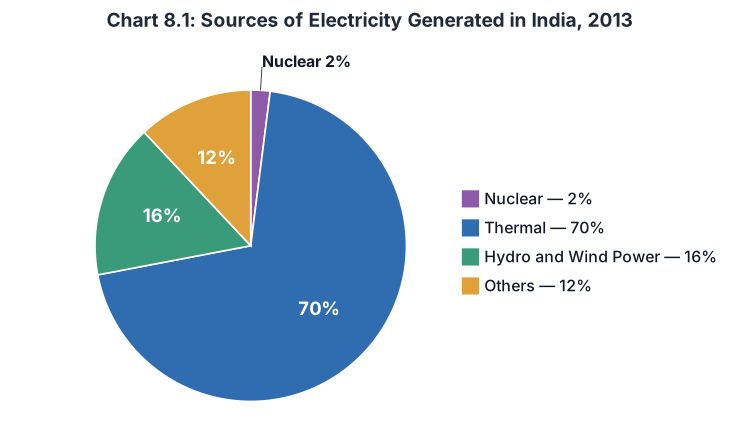
Drawn by us to help you understand the concept clearly, and verified to make sure it's accurate. For exams, practice from your textbook's own diagram.
Our recreation of the 2013 electricity-source split. Thermal sources dominate at 70%, followed by Hydro and Wind Power (16%) and Others (12%), with Nuclear supplying just 2% — far below the world average, which is why some econo …
Some Challenges in the Power Sector
Not all the electricity generated by power stations reaches the final consumer. A part is consumed by the power-station auxiliaries themselves, and a further portion is lost while being transmitted — what actually reaches our homes, offices and factories is the net availability. India's power sector faces several challenges:
- (i) India's installed capacity is not sufficient to feed 7-8 per cent annual economic growth; commercial energy supply needs to grow by about 7 per cent, but India adds only about 20,000 MW a year, and even the installed capacity is under-utilised because plants are not run properly.
- (ii) The State Electricity Boards (SEBs) that distribute power incur losses exceeding ₹500 billion, caused by transmission and distribution losses, wrong pricing of electricity, and other inefficiencies — some blame the distribution of electricity to farmers, and theft of electricity also adds to their woes.
- (iii) Private-sector power generators, and foreign investors, are yet to play a major role.
- (iv) There is general public unrest over high power tariffs and prolonged power cuts in different parts of the country.
- (v) Thermal power plants, the mainstay of India's power sector, face a shortage of raw material and coal supplies.
Thus continued economic development and population growth are driving the demand for energy faster than India is currently producing it. More public investment, better research and development, exploration, technological innovation and the use of renewable sources can all help ensure additional supply. Instead of adding to installed capacity, the government has chosen to privatise the power sector — particularly distribution — and to allow much higher prices for electricity, which have hurt certain sectors badly. Whether this is the right policy remains a live debate.
Box 8.1 — Making a Difference
…