Economics · Ch 15 — Poverty
How are Poor People Identified?
How are Poor People Identified?
If India is to solve the problem of poverty, it must find viable and sustainable strategies to address the causes of poverty and design schemes to help the poor. But for such schemes to be implemented, the government must be able to identify who the poor are — which needs a carefully chosen scale to measure poverty.
The origin of the Poverty Line
In pre-independent India, Dadabhai Naoroji was the first to discuss the concept of a Poverty Line. He used the menu for a prisoner and the prevailing prices to arrive at what may be called the 'jail cost of living'. However, only adults stay in jail, whereas an actual society also has children, so he adjusted this cost of living. Assuming that one-third of the population consisted of children — half of whom consumed very little while the other half consumed half of the adult diet — he arrived at a factor of three-fourths:
This weighted average of the consumption of the three segments gives the average poverty line, which comes out to be three-fourths of the adult jail cost of living.
In post-independent India there have been several attempts to work out a mechanism to identify the number of poor: the Planning Commission's Study Group (1962), the 'Task Force on Projections of Minimum Needs and Effective Consumption Demand' (1979), and Expert Groups (1989 and 2005). Besides the Planning Commission, many individual economists have also attempted to develop such a mechanism.
Box 4.2: What is Poverty?
Two scholars, Shaheen Rafi Khan and Damian Killen, put the conditions of the poor in a nutshell: Poverty is hunger. Poverty is being sick and not being able to see a doctor. Poverty is not being able to go to school and not knowing how to read. Poverty is not having a job. Poverty is fear for the future, having food once in a day. Poverty is losing a child to illness brought about by unclean water. Poverty is powerlessness, lack of representation and freedom.
Dividing the poor from the non-poor
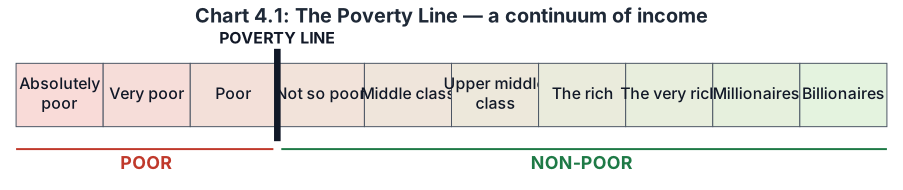
To define poverty we divide people into two categories — the poor and the non-poor — and the poverty line separates the two. But there are many kinds of poor (the absolutely poor, the very poor and the poor) and many kinds of non-poor (the middle class, the upper middle class, the rich, the very rich and the absolutely rich). Think of a continuum from the very poor to the absolutely rich, with the poverty line dividing the poor from the non-poor — this is what Chart 4.1: Poverty Line depicts, with the categories ordered as below:
| Side of the poverty line | Categories (poorest → richest) |
|---|---|
| POOR | Absolutely poor · Very poor · Poor |
| NON-POOR | Not so poor · Middle class · Upper middle class · The rich · The very rich · Millionaires · Billionaires |
Drawn by us to help you understand the concept clearly, and verified to make sure it's accurate. For exams, practice from your textbook's own diagram.
Our recreation of the poverty-line continuum. Income runs from left (the absolutely poor) to right (billionaires); a single bold vertical line — the poverty line — divides everyone into just two groups, the poor (the three poorest categories) and the non-poor (everyone above the line). Though there are man …
Categorising poverty over time
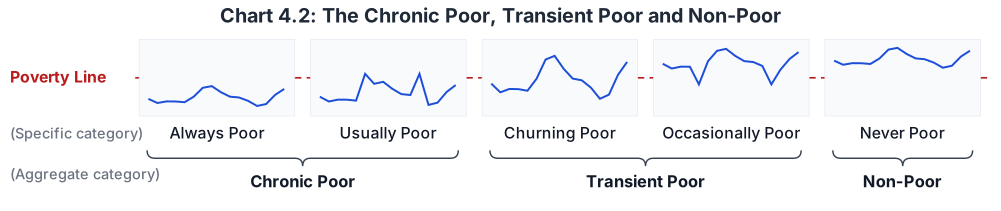
Poverty can also be categorised by how it changes over time (Chart 4.2). People who are always poor and those who are usually poor but may sometimes have a little more money (for example casual workers) are grouped as the chronic poor. The churning poor move regularly in and out of poverty (for example small farmers and seasonal workers), and the occasionally poor are rich most of the time but sometimes have a patch of bad luck — together these two form the transient poor. Those who are never poor are the non-poor.
| Specific category | Aggregate category |
|---|---|
| Always poor · Usually poor | Chronic poor |
| Churning poor · Occasionally poor | Transient poor |
| Never poor | Non-poor |
Drawn by us to help you understand the concept clearly, and verified to make sure it's accurate. For exams, practice from your textbook's own diagram.
Own recreation showing how poverty changes over time. Each panel traces one household's income against a dashed poverty line: the always poor and usually poor stay at or below it (the chronic poor); the churning poor and occasionally poor cross above and below it (the **transient poo …
The Poverty Line
There are many ways of measuring poverty. One way is to determine the poverty line by the monetary value (per capita expenditure) of a minimum calorie intake, estimated at 2,400 calories for a rural person and 2,100 calories for an urban person. Based on this, in 2009-10 the poverty line was defined as monthly consumption worth ₹673 per person for rural areas and ₹860 for urban areas. The government uses Monthly Per Capita Expenditure (MPCE) as a proxy for the income of households to identify the poor.