Computer Science · Ch 11 — Data Communication
Transmission Media
Transmission Media
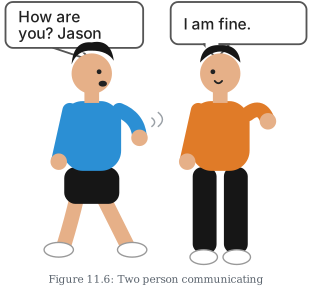
A transmission medium is anything that can carry signals or data between a source (transmitter) and a destination (receiver). The textbook gives two everyday examples: when you switch on a ceiling fan or a light bulb, the electric wire is the medium carrying current from the switch to the fan or bulb. When two people talk to each other, the medium is air.
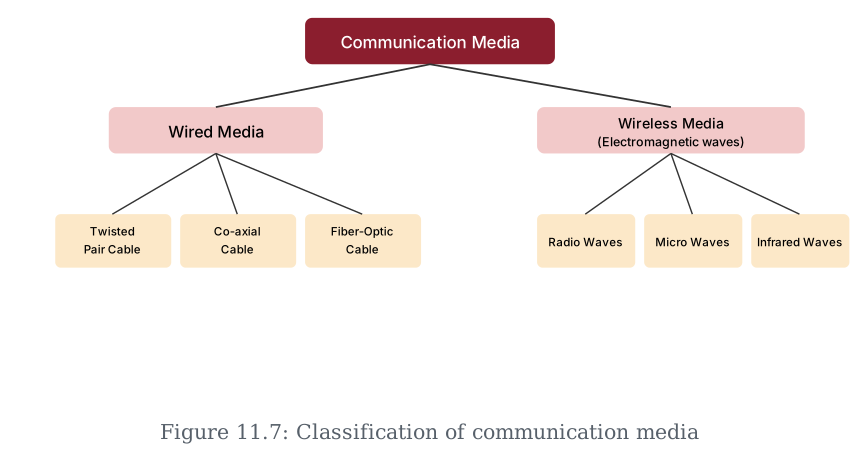
In data communication, transmission media are the physical links that carry messages between two or more communicating devices. These media are classified into two broad categories: guided and unguided.
Guided transmission media involve a physical link made of wire or cable through which data, in the form of signals, is propagated between nodes. Examples include metallic cables and fibre-optic cables. These are also known as wired media.
Unguided transmission media involve data travelling through air in the form of electromagnetic waves, using an antenna. These are also known as wireless media. …
Drawn by us to help you understand the concept clearly, and verified to make sure it's accurate. For exams, practice from your textbook's own diagram.
The simplest possible example of communication: two people talking face to face. One asks "How are you?", the other replies "I am fine." — a message travels from one person to the other and back again. …
Drawn by us to help you understand the concept clearly, and verified to make sure it's accurate. For exams, practice from your textbook's own diagram.
Every physical path data can travel along falls into one of two broad categories. Wired Media means the signal travels through a physical cable — Twisted Pair Cable, Co-axial Cable, or Fiber-Optic Cable are the three types covered in this chapter. Wireless Media means the signal travels through the air as electromagnetic waves — Radio Waves, Micro Waves, or Infrared Waves. …