Computer Science · Ch 11 — Data Communication
Wired Transmission Media
Wired Transmission Media
Wired transmission media are any physical links that carry data in the form of signals. The three most common types are twisted pair cable, coaxial cable, and fibre optic cable. Twisted pair and coaxial cables carry electrical signals, while fibre optic cable carries light signals.
Twisted Pair Cable
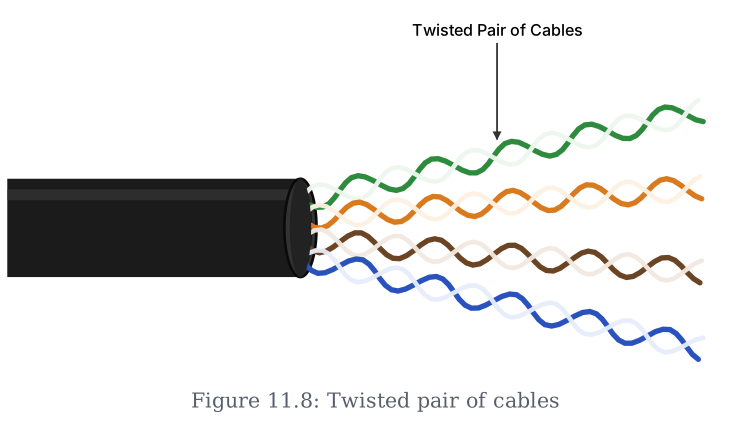
A twisted pair cable consists of two insulated copper wires twisted together in a helical pattern, similar to the structure of DNA. Each copper wire is individually covered with a plastic insulator. Usually, several such pairs are bundled together and wrapped in a protective outer covering. Each twisted pair within the bundle acts as a single communication link.
The twisting of the wires is deliberate — it minimises the effect of electrical interference from other similar pairs that are close by. Twisted pair cables are less expensive than other wired media and are most commonly used in telephone lines and local area networks (LANs).
There are two types of twisted pair cables:
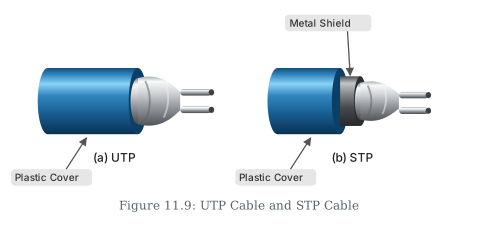
- Unshielded Twisted Pair (UTP): Has only the plastic covering around each wire and the outer jacket. It is the more common and cheaper type.
- Shielded Twisted Pair (STP): Has an additional metal shield wrapped around the twisted pairs, inside the outer plastic cover. This provides better protection against interference.
Coaxial Cable
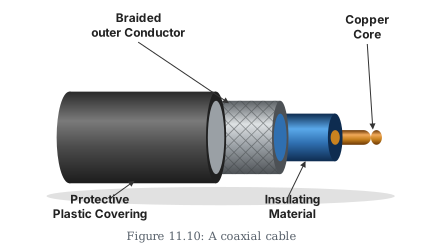
Coaxial cable is a better-shielded medium with more bandwidth than twisted pair. Its construction is layered:
- A solid copper wire at the core.
- An insulating material surrounding the copper core.
- An outer conductor (usually a braided copper mesh) surrounding the insulator.
- A protective plastic covering over the entire assembly.
The key advantage of coaxial cable is its shielded design. The outer conductor protects the inner copper core from external electromagnetic interference, allowing data to be transmitted quickly and over longer distances. Because of this, coaxial cables are used to carry signals of higher frequencies to longer distances compared to twisted pair.
Fibre Optic Cable
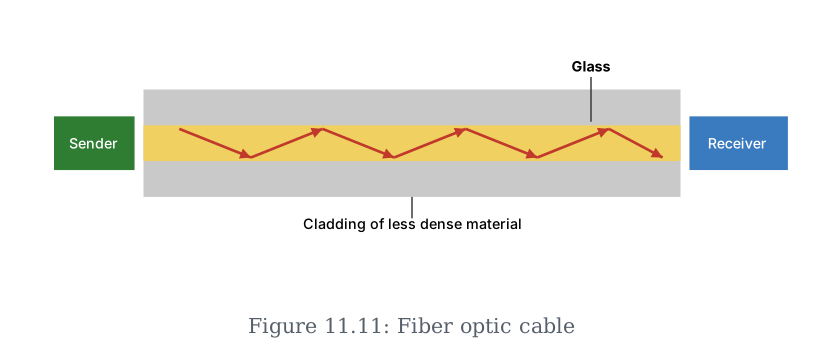
Fibre optic cable carries data as pulses of light, not electricity. The light travels inside a very thin strand of glass. The construction is:
- A thin, transparent strand of glass at the centre (the core).
- A layer of less dense glass called cladding surrounding the core. The cladding uses the principle of refraction to keep the light signal confined within the core.
- An outer jacket made of PVC or Teflon covering the cladding. …
Drawn by us to help you understand the concept clearly, and verified to make sure it's accurate. For exams, practice from your textbook's own diagram.
A twisted-pair cable — the most common wired connection you'll find (it's what a typical Ethernet cable is) — bundles several PAIRS of insulated copper wires together, with each pair twisted around each other along their length. …
Drawn by us to help you understand the concept clearly, and verified to make sure it's accurate. For exams, practice from your textbook's own diagram.
There are two variants of twisted-pair cable, differing in how well-protected the wires inside are. (a) UTP (Unshielded Twisted Pair) has just the twisted copper cores inside a plastic cover — nothing extra protecting them from outside interference. …
Drawn by us to help you understand the concept clearly, and verified to make sure it's accurate. For exams, practice from your textbook's own diagram.
A coaxial cable is built as several layers, one inside the other, each with a job. At the very centre is a solid Copper Core — this is what actually carries the signal. Around it sits Insulating Material, keeping the core electrically separated from the next layer. Outside that is a Braided outer Conductor — a woven metal mesh that shields the core from outside interference. The whole thing is wrapped in a Protective Plastic Covering. …
Drawn by us to help you understand the concept clearly, and verified to make sure it's accurate. For exams, practice from your textbook's own diagram.
A fiber-optic cable carries data as pulses of LIGHT instead of electricity. At the centre is a Glass core; on either side sits a Cladding layer made of a less dense material.
The zig-zag path shown inside the glass core is the key idea: because the cladding is less dense than the glass core, light hitting the boundary between them bounces back inward instead of escaping — a phenomenon called total internal reflection. That's what lets the light signal bounce its way from the …