Physical Education · Ch 10 — Training in Sports
Endurance
Endurance
Endurance is the ability to sustain an activity — to keep producing energy over a long period and resist fatigue. Like strength, it is a conditional ability, and it matters hugely in health, training and competition. It is usually measured by how many repetitions, or how long, an action can be performed.
Definitions
- Harre: endurance is the ability to resist fatigue.
- Barrow and McGee: the result of a physiological capacity of an individual to sustain movement over a period of time.
- H. Singh: the ability to sustain an activity.
Types of Endurance
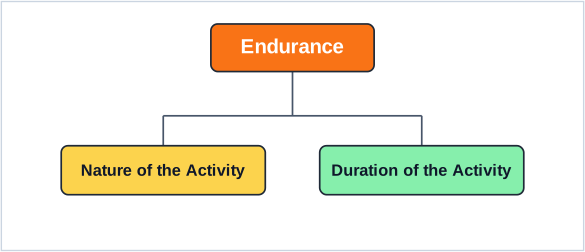
Endurance is classified in two ways — by the nature of the activity and by its duration.
Drawn by us to help you understand the concept clearly, and verified to make sure it's accurate. For exams, practice from your textbook's own diagram.
This is the top-level classification chart for endurance, showing the two independent criteria used to group its sub-types in the text below. The 'Endurance' box at the top branches into two child boxes — 'Nature of the Activity' and 'Duration of the Activity' — because endurance can be sorted either by WHAT kind of movement is involved (its energy system and intensity, expanded in Figure 10.5) or by HOW LONG the activity lasts (expanded in Figure 10.6). A student should read the two branches as two separate, parallel lenses applied to the same ability, not as a sequence — any single endurance activity, such as a 400 m sprint or a marathon, can be classified by its nature A …
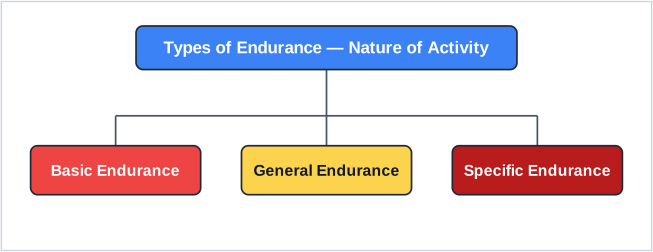
I. According to the nature of the activity. This grouping is based on the kind of activity involved.
Drawn by us to help you understand the concept clearly, and verified to make sure it's accurate. For exams, practice from your textbook's own diagram.
This chart expands the 'Nature of the Activity' branch from Figure 10.4 into its three sub-types. The header box 'Types of Endurance - Nature of Activity' branches down into three boxes — 'Basic Endurance', 'General Endurance' and 'Specific Endurance' — drawn side by side because none is a prerequisite stage of another; they are three distinct categories a sportsperson's endurance can be judged against, not three steps of one programme. Basic endurance, the leftmost box, is the foundation every other type of endurance training builds on, which is why the text right after this figure explains it first, followed by the less sport-specific ge …
- Basic Endurance — resisting fatigue under a medium-intensity load using aerobic muscular metabolism: slow-paced movement of large muscle groups over a long period, such as jogging, cycling or swimming for more than 30 minutes. It forms the base for all other types of endurance.
- General Endurance — the ability to perform general (non-sport-specific) movements for a prolonged time. It can involve higher-intensity work than basic endurance, but for a shorter duration, and can be built through general exercise.
- Specific Endurance — the ability to resist fatigue in the movements of a particular sport. It varies from sport to sport because the nature of fatigue differs; a hockey player's specific endurance is not the same as a marathon runner's or a cyclist's.
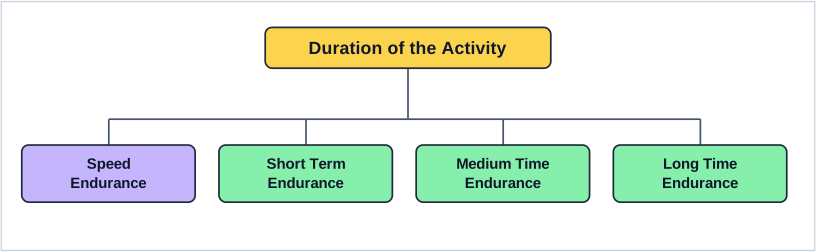
II. According to the duration of the activity. This grouping considers only cyclic activities and is based on physiological factors; following Harre (1986) it divides into:
Drawn by us to help you understand the concept clearly, and verified to make sure it's accurate. For exams, practice from your textbook's own diagram.
This chart expands the 'Duration of the Activity' branch from Figure 10.4 into its four physiologically-defined sub-types, each tied to a specific time window: 'Speed Endurance' (up to 45 seconds), 'Short Term Endurance' (45 seconds to 2 minutes), 'Medium Time Endurance' (2 to about 11 minutes) and 'Long Time Endurance' (more than 11 minutes). The four boxes are drawn left to right in increasing order of duration, which matters because the dominant energy system an athlete relies on shifts along the same axis — from anaerobic, phosphagen-dominant efforts on the left (a 400 m sprint) to aerobic-dominant efforts on the right (a marathon) — so th …
- Speed Endurance — resisting fatigue in cyclic activities lasting up to 45 seconds; the classic example is the 400 m sprint. It depends mainly on the power and capacity to produce energy.
- Short Term Endurance — needed for activities lasting 45 seconds to about 2 minutes, such as an 800 m run; depends largely on speed endurance and strength endurance.
- Medium Time Endurance — needed for activities lasting 2 to about 11 minutes, such as the 1500 m and 3000 m runs or rowing; depends on speed and strength endurance, but to a limited extent.
- Long Time Endurance — needed for activities lasting more than 11 minutes, such as the marathon and cross country.
Methods to Develop Endurance
Drawn by us to help you understand the concept clearly, and verified to make sure it's accurate. For exams, practice from your textbook's own diagram.
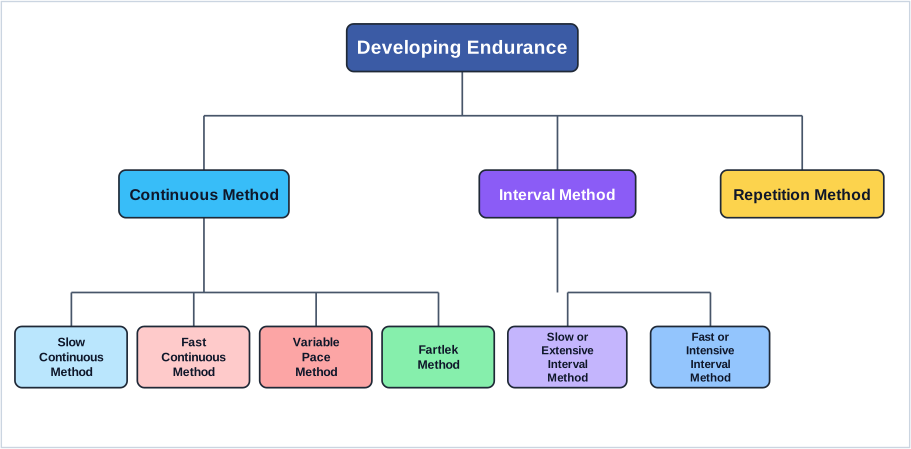
A top box 'Developing Endurance' branches into 'Continuous Method', 'Interval Method' and 'Repetition Method'. 'Continuous Method' branches into 'Slow Continuous Method', 'Fast Continuous Method', 'Variable Pace Method' and 'Fartlek Method'. 'Interval Method' branches into 'Slow or Extensive Inte …
1. Continuous Method. Exercise is done for a long time without rest; because the duration is long, the intensity is kept low. Its sub-methods are:
- (a) Slow Continuous Method — a steady speed with no break for a long time, paced by heart rate. A trained athlete's heart rate should be 140-160 beats per minute, for at least 30 minutes; used for walking, running and cycling. Effect: mainly on the muscles, with some psychic and metabolic benefits — more muscle and liver glycogen, greater capillarisation, more and larger mitochondria, better thermal regulation, improved oxidative enzymes, more fat metabolism, a positive effect on heart and lungs, and improved willpower and self-discipline.
- (b) Fast Continuous Method — performed faster but at a uniform speed, with heart rate at 160-180 beats per minute; being more strenuous, the duration is at least 20 minutes. Effect: improves VO2 max and the muscles' capacity to use oxygen, markedly increases mitochondria, and improves anaerobic capacity.
- (c) Variable Pace Method — the pace changes, but the changes are pre-planned; heart rate ranges 140-180 beats per minute for 15 minutes to 1 hour. Very strenuous, so it suits trained athletes. Effect: raises muscle glycogen, increases mitochondria, improves heart-lung efficiency and VO2 max, and builds willpower and confidence.
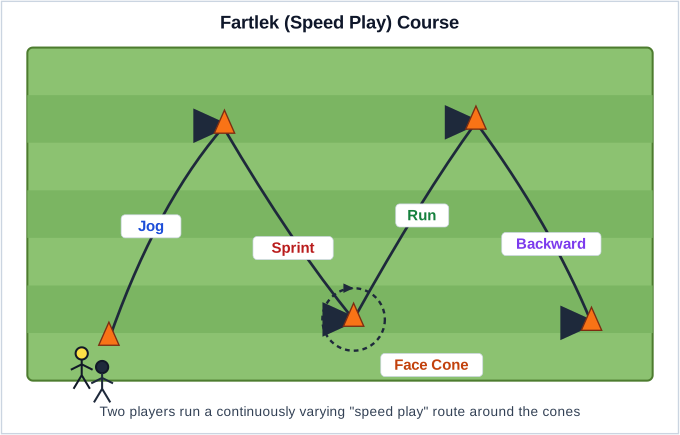
- (d) Fartlek Method — a Swedish word meaning 'speed play'. It is like the variable pace method, except the speed change is not planned: the athlete varies pace at will in response to terrain, surroundings and feeling. Heart rate and duration are similar to the variable pace method. The diagram shows a typical fartlek course.
Drawn by us to help you understand the concept clearly, and verified to make sure it's accurate. For exams, practice from your textbook's own diagram.
A grass field marked with cones (triangles). Two runners follow a winding course whose segments are labelled by movement type: 'Sprint', 'Run', 'Jog', 'Backward' and 'Face Cone', with arrows showing direction around the cones - a …
Fartlek training promotes weight loss, tests strength and endurance, improves speed and race tactics, builds the 'mind over matter' element, mimics the surges of a real race, raises physical and mental energy, improves flexibility, and develops both fast- and slow-twitch muscle response.
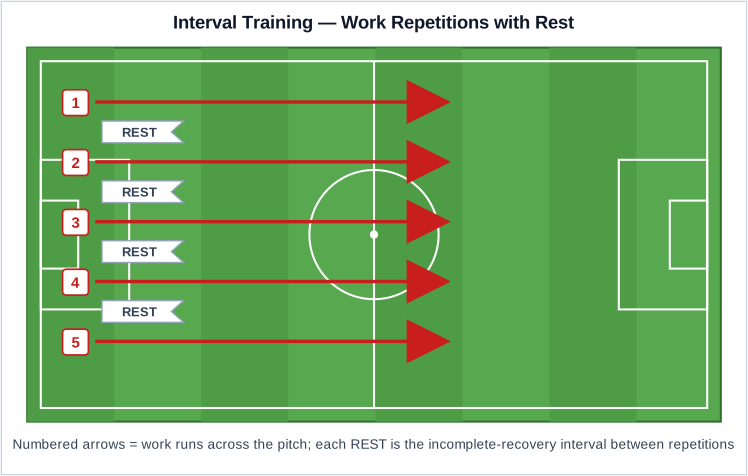
2. Interval Method. The most versatile method for improving endurance. The activity is done at a comparatively high intensity with intervals of incomplete recovery, on the principle that work should be done with enough speed and duration to raise the heart rate to about 180 beats per minute; after a short interval, when it drops to 120-130 beats per minute, work begins again. The diagram shows work bouts separated by rest intervals.
Drawn by us to help you understand the concept clearly, and verified to make sure it's accurate. For exams, practice from your textbook's own diagram.
A football pitch with centre circle and penalty areas. Five numbered work repetitions (1 to 5) are drawn as arrows running across the pitch and back; between each repetition a 'REST' marker shows the incomplete-reco …
Effect: improved circulatory system, better aerobic capacity, greater lactic-acid tolerance and improved VO2 max. …