Botany · Ch 3 — Morphology of Flowering Plants
The Leaf
The Leaf
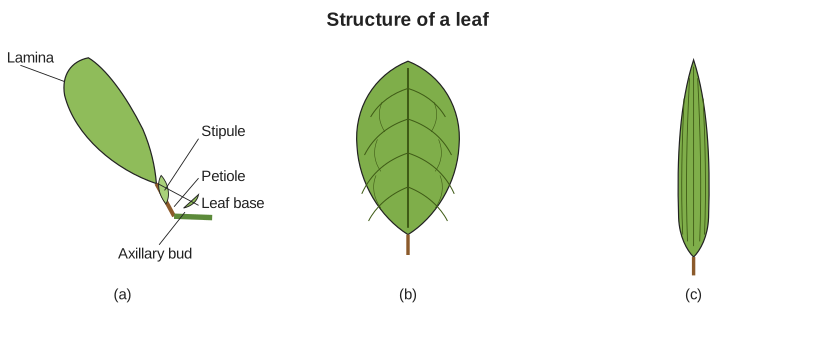
The leaf is a lateral, generally flattened structure borne on the stem. It develops at the node and bears a bud in its axil. The axillary bud later develops into a branch. Leaves originate from shoot apical meristems and are arranged in an acropetal order. They are the most important vegetative organs for photosynthesis.
A typical leaf consists of three main parts:
- Leaf base — the part by which the leaf is attached to the stem. It may bear two lateral small leaf-like structures called stipules. In monocotyledons, the leaf base expands into a sheath covering the stem partially or wholly. In some leguminous plants the leaf base may become swollen, which is called the pulvinus.
- Petiole — the stalk of the leaf. The petiole helps hold the blade to light. Long, thin, flexible petioles allow leaf blades to flutter in wind, thereby cooling the leaf and bringing fresh air to the leaf surface. …
Drawn by us to help you understand the concept clearly, and verified to make sure it's accurate. For exams, practice from your textbook's own diagram.
This figure has three panels. Panel (a) names the main parts of a typical leaf: the leaf base, the point where the leaf joins the stem, which in many plants bears small lateral outgrowths called stipules; the petiole, the stalk extending from the leaf base that holds the leaf away from the stem so it catches light and lets air cool the blade; the lamina or leaf blade, the broad flat food-making surface; and the axillary bud sitting in the angle between the petiole and the stem. Panel (b) shows reticulate venation, in which the veinlets branch and rejoin to form an irregular network across the lamina, the pattern typical of dicotyledonous leaves. Panel (c) shows parallel venation, in which the veins run along …