Chemistry · Ch 2 — Structure of Atom
Charge to Mass Ratio of Electron
Charge to Mass Ratio of Electron
The Discovery of the Electron: Why Charge-to-Mass Ratio Mattered
By the late 19th century, scientists knew that atoms existed, but what were they made of? The first clue came from studying electrical discharges through gases at very low pressure. When a high voltage was applied across two electrodes sealed inside a partially evacuated glass tube, a ray of "something" streamed from the negative electrode (the cathode) toward the positive one. These were called cathode rays.
The key question was: what were these rays? Were they waves, like light, or were they particles? And if they were particles, were they atoms, molecules, or something smaller? The answer came from a series of experiments that measured how these rays behaved in electric and magnetic fields.
The basic rule that governs all these experiments is simple: like charges repel, unlike charges attract. A charged particle moving through a magnetic field also experiences a force, but that force is always perpendicular to both the particle's velocity and the field direction.
J.J. Thomson's Experiment: Measuring
J.J. Thomson, in 1897, designed an elegant experiment to determine the nature of cathode rays. He used a specially designed discharge tube with three key features:
- A cathode to produce the rays.
- An anode with a slit in it, which allowed a narrow beam of rays to pass through.
- Electric and magnetic fields applied perpendicular to the beam's path, which could deflect it.
The beam then struck a fluorescent screen at the end of the tube, creating a bright spot. By observing how the spot moved when fields were applied, Thomson could measure the deflection.
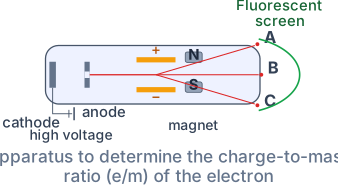
Drawn by us to help you understand the concept clearly, and verified to make sure it's accurate. For exams, practice from your textbook's own diagram.
Fig. 2.2 is a schematic of a cathode‑ray tube — the apparatus J.J. Thomson used to measure the charge‑to‑mass ratio of the electron. The tube is a sealed glass chamber with a very low internal pressure. At one end sits a cathode (negative electrode) and, a short distance away, an anode (positive electrode) with a slit in it. When a high voltage is applied across these electrodes, electrons boil off the cathode and accelerate toward the anode. Most are stopped by the anode, but a narrow beam slips through the slit and travels in a straight line down the length of the tube.
That beam then passes between a pair of charged deflecting plates — one positive, one negative — that produce a uniform electric field perpendicular to the beam’s direction. Beyond the plates, the beam also crosses a region where an external magnetic field is applied, oriented perpendicular to both the beam and the electric field. Finally, the beam strikes a fluorescent screen at the far end of the tube, producing a visible spot where it hits.
The key idea is that the electric and magnetic fields each exert a force on the moving electrons, and these forces can be made to cancel each other. The electric field (pointing from the positive plate to the negative plate) exerts a force on an electron of charge , pushing it sideways. The magnetic field (directed into or out of the page, perpendicular to the beam) exerts a force , where is the electron’s speed. By the right‑hand rule for a negative charge, this magnetic force points opposite to the electric force when the fields are arranged correctly.
When the two forces balance, the beam passes straight through undeflected:
So by measuring and at the balance point, Thomson could find the electron’s speed without knowing its charge or mass individually.
Once is known, he turned off the magnetic field and measured the deflection of the beam under the electric field alone. From the geometry of the tube — the plate length, the distance to the screen, and the observed spot displacement — he could calculate the acceleration and hence the ratio . The result is the famous formula:
where is the measured deflection of the spot on the screen, the length of the deflecting-plate region, and the drift distance from the plates to the screen — the relation derived step-by-step in this section's text (the deflection grows with the charge and shrinks with the mass, so measuring it fixes the ratio). The textbook itself quotes only the final result, C kg.
The experiment showed that is constant regardless of the cathode material or the gas in the tube — proving that electrons are a universal constituent of all matter.
The figure itself does not show a plot or graph; it is a labelled line drawing of the tube. The labels are: cathode, anode, electric field plates (marked and ), magnetic field (indicated by a symbol or region), fluorescent screen, and two beam paths — one undeflected (straight line) and one deflected (curved path). The undeflected path corresponds to the balanced‑field condition; the deflected path shows what happens when only the electric field (or only the magnetic field) acts. …
Step 1: Balancing the Forces
Thomson first applied both an electric field () and a magnetic field () simultaneously, in such a way that they deflected the beam in opposite directions. He adjusted the strengths of these fields until the beam passed through undeflected — the electric force and the magnetic force exactly cancelled each other out.
The electric force on a particle with charge is .
The magnetic force on a particle with charge moving with velocity perpendicular to a magnetic field is .
For the beam to be undeflected:
This gives a direct way to measure the velocity of the particles in the beam:
This "velocity selector" technique is a powerful idea. By balancing two forces, you can measure a particle's speed without needing to know its mass or charge.
Step 2: Measuring the Deflection
With the velocity known, Thomson then switched off the magnetic field. The beam was now deflected only by the electric field . By measuring the amount of deflection (how far the spot moved on the screen), he could calculate the acceleration of the particles.
The force on a particle in the electric field is . From Newton's second law, , so the acceleration is:
The deflection of the beam depends on this acceleration and the time the particle spends in the electric field. By measuring the geometry of the tube and the deflection, Thomson could determine the value of . Since was known, he could then calculate the ratio .
›Proof
Derivation of from Thomson's experiment
Let the electric field be applied over a horizontal length of the tube. The particle enters the field with a horizontal velocity (which we already know from the balancing step). The time it spends in the field is:
While in the field, it experiences a constant vertical acceleration . The vertical velocity it gains by the time it leaves the field is:
The vertical displacement it acquires while inside the field is:
After leaving the field, the particle travels in a straight line (no more force) for a distance to the screen. The additional vertical displacement during this drift is , where . So the total vertical deflection on the screen is:
All quantities on the right-hand side except are known from the experiment (, , , ) or measured (). Therefore, the charge-to-mass ratio can be calculated:
The Result: A Universal Particle
Thomson's measurements gave a stunning result. The charge-to-mass ratio () for the particles in cathode rays was always the same, regardless of what gas was in the tube or what metal the electrodes were made of. The value he obtained was approximately C/kg. …