Chemistry · Ch 2 — Structure of Atom
Discovery of Protons and Neutrons
Discovery of Protons and Neutrons
Discovery of Protons
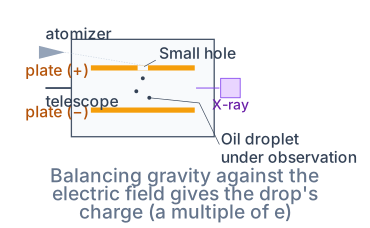
Before turning to the discovery of protons and neutrons, it's worth pausing on how Millikan actually measured the electron's charge in the first place — the apparatus is shown in Fig. 2.3. Balancing gravity, an adjustable electric field, and a small viscous drag force on a single charged oil droplet let him isolate the tiny, indivisible unit of charge described in the previous section.
Drawn by us to help you understand the concept clearly, and verified to make sure it's accurate. For exams, practice from your textbook's own diagram.
Millikan’s oil drop experiment is a masterpiece of precision measurement. The figure shows the apparatus that allowed him to isolate a single charged droplet and measure the smallest unit of electric charge.
The central component is a cylindrical chamber with two horizontal parallel plates. The top plate is positively charged and has a small hole in it; the bottom plate is negatively charged. An atomiser on the left sprays a fine mist of oil droplets into the space above the top plate. Some of these droplets fall through the hole and enter the region between the plates. On the right side of the chamber, an X-ray source ionises the air inside. As the droplets pass through the ionised air, they pick up one or more electrons and become negatively charged.
A telescope is positioned to observe a single droplet suspended between the plates. By adjusting the voltage across the plates, Millikan could balance the downward gravitational force on the droplet with the upward electrostatic force. When the droplet was stationary, the two forces were equal in magnitude.
The key physical idea is that the charge on any droplet is always an integer multiple of a fundamental unit — the charge of a single electron. By measuring many droplets, Millikan found that the charges were always , , , and so on. The smallest of these values is the charge on one electron.
where is the charge on the droplet, is an integer (), and is the elementary charge ().
The experiment also involved measuring the terminal velocity of the droplet when the electric field was turned off. From Stokes’ law, the viscous drag force on a sphere moving through a fluid is , where is the viscosity of air, is the radius of the droplet, and is its terminal velocity. At terminal velocity, the drag force equals the weight of the droplet:
Here is the density of the oil and is the acceleration due to gravity. This equation allows the radius of the droplet to be calculated. Once is known, the mass is known, and the weight is known.
When the electric field is switched on and the droplet is held stationary, the electrostatic force balances the weight:
The electric field between the plates is , where is the applied voltage and is the plate separation. So:
From this, can be calculated. Repeating the experiment for many droplets, Millikan observed that every measured was an integer multiple of . …
The same cathode ray tube that revealed the electron also held the key to discovering its positive counterpart. When scientists modified the tube — by using a perforated cathode (a cathode with holes in it) — they observed rays travelling in the opposite direction to the cathode rays, passing through the holes and striking the opposite end of the tube. These were called canal rays or positive rays.
The key difference from cathode rays was immediate: these rays consisted of positively charged particles, and their properties depended heavily on the gas inside the tube.
Properties of Positive Rays (Canal Rays)
- Mass depends on the gas. Unlike electrons, which have the same mass regardless of the gas used, the mass of these positive particles changes with the nature of the gas in the tube. This makes sense: these particles are simply the positively charged gaseous ions formed when electrons are knocked out of neutral gas atoms. If the gas is hydrogen, the positive ion is H⁺; if it is helium, the ion is He⁺ or He²⁺, which is much heavier.
- Charge-to-mass ratio varies. The charge-to-mass ratio () of these particles is not constant. It depends on the gas from which the particles originate. For a hydrogen ion (H⁺), the ratio is much larger than for a heavier ion like oxygen (O⁺), because the mass in the denominator is smaller.
- Multiple charges are possible. Some of these positively charged particles carry a charge that is an integer multiple of the fundamental unit of electrical charge (). For example, a helium atom can lose two electrons to form He²⁺, which carries a charge of .
- Opposite behaviour in fields. In electric and magnetic fields, these positive particles deflect in the direction opposite to that of electrons. This is the direct experimental evidence that they carry a positive charge — the force on a positive charge in an electric field is in the opposite direction to the force on a negative charge.
Watch out
A common mistake is to think that canal rays are protons. They are not — they are positive ions of whatever gas is in the tube. Only when the gas is hydrogen do you get the hydrogen ion, H⁺, which is a proton.
The Proton
The smallest and lightest positive ion was obtained when hydrogen gas was used in the discharge tube. This particle — the hydrogen ion, H⁺ — was given the name proton. It was formally characterised in 1919 by Ernest Rutherford.
The proton carries a charge equal in magnitude to that of the electron ( C) but has a mass approximately 1836 times greater than that of the electron.
The proton is not a fundamental particle in the sense that it has internal structure (quarks), but for the purposes of atomic structure at the Class 11 level, it is treated as one of the three fundamental subatomic particles.
Discovery of Neutrons
After the discovery of the proton, a puzzle remained. The mass of most atoms was greater than the combined mass of their protons. For example, a helium atom has two protons (mass u) but its atomic mass is about 4 u. Something else — electrically neutral — must be present to account for the missing mass without adding extra positive charge.
This neutral particle was discovered by James Chadwick in 1932.
Chadwick's Experiment
Chadwick bombarded a thin sheet of beryllium metal with alpha particles (-particles, which are helium nuclei, He²⁺). The reaction produced a highly penetrating radiation that was not deflected by electric or magnetic fields — meaning it was electrically neutral. …