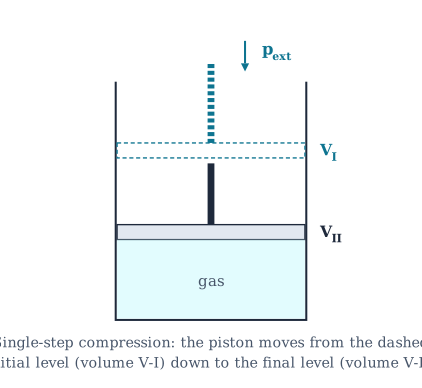
Q.What will be the work done on an ideal gas enclosed in a cylinder, when it is compressed by a constant external pressure, in a single step as shown in Fig. 6.2. Explain graphically.
You're viewing a preview — the full solution, concept, methods & PYQ mapping are locked.
Start your 14-day free trial to unlock the full solution →For a single-step compression against constant external pressure, the work done on the gas is , represented graphically by the area of a rectangle of height and width on a – diagram.
The First Law of Thermodynamics tells us that work is a path-dependent quantity — it depends on how the volume change happens, not just the start and end states. For a gas, the work done on the gas is given by
where is the pressure of the gas at each instant. The negative sign ensures that when volume decreases (), work on the gas comes out positive.
But here’s the key: in a single-step compression against a constant external pressure , the gas does not control the process — the surroundings do. The gas is forced to compress until its pressure equals (or until the piston stops). During the entire compression, the external pressure remains fixed at , so the work done on the gas by the surroundings is simply:
Why no integral? Because is constant, the integral becomes , and since , the result is positive — work is done on the gas.
A common mistake is to write . That gives a negative value for compression, which would mean work is done by the gas — the opposite of what happens. Always check the sign: compression → work done on gas → positive .
Now let’s walk through the reasoning step by step.
-
Identify the process. The gas is compressed from to in a single step. The external pressure is constant throughout. This is an irreversible compression because the gas pressure is not equal to during the process — it jumps suddenly.
-
Work formula for constant external pressure. When the external pressure is constant, the work done by the surroundings on the gas is:
Here is negative, so is positive.
- Why not use gas pressure? In an irreversible process, the gas pressure is not uniform or well-defined during the compression — it may vary with position and time. The only pressure we can reliably use is the external one, because that’s what the surroundings actually apply. The formula is valid only if the gas is in equilibrium throughout (a reversible process). For a single-step irreversible compression, we must use . …
Unlock everything free for 14 days
- Full step-by-step solutions
- Concept-first explanations
- Methods, shortcuts & mistakes
- PYQ mapping + timed mock tests
Full access for 14 days. No credit card required.