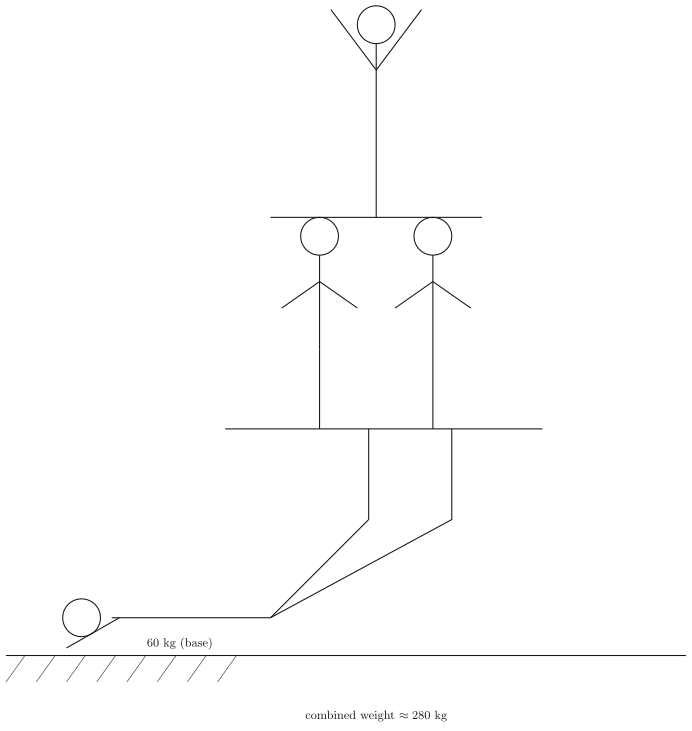
Q.In a human pyramid in a circus, the entire weight of the balanced group is supported by the legs of a performer who is lying on his back (as shown in Fig. 8.4). The combined mass of all the persons performing the act, and the tables, plaques etc. involved is 280 kg. The mass of the performer lying on his back at the bottom of the pyramid is 60 kg. Each thighbone (femur) of this performer has a length of 50 cm and an effective radius of 2.0 cm. Determine the amount by which each thighbone gets compressed under the extra load.
You're viewing a preview — the full solution, concept, methods & PYQ mapping are locked.
Start your 14-day free trial to unlock the full solution →The performer's thighbones carry the weight of everyone stacked above him — the total mass minus his own. Using Young's modulus for bone, each thighbone compresses by approximately .
When a material is subjected to an external force, it deforms — an elongation (stretching) or a compression (shortening), depending on the nature of the force. The extent of deformation is governed by the material's Young's modulus, , the ratio of stress to strain:
Rearranged to find the compression:
In this problem, the performer's thighbones (femurs) act like columns supporting a compressive load.
- Identify the load actually carried by the thighbones. The performer's own body weight is supported directly by his own skeleton through his feet — it does not add to the compressive load his thighbones carry from above. The extra load his thighbones must bear is the weight of everyone and everything stacked on top of him:
This is the standard way this classic problem is solved: the performer's own mass (60 kg) is subtracted from the total (280 kg), since his own weight is not part of the "extra load" transmitted through his femurs from the people above him.
- Calculate the total force (weight) of this extra load.
- Calculate the force on each thighbone. The performer has two thighbones sharing the load equally:
- Calculate the cross-sectional area of each thighbone. …
Unlock everything free for 14 days
- Full step-by-step solutions
- Concept-first explanations
- Methods, shortcuts & mistakes
- PYQ mapping + timed mock tests
Full access for 14 days. No credit card required.