Informatics Practices · Ch 5 — Internet and Web
Metropolitan Area Network (MAN)
Metropolitan Area Network (MAN)
A Metropolitan Area Network, or MAN, is a natural step up from a Local Area Network. While a LAN covers a single building or campus, a MAN extends that reach to cover an entire city or a large town. Think of it as a network that can connect multiple offices, schools, or government buildings spread across a metropolitan area.
The data transfer rate in a MAN is still measured in Mbps (megabits per second), just like a LAN. However, the book makes an important distinction: the speed of a MAN is considerably less than that of a LAN. This trade-off is expected — covering a much larger distance introduces more signal loss and requires more complex equipment, which reduces the maximum possible speed.
A very common real-world example of a MAN is a cable TV network or the cable-based broadband internet services that many homes and businesses use. The same coaxial or fibre-optic cables that bring you television channels also carry internet data across the city.
The physical reach of a MAN is limited. The textbook states that this kind of network can be extended up to 30–40 kilometres. Beyond that distance, the signal degrades too much, and you would need a different type of network (like a WAN) to connect further locations.
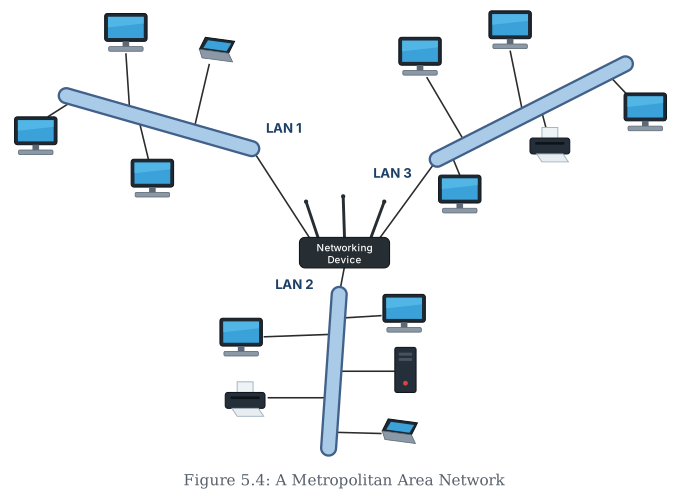
A MAN is often built by connecting several LANs together. For instance, a university with three separate campuses in different parts of a city might link its three LANs (one per campus) using high-speed networking devices to form a single MAN. This is exactly what Figure 5.4 in the textbook illustrates — three separate LANs connected through a central networking device to form one larger MAN. …
Drawn by us to help you understand the concept clearly, and verified to make sure it's accurate. For exams, practice from your textbook's own diagram.
Figure 5.4 is a schematic diagram, not a photograph. It shows how a Metropolitan Area Network (MAN) is built by connecting three separate Local Area Networks (LANs) together.
The diagram contains three distinct clusters of computers, each labelled LAN 1, LAN 2, and LAN 3. Each cluster represents a small, independent network — likely located in different buildings or campuses within the same city. These three LANs are not directly linked to each other. Instead, they all connect to a single, central Networking Device drawn in the middle of the figure. This central device is the backbone of the MAN — it could be a high-capacity router or switch that forwards data between the three LANs.
The layout teaches the core idea of a MAN: it is an aggregation of smaller LANs, joined through a common infrastructure, to cover a larger geographical area (a city or town). The arrows or lines in the schematic (implied by the connections) show the flow of data from each LAN into the central device and then out to the other LANs. There are no distances, dates, or real-world landmarks shown — only the abstract representation of three LANs converging on one networking device. …