Informatics Practices · Ch 5 — Internet and Web
Ring Topology
Ring Topology
Ring Topology
In a ring topology, each node (computer or device) is connected to exactly two other nodes — one on its left and one on its right. This creates a closed loop, or ring, of connected devices. The key idea is that every node has two neighbours, and the entire network forms a circular path.
The connection in a ring topology is unidirectional. This means data can travel in only one direction around the ring — either clockwise or counterclockwise. When a node sends data, it passes through each intermediate node in sequence until it reaches the intended recipient. Because the direction is fixed, there is no risk of data collisions, but if any single node or link fails, the entire ring breaks and communication stops.
The textbook mentions Figure 5.13 to illustrate a ring topology, but the figure itself is not reproduced here. Visualise a circle of computers, each connected to its two neighbours, with arrows showing data flowing in one direction around the loop.
Key characteristics:
- Each node has exactly two connections (one to each neighbour).
- The physical layout forms a closed loop.
- Data transmission is unidirectional (one way only).
- The ring is a single path — data must pass through every intermediate node to reach its destination.
Advantages:
- Simple to install and configure.
- No data collisions because data flows in one direction.
- Performs well under heavy traffic compared to bus topology.
Disadvantages:
- A failure in any one node or cable breaks the entire network.
- Adding or removing a node disrupts the ring. …
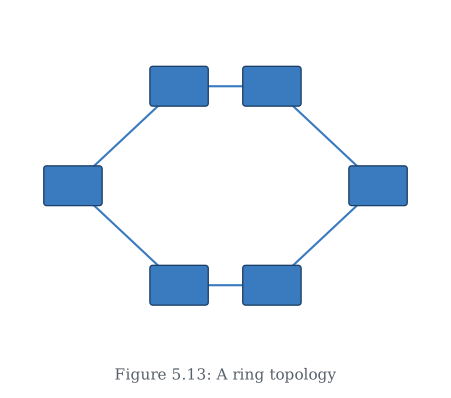
Drawn by us to help you understand the concept clearly, and verified to make sure it's accurate. For exams, practice from your textbook's own diagram.
The diagram shows a set of nodes drawn as small circles, arranged in a closed loop. Each node has exactly two connections: one to the node immediately on its left and one to the node immediately on its right. No node connects to any other node beyond these two neighbours. The connecting lines between the nodes form a single continuous ring — there is no central hub or branching path.
The ring is drawn with arrows on the links, indicating that data travels in only one direction around the loop. In the diagram, the direction is shown as clockwise (or counterclockwise — the textbook specifies that either direction is possible, but the figure illustrates one consistent direction). This means that if a node wants to send data to a node on the opposite side of the ring, the data must pass through every intermediate node along the way, moving step by step around the circle. …