Botany · Ch 7 — Molecular Basis of Inheritance
Translation
Translation
Translation is the process by which the genetic information carried by mRNA is decoded to produce a specific sequence of amino acids, forming a polypeptide chain. This is the final step in the central dogma of molecular biology, where the language of nucleic acids (nucleotides) is converted into the language of proteins (amino acids).
The machinery required for translation includes:
- mRNA – the template that carries the genetic code.
- tRNA – the adapter molecule that brings specific amino acids and recognises codons on mRNA via its anticodon.
- Ribosomes – the cellular factories that facilitate the binding of tRNA and catalyse peptide bond formation.
- Aminoacyl-tRNA synthetases – enzymes that charge tRNA with its corresponding amino acid (a process requiring ATP).
- Energy sources – GTP and ATP.
- Protein factors – initiation, elongation, and release factors that assist the process.
The process of translation occurs in three main stages: initiation, elongation, and termination.
Initiation begins when the small ribosomal subunit binds to the mRNA near the start codon (AUG). In prokaryotes, the Shine-Dalgarno sequence on the mRNA helps position the ribosome correctly. The initiator tRNA (carrying methionine in eukaryotes, or formylmethionine in prokaryotes) binds to the start codon via its anticodon (UAC). The large ribosomal subunit then joins, forming a functional ribosome with three sites: the A (aminoacyl) site, the P (peptidyl) site, and the E (exit) site. The initiator tRNA occupies the P site.
Elongation involves the repeated addition of amino acids to the growing polypeptide chain. A charged tRNA enters the A site, its anticodon pairing with the next codon on the mRNA. A peptide bond forms between the amino acid in the P site and the amino acid in the A site, catalysed by the ribosome's peptidyl transferase activity (which is actually an rRNA, making the ribosome a ribozyme). The ribosome then translocates one codon along the mRNA. The now-uncharged tRNA moves to the E site and exits, while the tRNA carrying the growing peptide chain shifts from the A site to the P site. This cycle repeats, with each step consuming GTP.
Termination occurs when a stop codon (UAA, UAG, or UGA) enters the A site. No tRNA recognises these codons. Instead, release factors bind to the A site, causing the ribosome to release the completed polypeptide chain and dissociate from the mRNA. The ribosomal subunits separate and can be reused. …
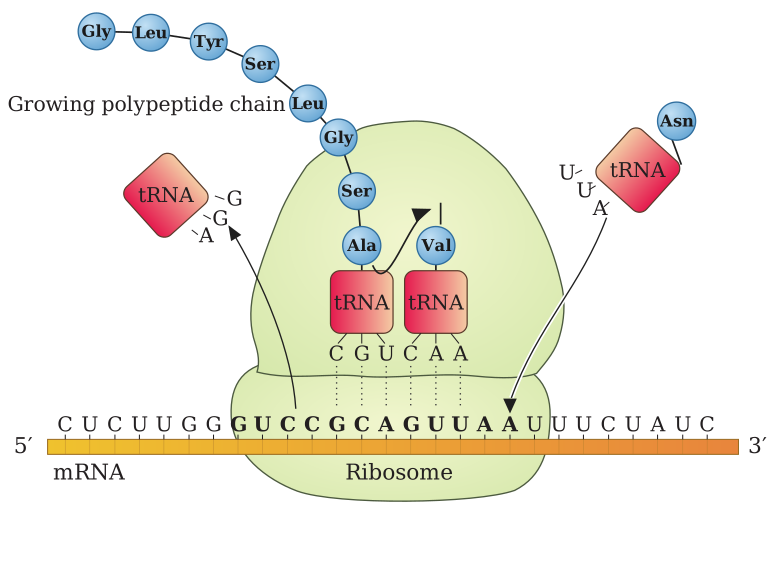
Drawn by us to help you understand the concept clearly, and verified to make sure it's accurate. For exams, practice from your textbook's own diagram.
The figure shows a ribosome actively translating an mRNA molecule. The ribosome is drawn as two distinct parts: a small subunit and a large subunit, which together clamp around the mRNA. The mRNA itself runs horizontally through the ribosome, and its nucleotide sequence is represented as a series of codons — each triplet of bases is visible along the strand.
Three transfer RNA (tRNA) molecules are shown bound to the ribosome at any one time, each carrying a specific amino acid at its top end. The tRNAs are positioned at three distinct sites on the ribosome, labelled A-site (aminoacyl site), P-site (peptidyl site), and E-site (exit site). The A-site holds the incoming charged tRNA whose anticodon matches the next codon on the mRNA. The P-site holds the tRNA that carries the growing polypeptide chain. The E-site holds the now-uncharged tRNA that is about to leave the ribosome.
Arrows in the figure indicate the direction of movement: the ribosome moves along the mRNA from the 5' end toward the 3' end. As it shifts forward by one codon, the tRNA that was in the A-site moves into the P-site, the P-site tRNA moves into the E-site, and the E-site tRNA is released. This directional flow is the essence of translocation.
At the top of the large subunit, a nascent polypeptide chain is shown emerging from the ribosome. The chain is attached to the tRNA in the P-site. The figure makes clear that the polypeptide grows one amino acid at a time as each new tRNA enters the A-site, its amino acid is transferred to the growing chain via a peptide bond, and the ribosome then shifts to the next codon. …