Chemistry · Ch 6 — Haloalkanes and Haloarenes
Answers to Intext Questions
Answers to Intext Questions
These are the final answers printed at the end of the NCERT chapter. The book gives answers for some intext questions only — every question below links to our complete worked solution.
6.1 — answered in the worked solution · Full solution →
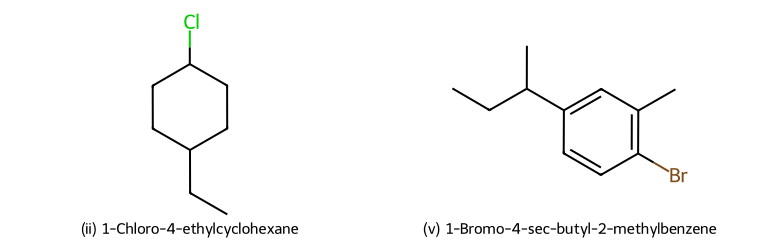
Drawn by us to help you understand the concept clearly, and verified to make sure it's accurate. For exams, practice from your textbook's own diagram.
1-Chloro-4-ethylcyclohexane and 1-bromo-4-sec-butyl-2-methylbenzene, the two ring-based structures among Intext Question 6.1's sub-parts -- drawn out here in the 'Answers to Some Intext Questions' appendix exactly as the real textbook page presents them, alo …
6.2 — answered in the worked solution · Full solution →
6.3 — answered in the worked solution · Full solution →
6.4 — answered in the worked solution · Full solution →
6.5 — answered in the worked solution · Full solution →
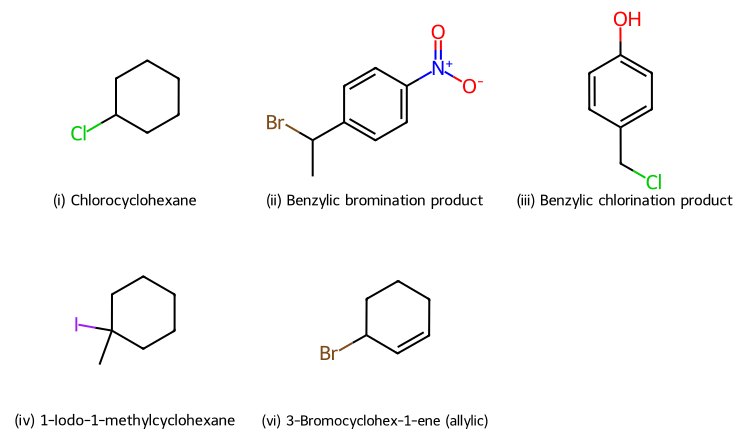
Drawn by us to help you understand the concept clearly, and verified to make sure it's accurate. For exams, practice from your textbook's own diagram.
The major monohalogenated products for parts (i), (ii), (iii), (iv), and (vi) of Intext Question 6.5, drawn out exactly as the real textbook's own 'Answers to Some Intext Questions' appendix presents them, matching each product struc …
6.6 — answered in the worked solution · Full solution →
6.7 — answered in the worked solution · Full solution → …
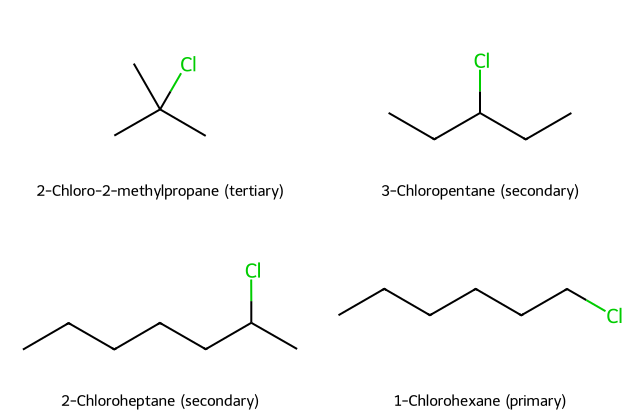
Drawn by us to help you understand the concept clearly, and verified to make sure it's accurate. For exams, practice from your textbook's own diagram.
The two chlorobutane pairs compared in Intext Question 6.8, drawn exactly as the real page shows them, so you can see at a glance which member of each pair forms the more stable carbocation and therefo …
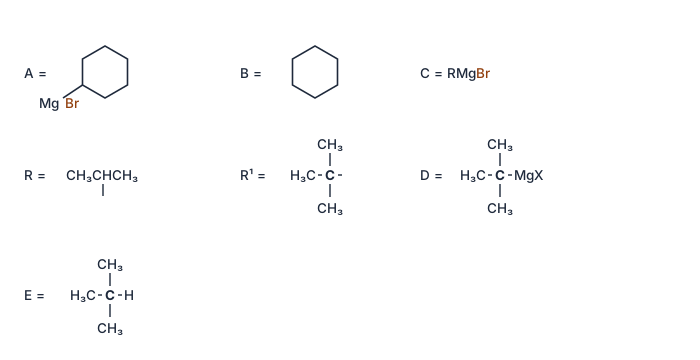
Drawn by us to help you understand the concept clearly, and verified to make sure it's accurate. For exams, practice from your textbook's own diagram.
The structures for A, B, R1, D, and E identified in Intext Question 6.9's Grignard-reagent sequence -- cyclohexylmagnesium bromide, cyclohexane, the isopropyl and tert-butyl fragments, and the corresponding Grignard reagent and hydrocarbon -- matching the real …