Chemistry · Ch 6 — Haloalkanes and Haloarenes
From Hydrocarbons
From Hydrocarbons
(I) From Alkanes by Free-Radical Halogenation
Alkanes can be chlorinated or brominated directly through a free-radical chain reaction, typically initiated by UV light or heat:
This is a poor route to a single pure compound: because the reaction proceeds by abstracting a hydrogen from essentially any C–H bond in the chain, it produces a complex mixture of isomeric mono- and polyhaloalkanes. Separating any one isomer out in good yield is difficult, so the overall yield of a targeted product stays low.
(II) From Alkenes
An alkene's carbon–carbon double bond is a site of high electron density, which makes it reactive toward two different kinds of addition.
(i) Addition of Hydrogen Halides
An alkene adds a hydrogen halide (HCl, HBr, or HI) directly across its double bond to give the corresponding alkyl halide:
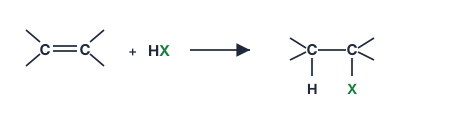
Drawn by us to help you understand the concept clearly, and verified to make sure it's accurate. For exams, practice from your textbook's own diagram.
The book's own generic scheme: an alkene's C=C double bond adds H–X directly across it, H bonding to one carbon and the halogen X to the other, giving …
With an unsymmetrical alkene such as propene, addition can in principle give two different products, but only one predominates — the one dictated by Markovnikov's rule (the halogen ends up on the more substituted carbon, via the more stable intermediate carbocation):
(ii) Addition of Halogens
Bromine dissolved in carbon tetrachloride adds across an alkene's double bond in the laboratory. As the addition proceeds, the reddish-brown colour of the bromine solution fades — this colour discharge is itself a standard test for detecting a carbon–carbon double bond in a molecule. The product is a colourless vicinal-dibromide (the two bromine atoms sit on adjacent carbons): …