Chemistry · Ch 6 — Haloalkanes and Haloarenes
Reactions of Haloalkanes
Reactions of Haloalkanes
(1) Nucleophilic Substitution: The General Picture
A nucleophile is an electron-rich species — it may be a negatively charged ion or a neutral molecule with a lone pair — and it seeks out the electron-deficient carbon of the C—X bond. When it attacks that carbon, it forms a new bond there while the halogen is pushed out as a halide ion. Because the whole event is triggered by the incoming nucleophile, the process is named a nucleophilic substitution reaction, and the haloalkane undergoing it is called the substrate:
This is one of the richest classes of reactions available to alkyl halides precisely because so many different nucleophiles can play the role of , and each one installs a different functional group in place of the halogen. Hydroxide ion gives an alcohol, an alkoxide gives an ether, cyanide gives a nitrile, ammonia gives a primary amine, a carboxylate gives an ester, and so on — a whole card of nucleophilic-substitution products is built up this way for a single substrate class, which is why this reaction is so central to converting a haloalkane into virtually any other functional group (the specific reagent–nucleophile–product correspondences are collected together as reference data, not repeated here).
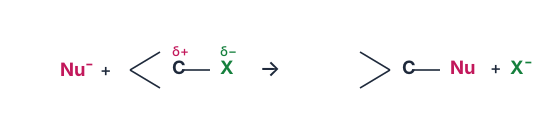
Drawn by us to help you understand the concept clearly, and verified to make sure it's accurate. For exams, practice from your textbook's own diagram.
Nu(-) attacks the delta+ carbon bearing the halogen while X simultaneously leaves as the halide ion X(-) -- the drawn, structural version of the generic nucleophilic-substitution formula already given above in words, showing exactly where the incoming an …
Ambident Nucleophiles
A handful of nucleophiles are unusual in offering two distinct atoms through which they can bond, and these are called ambident nucleophiles. The cyanide ion is the standard example: it can be drawn as a resonance hybrid, , so it is genuinely free to attack a substrate through either its carbon end or its nitrogen end. In practice which end is used depends on the character of the reagent supplying the cyanide. An ionic source such as delivers a "naked," fully ionic cyanide ion in solution, and here the attack proceeds mainly through carbon (because the resulting C—C bond is more stable than a C—N bond), giving an alkyl cyanide as the chief product. A covalent source such as , on the other hand, is not freely ionic; the silver holds the carbon end tightly, leaving the nitrogen free to act as the nucleophilic centre, so the same substrate now gives predominantly the isocyanide (isonitrile). The nitrite ion, , is the second common ambident nucleophile: linkage through its oxygen atom produces an alkyl nitrite, while linkage through its nitrogen atom produces a nitroalkane.
This reaction has been shown to occur through two distinct mechanistic pathways, and the pathway a given substrate follows has consequences for reaction rate, stereochemistry, and even the product distribution when several products are possible. These two mechanisms are examined next.
R—X + Nu⁻ → R—Nu + X⁻
| Reagent | Nucleophile (Nu⁻) | Product R—Nu | Class of product |
|---|---|---|---|
| NaOH (KOH) | ROH | Alcohol | |
| ROH | Alcohol | ||
| NaOR' | ROR' | Ether | |
| NaI | R—I | Alkyl iodide | |
| Primary amine | |||
| RNHR' | Secondary amine | ||
| RNR'R'' | Tertiary amine | ||
| KCN | RCN | Nitrile (cyanide) | |
| AgCN | Ag—CN | RNC | Isonitrile |
| R—O—N=O | Alkyl nitrite | ||
| Ag— | Nitroalkane |
(a) The Mechanism — Bimolecular Nucleophilic Substitution
When methyl chloride reacts with hydroxide ion to give methanol and chloride ion, careful kinetic measurement shows that the reaction rate depends on the concentration of both reactants at once — doubling either the haloalkane concentration or the hydroxide concentration doubles the rate. This is second-order kinetics, and a reaction obeying it is called bimolecular nucleophilic substitution, abbreviated .
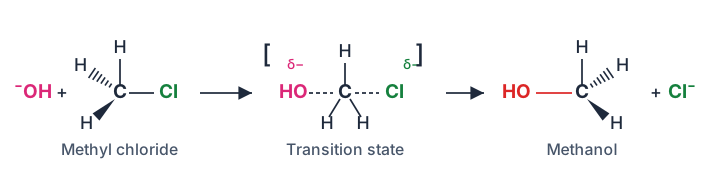
Drawn by us to help you understand the concept clearly, and verified to make sure it's accurate. For exams, practice from your textbook's own diagram.
The full wedge-dash worked mechanism: hydroxide attacks methyl chloride from the face opposite chlorine, passes through a partial-bond transition state with delta-minus character on both the incoming and outgoing groups, and gives methanol …
Mechanism: A Single, Concerted Step
The defining feature of is that there is only one step and no intermediate is ever formed. The incoming nucleophile does not wait for the halide to leave first — it approaches the carbon from the side directly opposite the leaving halogen (a "backside" approach) at the same moment that the carbon–halogen bond is weakening. As the nucleophile's bond to carbon strengthens and the carbon–halogen bond stretches and breaks, the three other substituents on that carbon (three C—H bonds, in the case of methyl chloride) are forced to sweep past the carbon and flip to the opposite side, exactly the way an open umbrella turns inside out when caught by a strong gust of wind.
At the mid-point of this process — the transition state — the reacting carbon is momentarily and simultaneously bonded to five groups: the three original substituents (now lying roughly in one plane), the partially-formed bond to the incoming nucleophile, and the partially-broken bond to the departing halogen. This five-coordinate arrangement is far too high in energy to be isolated as a real species; it exists only fleetingly, as a transition state, not an intermediate. Once past this point, the nucleophile's bond to carbon completes and the halide ion departs fully, leaving a product whose spatial arrangement at that carbon is the mirror image of what the substrate had.
Inversion of Configuration (Walden Inversion)
This flipping of the three retained substituents to the opposite face of the carbon is called inversion of configuration: the spatial arrangement of groups is inverted, exactly as an umbrella turned inside out has all its ribs pointing the opposite way.
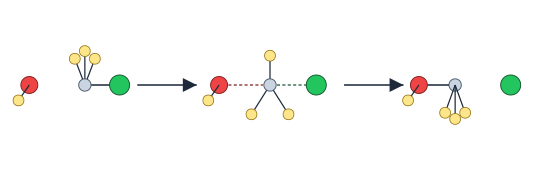
Drawn by us to help you understand the concept clearly, and verified to make sure it's accurate. For exams, practice from your textbook's own diagram.
The figure illustrates the Sₙ2 (bimolecular nucleophilic substitution) mechanism as a step-by-step molecular model sequence. It shows the reaction between methyl chloride () and a hydroxide ion () to form methanol () and a chloride ion ().
What the figure depicts
- Incoming nucleophile (red ball): The hydroxide ion () approaches the carbon atom from the side opposite the carbon–chlorine bond. This is called a backside attack.
- Outgoing leaving group (green ball): The chloride ion () is the leaving group, shown departing from the carbon.
- Transition state: At the midpoint of the reaction, the carbon is trigonal-bipyramidal — the three hydrogen atoms lie in a single plane (coplanar), while the carbon forms partial bonds to both the incoming and the outgoing . This five-coordinate structure is unstable and cannot be isolated.
- Product and inversion: The final product is methanol, with the group attached where the was. The configuration of the carbon has inverted — like an umbrella turning inside out in a strong wind. This is called inversion of configuration.
The physical idea
The Sₙ2 reaction occurs in a single step with no intermediate. Bond formation (C–OH) and bond breaking (C–Cl) happen simultaneously. The rate depends on the concentration of both the alkyl halide and the nucleophile, giving second-order kinetics.
Key formula from the textbook
The rate law for an Sₙ2 reaction is:
where: …
Every genuine step proceeds with complete inversion at the carbon under attack — the nucleophile always ends up bonded from the side opposite to where the leaving group departed, never from the same side.
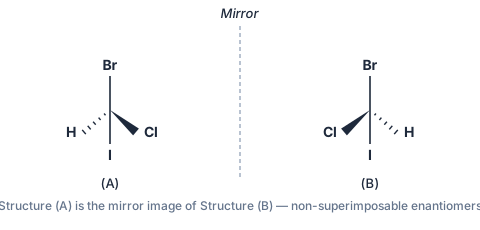
Drawn by us to help you understand the concept clearly, and verified to make sure it's accurate. For exams, practice from your textbook's own diagram.
A tetrahedral stereocentre bearing four different halogens/atoms -- Br, Cl, I, and H -- shown alongside its non-superimposable mirror image, the real textbook page's own worked example used to introduce the term 'configuration': the fixed three-dimensional spatial arrangement o …
Steric Effects and the Reactivity Order
Because the nucleophile must be able to approach the back face of the carbon bearing the halogen, anything that physically crowds that face slows the reaction down. A methyl halide, with only three small hydrogen atoms around the reacting carbon, offers the least resistance and reacts fastest. Moving to a primary halide (one alkyl group in the way), then a secondary halide (two alkyl groups), then a tertiary halide (three bulky alkyl groups surrounding the carbon) progressively blocks the nucleophile's path of approach more and more, so the rate of substitution falls steadily in that order. The overall reactivity sequence for is therefore:
with tertiary halides essentially unreactive by this pathway because the bulky groups make backside attack geometrically impossible.
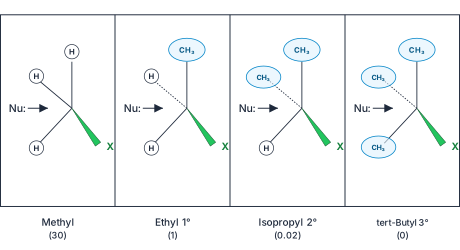
Drawn by us to help you understand the concept clearly, and verified to make sure it's accurate. For exams, practice from your textbook's own diagram.
What the Figure Shows
The figure presents four molecular structures arranged from left to right: methyl (), primary (ethyl, ), secondary (isopropyl, ), and tertiary (tert-butyl, ). In each, a nucleophile (shown as a red ball) approaches the carbon atom bearing the leaving group X (green ball) from the side opposite to X — the classic backside attack of an reaction. Below each structure, a relative rate is given in parentheses: 30, 1, 0.02, and 0 (essentially zero for the tertiary case). The increasing bulk of alkyl groups around the reaction centre is represented by the growing number of methyl groups attached to the -carbon.
The Physical Idea
The figure teaches that steric hindrance — the physical bulk of substituents around the carbon undergoing substitution — dramatically slows the reaction. In an mechanism, the nucleophile must approach the carbon from the back, along a line directly opposite the leaving group. If the carbon is crowded with large groups (like methyl groups in the tertiary halide), the nucleophile’s path is blocked, making the attack difficult or impossible. This is why methyl halides react fastest (only small hydrogen atoms), while tertiary halides are essentially unreactive via .
Key Formula and Explanation
The textbook uses this figure to illustrate the reactivity order for reactions:
The relative rates shown are:
Here:
- = methyl halide (fastest, rate = 30)
- = primary (ethyl) halide (reference, rate = 1)
- = secondary (isopropyl) halide (very slow, rate = 0.02) …
(b) The Mechanism — Unimolecular Nucleophilic Substitution
A different kinetic pattern shows up for reactions such as tert-butyl bromide with hydroxide ion in a polar protic solvent (water, an alcohol, or acetic acid, for instance): the rate here depends only on the concentration of the alkyl halide and is completely unaffected by how much hydroxide is present. This is first-order kinetics, and the pathway is called unimolecular nucleophilic substitution, or .
Mechanism: Two Steps Through a Carbocation
substitution happens in two distinct steps rather than one concerted motion.
Step 1 (slow, rate-determining, reversible). The polarised carbon–halogen bond breaks heterolytically on its own, without any help from the nucleophile, so the halide ion departs first and leaves behind a positively charged carbocation. Because breaking this bond costs energy, this ionisation step needs assistance — in a polar protic solvent, the departing halide ion is stabilised (solvated) by hydrogen-bonding to the solvent's protons, and this solvation is what supplies the energy needed for the bond to break. This step is the bottleneck of the whole reaction, which is exactly why the overall rate tracks only the alkyl halide's concentration: the hydroxide ion has no part to play until after the slow step is over.
Step 2 (fast). The nucleophile now attacks the carbocation that was generated in step 1, completing the substitution and giving the product.
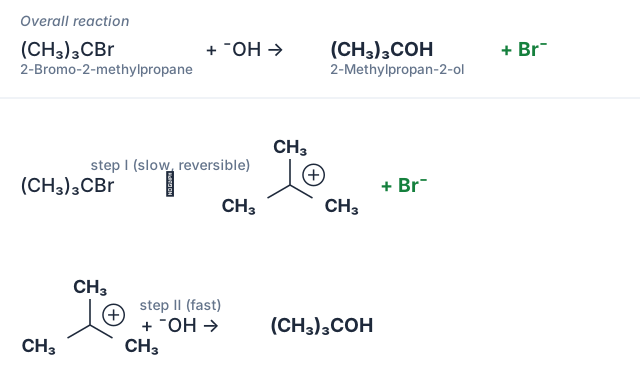
Drawn by us to help you understand the concept clearly, and verified to make sure it's accurate. For exams, practice from your textbook's own diagram.
Step 1 (slow, rate-determining): tert-butyl bromide, (CH3)3CBr, ionises on its own to a planar, trigonal tertiary carbocation plus a departed bromide ion, Br(-). Step 2 (fast): the hydroxide nucleophile, OH(-), then attacks this carbocation to give …
Carbocation Stability Governs the Rate
Since the rate-determining step is the formation of the carbocation, anything that makes that carbocation more stable makes it form faster and so speeds up the whole reaction. Alkyl groups are electron-donating relative to hydrogen, so a carbocation surrounded by more alkyl groups is more stabilised. This gives tertiary carbocations markedly greater stability than secondary, and secondary greater than primary, so a tertiary halide undergoes substitution the fastest of all, and the order runs:
The reactivity order is the exact reverse of the order. Steric bulk that slows down (by blocking the nucleophile's backside approach) is precisely what speeds up (by stabilising the intermediate carbocation through electron donation from the surrounding alkyl groups). A tertiary halide is the fastest substrate for and the slowest — practically unreactive — for ; a methyl halide is the reverse. Always identify which mechanism is operating before predicting how substitution at the carbon will change the rate.
Allylic and Benzylic Halides
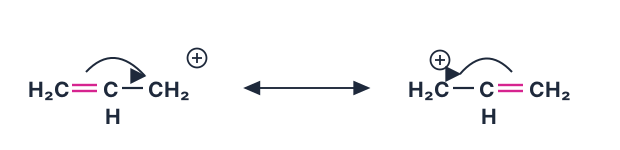
Drawn by us to help you understand the concept clearly, and verified to make sure it's accurate. For exams, practice from your textbook's own diagram.
The allyl cation's two equivalent resonance structures (the double bond and the positive charge swapping ends) -- this delocalisation is exactly why allylic halides, like benzylic halides, show high SN1 reactivity even though the carbo …
For the same reason — carbocation stability controlling the rate — allylic and benzylic halides are also unusually reactive in substitution, even though the carbon bearing the halogen may only be primary. The positive charge generated on ionisation is not confined to a single carbon; it is delocalised over the adjacent double bond (in an allylic system) or over the aromatic ring (in a benzylic system) through resonance, spreading the charge across several atoms and lowering the energy of the cation substantially. This resonance stabilisation is unavailable to an ordinary, unconjugated alkyl carbocation of the same degree, which is why allylic and benzylic substrates punch above their apparent (primary) weight in reactions.
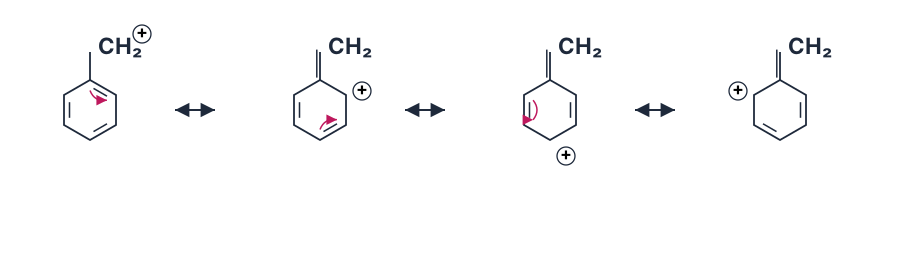
Drawn by us to help you understand the concept clearly, and verified to make sure it's accurate. For exams, practice from your textbook's own diagram.
Ionisation of a benzylic halide first puts the positive charge on the exocyclic carbon itself; the ring's own system can then donate into that carbon (forming an exocyclic C=CH) while the charge relocates to the ortho, para, and other ortho ring positions in turn -- the same four-structure delocalisation pattern that stabilises the intermediate and makes benzyl …
The Effect of the Halogen Itself
Independent of whether the mechanism is or , the identity of the halogen atom also affects how readily it is displaced, and — for a given alkyl group — this order is the same in both mechanisms:
Iodide is the best leaving group because the C—I bond is the weakest and the large iodide ion is best able to disperse its negative charge, while fluoride is a very poor leaving group because the C—F bond is exceptionally strong.
Rearrangement (beyond NCERT)
The rationalised NCERT chapter does not discuss carbocation rearrangement — this subsection is extra help for competitive-exam preparation, kept because rearrangement questions are common in entrance exams.
Because passes through a genuine, discrete carbocation intermediate, that intermediate is free to undergo the same kind of hydride or alkyl shifts any other carbocation can undergo before the nucleophile ever attacks it, so a rearranged product (built on a more stable, shifted skeleton) can sometimes appear alongside — or even instead of — the "straightforward" substitution product. This possibility of rearrangement is a direct consequence of a true intermediate existing, and it has no counterpart in the concerted, one-step pathway.
(c) Stereochemistry of Nucleophilic Substitution Reactions
To describe how the shape of a molecule changes across a substitution reaction, a short set of stereochemical ideas is needed first.
(i) Optical Activity
Ordinary light vibrates in every direction perpendicular to its path; passing it through a Nicol prism selects out only the light vibrating in a single plane, called plane-polarised light. Certain compounds, when placed in the path of this plane-polarised light, rotate the plane through some angle — these are optically active compounds, and the angle of rotation is measured with a polarimeter. A compound that rotates the plane to the right (clockwise, as seen by the observer) is dextrorotatory, or the -form, marked with a sign before the angle; one that rotates it to the left (anticlockwise) is laevorotatory, the -form, marked with a sign. A pair of and forms of the same compound are called optical isomers, and the phenomenon itself is optical isomerism.
(ii) Chirality, Asymmetric Carbons, and Enantiomers
The tetrahedral arrangement of four groups (valencies) around a carbon atom means that if all four attached groups are different from one another, the mirror image of that arrangement cannot be superimposed on the original — no amount of rotation makes the two coincide. Such a carbon is called an asymmetric carbon or a stereocentre, and the molecule built around it is described as an asymmetric or chiral molecule. This tetrahedral picture of the asymmetric carbon was proposed in the same year, 1874, by the Dutch scientist J. van't Hoff and the French scientist C. Le Bel — building on Louis Pasteur's 1848 observation that certain tartaric-acid salt crystals exist as two non-identical, mirror-image forms. This non-superimposability of the mirror image on the original is exactly what produces optical activity.
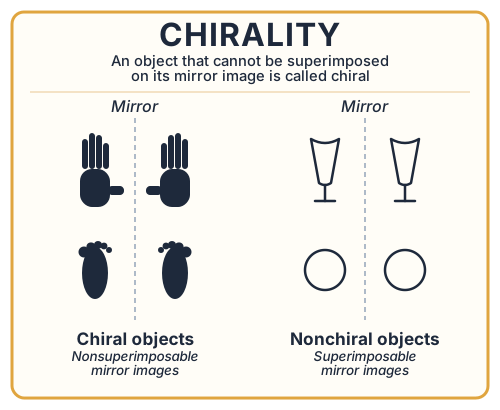
Drawn by us to help you understand the concept clearly, and verified to make sure it's accurate. For exams, practice from your textbook's own diagram.
Figure 6.4 is a two-column concept diagram that contrasts chiral objects (left column) with achiral objects (right column).
- Left column – Chiral objects: Shows a left hand and a right hand, and a left foot and a right foot. These are pairs of objects that are non-superimposable mirror images of each other.
- Right column – Achiral objects: Shows a wine glass and a circle. These objects are superimposable on their mirror images — the mirror image of a wine glass or a circle is identical to the original.
Physical idea: Chirality is the property of an object (or molecule) that is not identical to its mirror image. The left hand is the mirror image of the right hand, but you cannot place one exactly on top of the other (they are non-superimposable). In contrast, a wine glass or a circle is identical to its mirror image — they are achiral.
Key connection to chemistry: This figure introduces the concept of chirality in molecules, which is essential for understanding optical activity and stereochemistry in nucleophilic substitution reactions. A molecule with a single asymmetric carbon (a carbon with four different substituents) is chiral and exists as a pair of enantiomers — non-superimposable mirror images that rotate plane-polarised light in opposite directions.
Key formula(s) developed with this figure:
- The condition for chirality: A molecule is chiral if it has no plane of symmetry and its mirror image is non-superimposable.
- For a carbon atom to be a stereocentre (asymmetric carbon), it must have four different substituents.
- The optical rotation of a chiral compound is given by:
where is the specific rotation, is the observed rotation in degrees, is the path length in decimetres, and is the concentration in g/mL.
- Enantiomers have equal magnitude but opposite sign of : one is dextrorotatory () and the other laevorotatory ().
- A racemic mixture (equal amounts of both enantiomers) has and is optically inactive. …
The same idea of symmetry and asymmetry shows up in everyday objects. A sphere, a cube, or a cone is identical to its own mirror image and can be freely superimposed on it — such objects are achiral. A left hand and a right hand, by contrast, look alike but cannot be laid on top of one another once their mirror-image relationship is fixed — objects with this non-superimposable-mirror-image property are called chiral, and the property itself is chirality. Chiral molecules are optically active; achiral molecules are optically inactive.
The presence of a single asymmetric carbon is a convenient (though not the only) aid for spotting a chiral molecule. A molecule such as propan-2-ol, where the carbon bearing the carries two identical methyl groups (along with H and OH), does not have an asymmetric carbon — all four attached groups are not distinct — and sure enough, its mirror image can be rotated back into exact coincidence with the original: propan-2-ol is achiral.
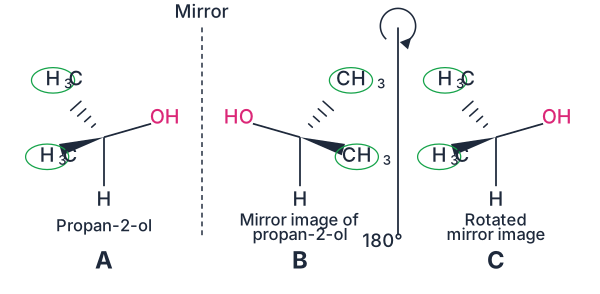
Drawn by us to help you understand the concept clearly, and verified to make sure it's accurate. For exams, practice from your textbook's own diagram.
What Figure 6.5 Shows
The figure presents three three-dimensional representations of the molecule propan-2-ol (isopropyl alcohol, ). Each structure is drawn around a central carbon atom (the -carbon) using wedge-and-dash notation:
- A solid wedge (—) indicates a bond coming out of the plane of the paper (toward the viewer).
- A dashed wedge () indicates a bond going behind the plane of the paper (away from the viewer).
- A straight line indicates a bond lying in the plane of the paper.
In all three structures, the central carbon is bonded to:
- Two methyl groups () — both drawn with straight lines (in the plane).
- One hydroxyl group () — on a solid wedge (coming out).
- One hydrogen atom () — on a dashed wedge (going back).
The three structures are labelled A, B, and C:
- A is the original molecule.
- B is the mirror image of A (as if reflected in a mirror placed between them).
- C is obtained by rotating B by 180° in the plane of the paper.
The key observation: C is exactly superimposable on A — every bond and atom lines up perfectly. This means that A and B are not different molecules; they are the same molecule viewed from different angles.
The Physical Idea: Chirality and Achirality
The figure teaches the concept of chirality (handedness) in organic molecules. A molecule is chiral if its mirror image is non-superimposable on itself — like your left and right hands. A molecule is achiral if its mirror image can be superimposed.
Propan-2-ol is achiral because the central carbon has two identical substituents (the two groups). When you reflect the molecule, the and swap positions, but because the two groups are identical, rotating the mirror image by 180° brings it back to the original arrangement. There is no "handedness."
In contrast, the textbook contrasts this with butan-2-ol (Figure 6.6), which has four different groups around the central carbon (, , , ). Its mirror image cannot be superimposed — it is chiral and exists as a pair of enantiomers (non-superimposable mirror images).
Key Formula and Notation
The condition for a carbon atom to be a chiral centre (or stereocentre) is:
A carbon atom bonded to four different substituents is asymmetric and gives rise to chirality.
For propan-2-ol, the central carbon has the groups:
Since two groups are identical, the carbon is not a chiral centre. The molecule is achiral and optically inactive.
The textbook uses this figure to introduce the concept of optical activity and enantiomers. The key relationship is:
- Enantiomers are stereoisomers that are non-superimposable mirror images.
- They rotate plane-polarised light in opposite directions: one is dextrorotatory (), the other laevorotatory ().
- A racemic mixture (equal amounts of both enantiomers) shows zero net rotation and is denoted by the prefix or . …
Butan-2-ol, on the other hand, has four genuinely different groups on the carbinol carbon (, , , and ); however its mirror image is rotated, it can never be brought back into coincidence with the original — butan-2-ol is chiral.
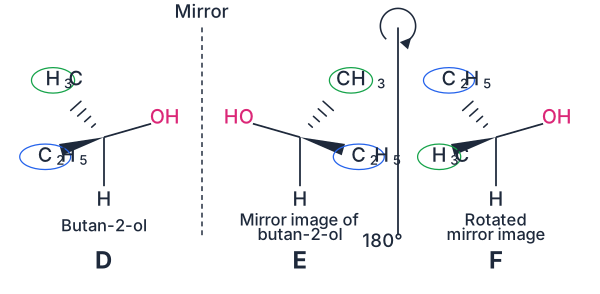
Drawn by us to help you understand the concept clearly, and verified to make sure it's accurate. For exams, practice from your textbook's own diagram.
The figure illustrates the concept of chirality using the molecule butan-2-ol. It shows three structures labelled D, E, and F, all centred on the tetrahedral carbon that bears four different groups: , , , and .
- Structure D is the original molecule.
- Structure E is the mirror image of D.
- Structure F is obtained by rotating E by in the plane of the page.
The key observation is that F is not superimposable on D. No matter how you rotate F in space, it cannot be made to exactly match D — the spatial arrangement of the four groups remains opposite. This non-superimposability of a molecule and its mirror image is the defining property of chirality. Because butan-2-ol has a carbon with four different substituents (an asymmetric carbon or stereocentre), it is chiral. The two non-superimposable mirror-image forms, D and F, are called enantiomers.
The physical idea taught here is that molecular asymmetry leads to optical activity. Enantiomers rotate plane-polarised light in opposite directions (one dextrorotatory, , and one laevorotatory, ). A 50:50 mixture of both enantiomers — a racemic mixture — shows no net rotation.
The textbook uses this figure to introduce the concept of inversion of configuration in reactions. In an reaction, the nucleophile attacks from the side opposite the leaving group, causing the configuration at the carbon to invert — much like turning an umbrella inside out. This is represented by the change from D to F (or from one enantiomer to the other). The rate law for an reaction is second order: …
Other familiar chiral examples include 2-chlorobutane, 2,3-dihydroxypropanal, bromochloroiodomethane, and 2-bromopropanoic acid — in each, the reacting or stereogenic carbon carries four different substituents.
A pair of stereoisomers that are related to each other as non-superimposable mirror images of one another are called enantiomers. Enantiomers share every ordinary physical property — melting point, boiling point, refractive index, density, and so on — identically; the only property in which they differ is the direction in which they rotate plane-polarised light. If one enantiomer of a pair is dextrorotatory, the other is necessarily laevorotatory, and by exactly the same magnitude.
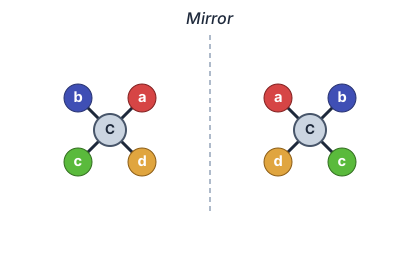
Drawn by us to help you understand the concept clearly, and verified to make sure it's accurate. For exams, practice from your textbook's own diagram.
What the Figure Shows
The figure is a ball-and-stick model of a chiral molecule and its mirror image. It depicts a central carbon atom (the stereocentre) bonded to four differently coloured groups — each colour represents a distinct atom or substituent (e.g., H, Cl, Br, CH₃). The molecule is shown on the left, and its exact mirror image is shown on the right, separated by a vertical mirror plane (often drawn as a dashed line or a plane). The two structures are non-superimposable: no matter how you rotate one in space, it cannot be placed exactly on top of the other. This pair is called enantiomers.
The Physical Idea It Teaches
The figure illustrates the concept of chirality — a property of molecules that lack an internal plane of symmetry. A carbon atom with four different substituents is called an asymmetric carbon or stereocentre. Such a molecule and its mirror image are related like your left and right hands: they are mirror images but not identical. This non-superimposability is the origin of optical activity — each enantiomer rotates plane-polarised light in opposite directions (one clockwise, the other anticlockwise). The figure makes this abstract idea concrete by showing the three-dimensional arrangement of atoms.
Key Formula Developed with This Figure
The textbook uses this figure to introduce the concept of enantiomers and the condition for chirality. The central idea is summarised by the condition for a molecule to be chiral:
More formally, if a molecule has a single asymmetric carbon (a stereocentre), it exists as a pair of enantiomers. The number of possible stereoisomers for a molecule with asymmetric carbons is given by:
where is the number of asymmetric carbon atoms. For the molecule in the figure, , so there are stereoisomers — the two enantiomers shown. …
The sign of optical rotation is not necessarily tied to the absolute spatial configuration of the molecule. Two compounds can share the same configuration at the stereocentre yet have opposite signs of rotation, because the sign depends on the overall electronic and structural environment, not on configuration alone.
Racemic Mixtures and Racemisation
A mixture containing the two enantiomers of a compound in exactly equal proportions shows zero net optical rotation, because the rotation contributed by one enantiomer is exactly cancelled by the equal-and-opposite rotation of the other. Such a 50:50 mixture is called a racemic mixture (or racemic modification), and is denoted by prefixing - or - to the compound's name. The process by which a single, optically active enantiomer is converted into this 50:50 mixture is called racemisation.
(iii) Retention
Retention of configuration means that the spatial arrangement of the bonds around a stereocentre is preserved through a chemical change. In general, if a reaction does not break any bond directly attached to the stereocentre, the product keeps the same general arrangement of groups that the reactant had, and the reaction is said to proceed with retention of configuration — even though, as noted above, the sign of rotation in the product need not match that of the reactant, since it is the spatial configuration, not the sign of rotation, that is preserved.
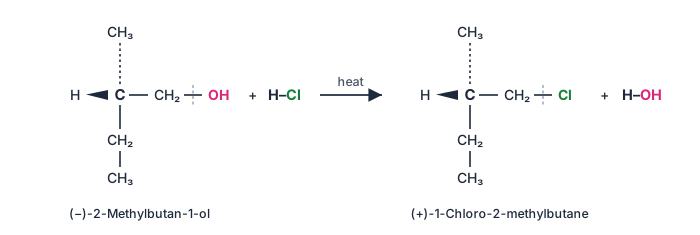
Drawn by us to help you understand the concept clearly, and verified to make sure it's accurate. For exams, practice from your textbook's own diagram.
(-)-2-Methylbutan-1-ol, heated with concentrated HCl, gives (+)-1-chloro-2-methylbutane in which the stereocentre keeps exactly the SAME spatial arrangement of its four groups as the starting alcohol had -- because this substitution does not break any bond directly attached to that stereocentre, the configuration is retained even tho …
(iv) Inversion, Retention, and Racemisation
When a bond directly attached to an asymmetric carbon is broken during a reaction, three outcomes are possible for what happens at that carbon:
- If the product retains the same spatial arrangement as the reactant (with the new group taking the position vacated by the old one, on the same side), the process is inversion's opposite and is again called retention of configuration.
- If the new group ends up on the side directly opposite to where the old group was — the configuration has flipped — the process is called inversion of configuration.
- If the reaction gives a 50:50 mixture of both possible spatial outcomes, so that the net product is optically inactive, the process is racemisation.
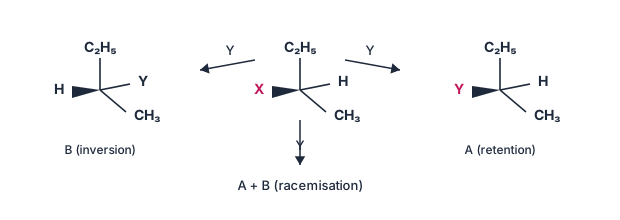
Drawn by us to help you understand the concept clearly, and verified to make sure it's accurate. For exams, practice from your textbook's own diagram.
A generic leaving group X being replaced by an incoming group Y at a stereocentre, shown as three possible spatial outcomes: attack from the same face X departed from gives product A (retention of configuration), attack from the opposite face gives product B (inversion of configuration), and a 50:50 mixture of both faces being …
Proceeds with Inversion
When an optically active alkyl halide undergoes genuine substitution, the product invariably shows inverted configuration relative to the starting material, because — as already described in the mechanism — the nucleophile can only attack from the face opposite to the leaving halogen. A reaction between an optically active secondary bromide and hydroxide ion illustrates this cleanly: the incoming group ends up occupying the position on the carbon skeleton exactly opposite to the one the bromide had occupied. Since only a single, clean backside attack is geometrically possible, substitution of an optically active substrate gives a single, fully inverted, optically active product — inversion is complete, not partial.
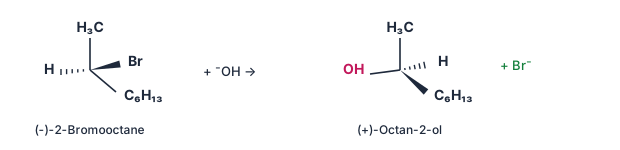
Drawn by us to help you understand the concept clearly, and verified to make sure it's accurate. For exams, practice from your textbook's own diagram.
(-)-2-Bromooctane reacting with hydroxide, OH(-), in a clean SN2 substitution gives (+)-octan-2-ol, with the incoming OH group ending up in the position directly opposite to where the departing Br had been bonded -- the single, complete backside attack that defines SN2 …
Proceeds with Racemisation
When an optically active alkyl halide undergoes substitution, the outcome is different: the product is (largely) racemised. The reason lies in the geometry of the intermediate. The carbocation generated in the slow, rate-determining step is -hybridised, so the three groups attached to the positively charged carbon — along with the carbon itself — lie flat, in one plane. A planar carbocation of this kind is itself achiral: it has no "front" or "back" face that is inherently different from the other. The incoming nucleophile in the fast second step is therefore free to attack this flat cation from either face with roughly equal likelihood, and each face of attack leads to a different spatial outcome at the carbon. Attack from the face the leaving halide vacated from regenerates the same configuration the substrate originally had; attack from the opposite face gives the inverted configuration. Because both faces are attacked with nearly equal probability, the two outcomes are formed in close to equal amounts, giving an essentially racemic — and hence largely optically inactive — product overall.
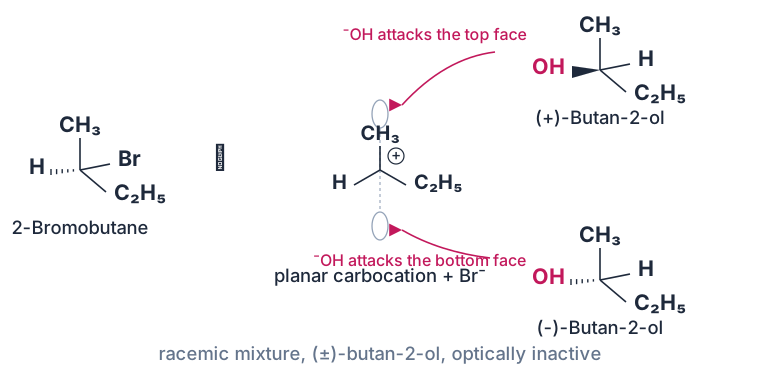
Drawn by us to help you understand the concept clearly, and verified to make sure it's accurate. For exams, practice from your textbook's own diagram.
2-Bromobutane first ionises to a planar, sp2-hybridised carbocation with an empty p-orbital open on both faces; the hydroxide nucleophile OH(-) then attacks this flat intermediate from either face with roughly equal probability, giving a near 50:50, racemic mixture of both butan-2-ol enantiomers -- the reason SN1 substitution at a s …
gives clean inversion because the concerted mechanism allows only one geometric pathway (backside attack). gives (near) complete racemisation because the flat, achiral carbocation intermediate offers the nucleophile two faces to attack with roughly equal ease. Whether a substitution should be predicted to invert or to racemise the stereocentre therefore depends entirely on which mechanism — or — is operating.
2. Elimination Reactions (Dehydrohalogenation)
Drawn by us to help you understand the concept clearly, and verified to make sure it's accurate. For exams, practice from your textbook's own diagram.
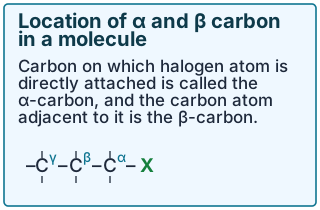
The carbon directly bonded to the halogen is the alpha-carbon; the carbon next to it is the beta-carbon, and the one after that is the gamma-carbon. This alpha/beta naming is exactly what the elimination-reaction terminology below (b …
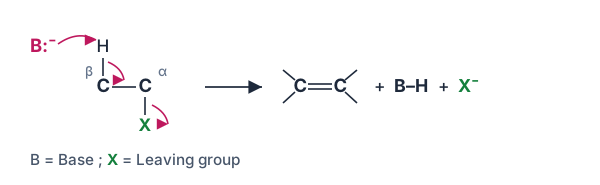
Nucleophilic substitution is not the only fate available to a haloalkane that carries a hydrogen on the carbon adjacent to the one bearing the halogen (this adjacent carbon is called the -carbon, and the carbon directly bonded to the halogen is the -carbon). When such a haloalkane is heated with an alcoholic solution of potassium hydroxide (rather than an aqueous one), a different reaction takes over: a base removes a hydrogen atom from the -carbon at the same time that the halogen departs from the -carbon, and a new bond forms between the - and -carbons in its place. The overall result is loss of one molecule of the hydrogen halide from the substrate and formation of an alkene:
Since it is specifically the hydrogen on the -carbon that is removed, this class of elimination is commonly called -elimination, and because the products lost are the elements of a hydrogen halide, the overall process is also known as dehydrohalogenation.
Drawn by us to help you understand the concept clearly, and verified to make sure it's accurate. For exams, practice from your textbook's own diagram.
The generic beta-elimination step: a base removes a hydrogen atom from the beta-carbon at the same moment the halogen X leaves the alpha-carbon, and a new pi bond forms between the alpha- and beta-carbons in its place -- the mechanism behind every dehydrohalogenation rea …
Saytzeff's Rule
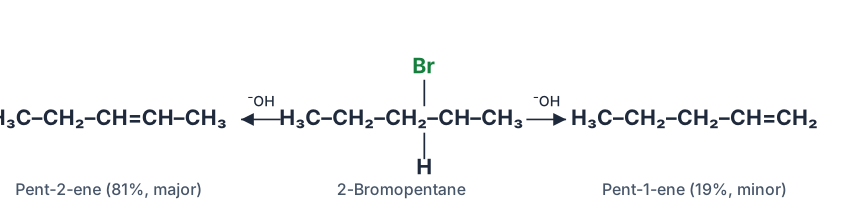
Many haloalkanes have more than one type of -hydrogen available — that is, hydrogens on more than one neighbouring carbon, or on carbons that would give differently substituted double bonds — so more than one alkene is, in principle, possible from a single elimination. In practice one of these alkenes usually dominates as the major product. The Russian chemist Alexander Zaitsev (Saytzeff) recognised this pattern in 1875 and stated it as a rule: in a dehydrohalogenation reaction, the preferred alkene is the one carrying the greater number of alkyl groups on its doubly bonded carbons — in other words, the more highly substituted, more stable alkene wins out as the major product, while the less-substituted alternative forms as the minor product. …
Drawn by us to help you understand the concept clearly, and verified to make sure it's accurate. For exams, practice from your textbook's own diagram.
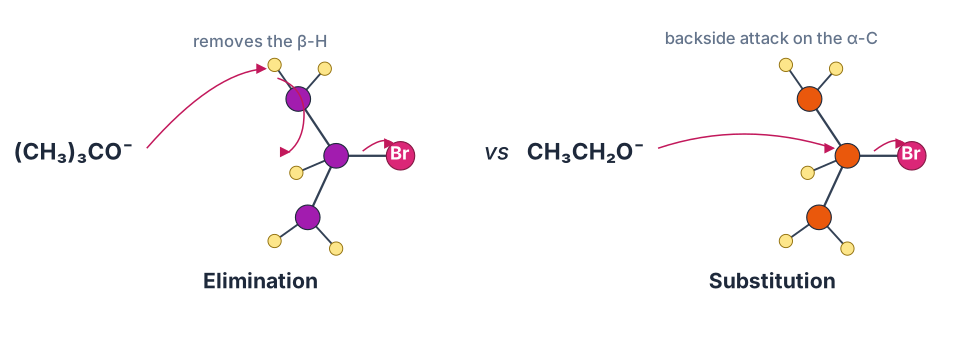
The same 3-carbon bromoalkane skeleton attacked by a bulky base (tert-butoxide) removes the beta-H to give elimination, while a smaller nucleophile (ethoxide) attacks the alpha-carb …
Drawn by us to help you understand the concept clearly, and verified to make sure it's accurate. For exams, practice from your textbook's own diagram.
2-Bromopentane eliminated with alcoholic KOH gives mostly pent-2-ene (81%, the more substituted, Zaitsev-preferred alkene, formed by removing a beta-hydrogen from the more substituted side) alongside pent-1-ene (19%, the less substituted m …