Chemistry · Ch 1 — Solutions
Reverse Osmosis and Water Purification
Reverse Osmosis and Water Purification
In ordinary osmosis, solvent flows into a solution across a semipermeable membrane. This direction can be turned around.
Reversing the flow
If a pressure larger than the osmotic pressure is applied to the solution side, the solvent is forced to flow the other way — pure solvent is squeezed out of the solution, back through the semipermeable membrane.
Reverse osmosis occurs when a pressure greater than the osmotic pressure is applied to a solution, driving pure solvent out of it through a semipermeable membrane.
Desalination of sea water
Reverse osmosis is of great practical value in the desalination of sea water — obtaining drinkable water from salty water. When a pressure well above the osmotic pressure of sea water is applied, pure water is pushed through the membrane while the dissolved salts are left behind.
Drawn by us to help you understand the concept clearly, and verified to make sure it's accurate. For exams, practice from your textbook's own diagram.
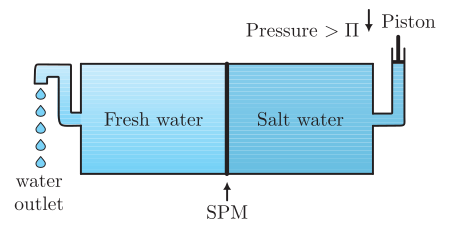
The figure shows a two‑compartment container divided vertically by a semipermeable membrane (SPM). The right compartment contains salt water (solution) and has a piston pressing down on it. The left compartment contains fresh water (pure solvent) and has an outlet from which water droplets flow out.
The piston applies a pressure on the salt-water side, and the figure labels it with the text "Pressure > " — the applied pressure exceeds the osmotic pressure of the solution. Because of this, solvent molecules are forced from the salt‑water side, through the SPM, into the fresh‑water side. The fresh‑water outlet shows that purified water can be collected.
Physical idea:
Normal osmosis moves solvent from low‑solute (pure water) to high‑solute (salt water) side. Reverse osmosis reverses this flow by applying an external pressure that exceeds the natural osmotic pressure. This is the principle behind desalination and water purification.
Key formula developed with this figure:
The condition for reverse osmosis is:
where
- = externally applied pressure (in Pa or atm)
- = osmotic pressure of the solution (in same units)
Osmotic pressure itself is given by the van’t Hoff equation (derived earlier in the chapter):
where
- = van’t Hoff factor (number of particles per formula unit; for non‑electrolytes ) …
The pressure required is quite high, because sea water has a large osmotic pressure. Many countries operate desalination plants based on reverse osmosis to meet their needs for potable water.