Q.Many of the diagrams given in Fig. 5.6 show magnetic field lines (thick lines in the figure) wrongly. Point out what is wrong with them. Some of them may describe electrostatic field lines correctly. Point out which ones.
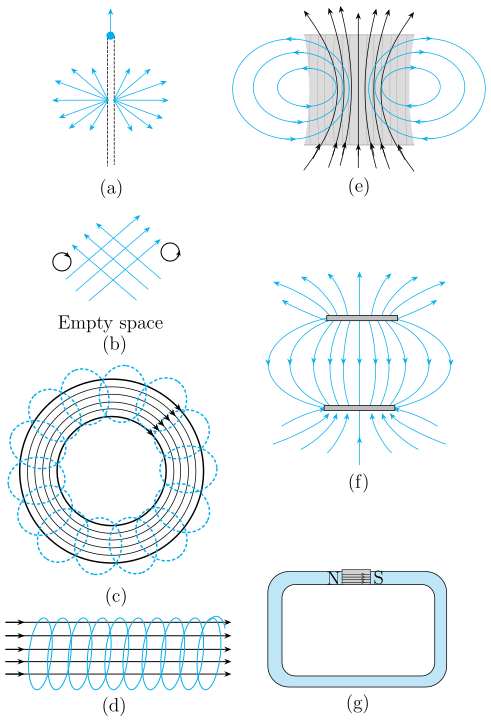
Magnetic field lines must form closed loops, never start or end at a point, and never cross. Diagrams (a), (b), (d), (f) violate these rules; (c), (e), (g) are correct for magnetic fields. Diagrams (a) and (f) would be correct for electrostatic fields.
The key idea is that magnetic field lines are fundamentally different from electrostatic field lines. Electrostatic field lines start on positive charges and end on negative charges — they can diverge from a point. Magnetic field lines, however, have no sources or sinks; they always form continuous closed loops. This follows from Gauss's law for magnetism: , which says magnetic monopoles don't exist.
Let's examine each diagram:
-
Diagram (a) — Lines radiating outward from a single point. This is impossible for a magnetic field because it would require a magnetic monopole (a north pole without a south pole). Magnetic field lines must form closed loops. However, this pattern is correct for an electrostatic field — it describes the field of a positive point charge. The dashed vertical line with a knob at top likely represents a charged rod, making this an electrostatic field line diagram.
-
Diagram (b) — Two families of straight lines crossing each other in an X pattern. Field lines can never cross. At the crossing point, the field would have two different directions simultaneously, which is physically impossible. The curl arrows at the sides suggest some attempt at showing circulation, but the crossing lines are the fundamental error. This is wrong for both magnetic and electrostatic fields.
-
Diagram (c) — Concentric closed circular loops confined within a dashed boundary. This is a correct representation of a toroidal magnetic field. The field lines form closed loops around the torus, never leaving the region. The arrowheads show consistent direction around each loop. This is correct for a magnetic field but would be wrong for an electrostatic field (which cannot form closed loops).
-
Diagram (d) — A solenoid with straight field lines continuing perfectly straight out both ends. The error is subtle but important: magnetic field lines from a solenoid do not continue straight indefinitely. They spread out and loop back around to form closed paths. The field lines emerging from one end of the solenoid must curve around and re-enter the other end. Showing them as straight lines that never close violates the closed-loop nature of magnetic fields.
-
Diagram (e) — A bar magnet with field lines shown both outside and inside the magnet, forming closed loops. This is correct. The lines emerge from the north pole, curve around outside, enter the south pole, and continue through the interior of the magnet back to the north pole. Showing the internal field lines is important — many students forget that the field exists inside the magnet too.
-
Diagram (f) — Two short horizontal plates with field lines bulging outward symmetrically above and below. This pattern describes the electrostatic field of a parallel-plate capacitor (with fringing fields at the edges). For a magnetic field, this would be wrong because the lines don't form closed loops — they appear to start and end on the plates. But for an electrostatic field, this is correct: field lines start on positive charges and end on negative charges.
-
Diagram (g) — A rounded-rectangle closed loop (a bar magnet bent into a ring) with N and S poles at the top-centre, and field lines forming a closed magnetic circuit. This is correct. The field lines form continuous closed paths through the magnetic material and the gap. This is essentially a toroidal magnet with a small air gap.
A common mistake is to treat magnetic field lines like electrostatic field lines. Remember: electrostatic lines can start and end on charges; magnetic lines must always close back on themselves. Also, field lines of any type can never cross.
To quickly check any field line diagram: ask yourself (1) Do the lines cross? (2) Do they start or end at a point (for magnetic fields)? (3) Do they form closed loops (for magnetic fields)? If the answer to any of these is wrong, the diagram is incorrect.
Diagrams (a), (b), (d), and (f) show magnetic field lines incorrectly; diagrams (c), (e), and (g) are correct for magnetic fields. Diagrams (a) and (f) correctly describe electrostatic field lines.
Unlock everything free for 14 days
- Full step-by-step solutions
- Concept-first explanations
- Methods, shortcuts & mistakes
- PYQ mapping + timed mock tests
Full access for 14 days. No credit card required.