Biology · Ch 5 — Morphology of Flowering Plants
Regions of the Root
Regions of the Root
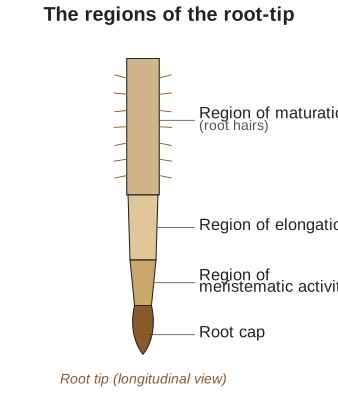
The root is covered at the apex by a thimble-like structure called the root cap. It protects the tender apex of the root as it makes its way through the soil.
A few millimetres above the root cap is the region of meristematic activity. The cells of this region are very small, thin-walled and have dense protoplasm. They divide repeatedly.
The cells proximal to (just above) the meristematic region undergo rapid elongation and enlargement, and are responsible for the growth of the root in length. This region is called the region of elongation.
The cells of the elongation zone gradually differentiate and mature. Hence, the zone proximal to the region of elongation is called the region of maturation. From this region, some of the epidermal cells form very fine and delicate, thread-like structures called root hairs. These root hairs absorb water and minerals from the soil. …
Drawn by us to help you understand the concept clearly, and verified to make sure it's accurate. For exams, practice from your NCERT textbook's own diagram.
This figure shows the zones found near the growing tip of a root, arranged one above the other. At the very tip is the root cap, a thimble-like layer of cells that protects the soft growing point as the root pushes through soil. Just behind it is the region of meristematic activity, where small, thin-walled cells divide rapidly to add new cells. Above this lies the region of elongation, where those newly formed cells stretch and lengthen, driving the root deeper. Higher still is the region of maturation, where cells differentiate and mature; some of its epidermal cel …