Biology · Ch 5 — Morphology of Flowering Plants
Types of Leaves
Types of Leaves
Leaves are classified into two basic kinds — simple and compound — depending on whether the lamina remains entire or is broken up into separate units. A leaf is said to be simple when its lamina is entire, or when the lamina is incised but the incisions do not touch the midrib. In contrast, when the incisions of the lamina reach right up to the midrib and break it into a number of segments called leaflets, the leaf is called compound.
The most reliable way to tell a compound leaf from a cluster of simple leaves is to look for the axillary bud. A bud is present in the axil of the petiole in both simple and compound leaves, but a bud is never present in the axil of the individual leaflets of a compound leaf. So the presence of a bud at the base of the whole structure, and its absence at the base of each leaflet, identifies a compound leaf.
Compound leaves themselves may be of two types: …
Drawn by us to help you understand the concept clearly, and verified to make sure it's accurate. For exams, practice from your NCERT textbook's own diagram.
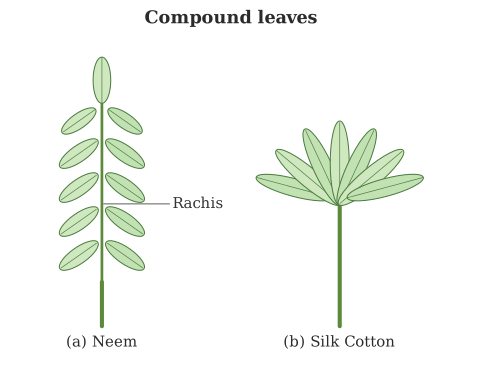
This figure compares two forms of compound leaf, in which the lamina is divided into separate leaflets rather than being a single undivided blade. In a pinnately compound leaf, several leaflets are arranged along a common central axis, the rachis, which represents the midrib; the overall look is feather-like, as in the neem tree. In a palmately compound leaf, the leaflets are all attached at a single point at the tip of the petiole and spread out like the fingers of a hand, as in the silk cotton plant. A useful clue …