Biology · Ch 11 — Photosynthesis in Higher Plants
The Electron Transport
The Electron Transport
Everything starts at PS II, where the P680 reaction-centre pigment absorbs a photon of 680 nm red light. That energy input knocks one of its electrons up to a higher, less-tightly-bound energy level — the electron is now excited and ready to leave the chlorophyll molecule. These excited electrons are picked up by an electron acceptor, which passes them on to an electron transport system consisting of cytochromes. This movement of electrons is downhill, in terms of an oxidation-reduction (redox) potential scale.
- The electrons are not used up as they travel; they are passed along the electron transport chain and finally handed on to the pigments of PS I.
- Simultaneously, electrons in the reaction centre of PS I are also excited when they receive red light of wavelength 700 nm, and are transferred to another acceptor molecule that has a greater redox potential.
- These electrons are then moved downhill again, this time to a molecule of energy-rich NADP+.
- The addition of these electrons reduces NADP+ to NADPH + H+. …
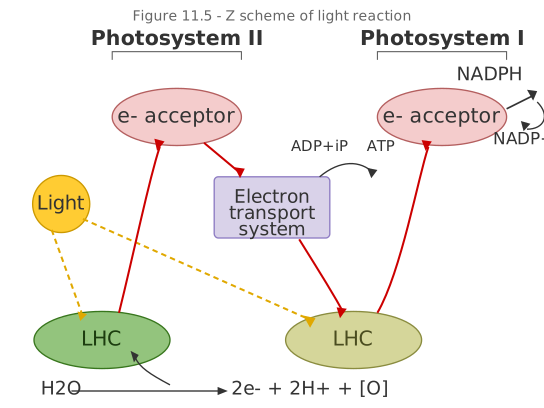
Drawn by us to help you understand the concept clearly, and verified to make sure it's accurate. For exams, practice from your NCERT textbook's own diagram.
This figure shows the Z scheme, the path of electrons during the light reaction. Light strikes Photosystem II, exciting electrons that pass to an electron acceptor and then move downhill through the electron transport system, a step that helps make ATP from ADP and inorganic phosphate. The electrons then reach Photosystem I, where light excites them again to a second acceptor before they are passed to NADP+, reducing it to NADPH. The electrons lost by PS II are replaced by the splitting of water, which yields 2 electrons, 2 H+ and [O]. When all the carriers are arranged on a redox pote …