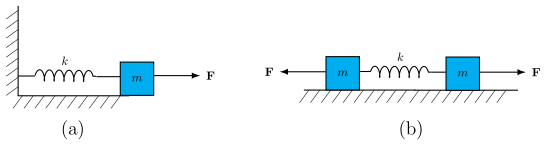
Q.Figure 13.21(a) shows a spring of force constant clamped rigidly at one end and a mass attached to its free end. A force applied at the free end stretches the spring. Figure 13.21(b) shows the same spring with both ends free and attached to a mass at either end. Each end of the spring in Fig. 13.21(b) is stretched by the same force .
You're viewing a preview — the full solution, concept, methods & PYQ mapping are locked.
Start your 14-day free trial to unlock the full solution →- The maximum extension is in both figures -- a spring's extension depends only on the tension running through it, whether one end is clamped or both ends are pulled.
- The period is for the single mass on the clamped spring (Fig. a), and for the two equal masses on the free spring (Fig. b), because the two-body system oscillates with a reduced mass .
(a) Maximum extension
Figure (a) -- one end clamped. A force is applied at the free end. By Hooke's law:
Figure (b) -- both ends free, each pulled by . Think about the tension running through the spring. When equal and opposite forces pull on the two ends, every cross-section of the spring carries the same internal tension -- exactly the same tension as in Figure (a), where the wall simply supplies the reaction force at the clamped end. Since a spring's extension is governed purely by the tension in it:
So the two cases give an identical maximum extension, .
A tempting but wrong approach equates the work done by to the spring's stored energy (), giving . That treats as if it does work through the full extension while all of it converts to spring PE -- but the equilibrium extension under a statically applied force is simply read off Hooke's law, , not the energy method (which instead describes a suddenly released mass overshooting to ).
(b) Period of oscillation
Figure (a) -- single mass on a spring of constant :
…
Unlock everything free for 14 days
- Full step-by-step solutions
- Concept-first explanations
- Methods, shortcuts & mistakes
- PYQ mapping + timed mock tests
Full access for 14 days. No credit card required.