Physics · Ch 14 — Waves
Reflection of Waves
Reflection of Waves
Reflection of Waves
When a wave travelling through a medium encounters a boundary — a point where the medium changes — part or all of the wave is reflected. This phenomenon, reflection of waves, is fundamental to understanding how waves behave at interfaces. The key question is: what happens to the wave's displacement, velocity, and phase when it bounces back?
Consider a wave pulse travelling along a string. The string is attached at one end to a rigid wall. When the pulse reaches the wall, it cannot continue — the fixed end cannot move. The pulse must reflect. But the reflected pulse is not identical to the incident one; it is inverted. A crest becomes a trough, and a trough becomes a crest.
Why does this inversion happen? At the fixed end, the displacement must always be zero. The incident wave alone would produce a non-zero displacement at the wall. To keep the net displacement zero, the reflected wave must arrive with opposite displacement — exactly cancelling the incident wave's effect at the boundary. This is the physical origin of the phase change of radians (180°) upon reflection from a rigid boundary.
Reflection from a rigid/fixed boundary inverts the wave — a phase change of radians. Reflection from a free boundary does not invert the wave — no phase change.
Now, let us examine the mathematics. Suppose an incident wave travelling along the positive -direction is described by
At a rigid boundary at , the reflected wave travels in the negative -direction. Because of the inversion, we write
The negative sign represents the phase reversal. The total displacement at any point is the sum of the incident and reflected waves:
Using the trigonometric identity , we get
This is the equation of a standing wave. At the boundary , for all , as required.
For a free boundary — say, a string tied to a massless ring that slides on a frictionless rod — the end is free to move. The boundary condition is that the slope at the free end is zero (no transverse force). In this case, the reflected wave is not inverted:
The total displacement becomes
At the free end , — the displacement is maximum, not zero.
A common mistake is to think that reflection always inverts the wave. The inversion depends entirely on the boundary condition: fixed ends invert, free ends do not.
Properties of Reflection
The textbook lists three key properties of wave reflection. Each is derived from the boundary conditions and the principle of superposition.
Property 1: Reflection from a rigid boundary produces a phase change of
When a wave reflects from a rigid boundary (a fixed end), the displacement at the boundary must remain zero at all times. The incident wave alone would produce a non-zero displacement there. The reflected wave must therefore arrive with opposite displacement — a phase shift of radians — so that the two cancel exactly at the boundary.
Proof: Let the incident wave be and the reflected wave be , where is the phase change upon reflection. At the boundary , the total displacement must be zero:
For this to hold for all , we need (amplitude unchanged for perfect reflection) and . Using the identity , we get
For this to be zero for all , we require , which gives , so . The reflected wave is .
Property 2: Reflection from a free boundary produces no phase change
When a wave reflects from a free boundary, the end is free to move. The boundary condition is that the slope at the free end is zero — no transverse force acts at the boundary.
Proof: For a free end at , the slope must be zero at all times. Let and . The total displacement is
The slope at is
For this to hold for all , we need and . This requires (or , which is equivalent). The reflected wave is — no phase change.
Property 3: The reflected wave travels with the same speed as the incident wave
The speed of a wave on a string depends only on the tension and linear mass density of the string: . Since the reflected wave travels in the same medium (the same string), both and are unchanged. Therefore, the speed of the reflected wave is identical to that of the incident wave. The wavelength and frequency also remain the same, as .
This property holds for reflection from any boundary where the medium on the incident side is unchanged. If the wave passes into a different medium (transmission), the speed changes — but that is refraction, not pure reflection.
The Principle of Superposition at Boundaries
The reflected wave is not created independently. It arises because the incident wave and the reflected wave must together satisfy the boundary condition at all times. This is a direct consequence of the superposition principle: the net displacement at any point is the sum of the displacements of all waves present. …
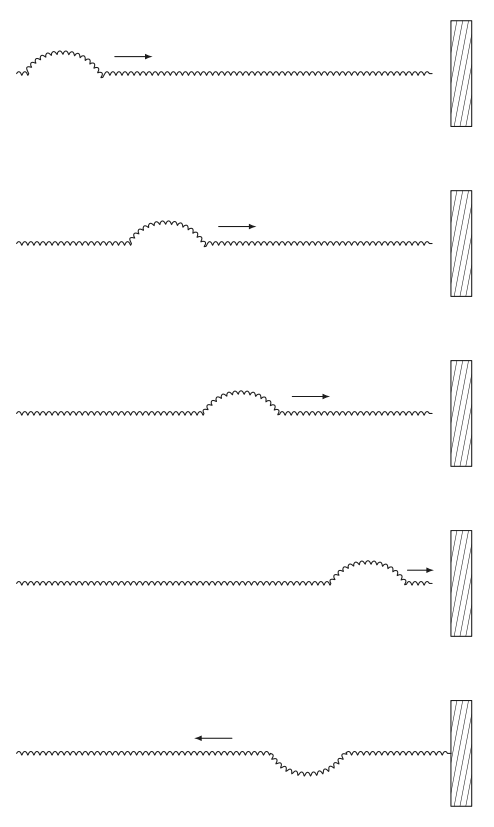
Drawn by us to help you understand the concept clearly, and verified to make sure it's accurate. For exams, practice from your NCERT textbook's own diagram.
Fig. 14.11 is a sequence of five snapshots of a string, one above the other, like frames of a slow-motion film. The horizontal axis in each panel is the position along the string; the vertical axis is the displacement of the string particles from their equilibrium line. The left end of the string is free, and the right end is a rigid boundary — drawn as a hatched wall. Time increases as you move from the top panel to the bottom panel.
In the top panel, a single upward pulse (a hump above the equilibrium line) travels to the right, approaching the wall. In the second panel, the pulse has moved closer. In the third panel, the pulse has just reached the wall — the leading edge of the hump touches the boundary. In the fourth panel, the pulse has begun to move away from the wall, but now it is a downward pulse (a dip below the equilibrium line) travelling to the left. In the fifth and final panel, the inverted pulse continues leftward, fully reflected.
The key physical idea is that a rigid boundary forces the displacement of the string to be zero at the wall at all times. The string is fixed there — it cannot move. When the upward pulse arrives, it exerts an upward force on the wall; the wall, being rigid, exerts an equal and opposite downward force on the string. This reaction generates a reflected pulse that is the exact mirror image of the incident pulse, but inverted. The inversion corresponds to a phase change of radians (or ): the crest becomes a trough.
The textbook uses this figure to derive the condition for reflection at a rigid boundary. If the incident wave is , the reflected wave must satisfy at the boundary for all . This forces the reflected wave to be — the same amplitude and speed, but opposite sign and reversed direction.
Here is the amplitude of the incident pulse, is the wave number, is the angular frequency, and the minus sign represents the phase change. The argument indicates propagation in the negative direction (leftward). The total displacement at any point is the sum , and at the rigid boundary this sum is identically zero. …