Physics · Ch 14 — Waves
Transverse and Longitudinal Waves
Transverse and Longitudinal Waves
The Two Fundamental Ways a Wave Can Travel
When a disturbance travels through a medium, the particles of the medium oscillate about their mean positions. The direction of this particle oscillation relative to the direction of the wave's propagation defines the wave's type. There are exactly two possibilities: the particles move parallel to the wave's direction, or they move perpendicular to it. These give us the two primary classes of mechanical waves.
Transverse Waves
In a transverse wave, the particles of the medium oscillate perpendicular to the direction in which the wave travels.
Think of a long, taut string. If you flick one end up and down, a pulse travels horizontally along the string. Each individual particle of the string moves only up and down (vertically), while the pulse itself moves horizontally. The motion of the medium is at right angles to the motion of the wave.
Transverse waves can only propagate in media that possess shear elasticity — the ability to resist a sideways, sliding deformation. Fluids (liquids and gases) have no shear elasticity, so transverse mechanical waves cannot travel through them, while solids can sustain both shearing and compressive strain.
Key visual: Imagine a sine curve. The wave shape moves to the right (or left), but each point on the curve moves only up and down.
Longitudinal Waves
In a longitudinal wave, the particles of the medium oscillate parallel to the direction of wave propagation.
The classic example is a sound wave in air. A vibrating source (like a speaker cone) pushes air molecules forward, creating a region of high pressure (a compression). The molecules then rebound, creating a region of low pressure (a rarefaction). This pattern of compressions and rarefactions travels outward. Each air molecule, however, only oscillates back and forth along the line of travel — it does not move with the wave.
A simple way to visualise a longitudinal wave is to imagine a long, horizontal spring (a Slinky). If you push and pull one end along its length, you send a pulse of alternating tight coils (compression) and loose coils (rarefaction) down the spring. Each coil of the spring moves only left and right, exactly along the direction the pulse travels.
Key visual: A series of alternating, closely-spaced dots (compressions) and widely-spaced dots (rarefactions) moving along a line.
Why Some Media Support Only One Kind
Because a transverse wave needs the medium to resist a sideways shearing deformation, and a longitudinal wave only needs the medium to resist compression, the two kinds of waves are not equally available in every medium. Fluids — liquids and gases — can be compressed but cannot sustain a shear (they simply flow instead of springing back), so a fluid can carry only longitudinal waves. Solids can sustain both compressive and shearing strain, so a solid such as steel can carry both a longitudinal wave and a transverse wave. This is why sound (longitudinal) can travel through air, but a violin string's transverse vibration cannot — air is a fluid and has nothing to push back against a sideways displacement.
These waves — whether transverse or longitudinal — are also called travelling or progressive waves, because the disturbance itself travels from one part of the medium to another while the material of the medium as a whole stays where it is. This is different from a steady flow (a stream of water moving downhill, or wind blowing) which is genuine bulk motion of the medium, not a wave; it is also different from a standing wave (covered later in this chapter), where the disturbance does not travel outward at all but oscillates in place between two boundaries.
It is also a general fact — used later in this chapter and beyond — that a transverse wave and a longitudinal wave usually travel at different speeds, even within the very same medium.
A Special Case: Waves on the Surface of Water
Water waves are a useful example precisely because they do not fit neatly into "purely transverse" or "purely longitudinal." Depending on what restoring force is driving them, surface water waves fall into two kinds:
- Capillary waves — small ripples, with a wavelength of no more than a few centimetres, restored by the surface tension of the water.
- Gravity waves — much larger waves, with wavelengths ranging from several metres up to a few hundred metres, restored by gravity pulling the raised water back down toward its lowest level.
In both kinds, the oscillation is not confined only to the surface — it extends downward into the body of water, with the amplitude of oscillation diminishing the deeper you go. And crucially, a water particle in such a wave does not move in a simple straight line up-and-down or purely back-and-forth — its actual path combines both kinds of motion. That is why ocean waves are best described as a combination of transverse and longitudinal waves, not as belonging cleanly to either category.
A Crucial Distinction: The Medium's Motion vs. The Wave's Motion
This is the single most important idea to grasp about waves. In both transverse and longitudinal waves, the medium does not travel with the wave. The wave is a disturbance that transfers energy and momentum from one point to another, but the particles of the medium themselves only oscillate about their fixed equilibrium positions.
- In a transverse wave, the particle displacement is perpendicular to the wave velocity.
- In a longitudinal wave, the particle displacement is parallel to the wave velocity.
In neither case does a particle make a net journey from the source to the receiver. A cork bobbing on the ocean surface (a transverse water wave) does not travel with the wave; it moves in a small circle. A person hearing a sound does not receive a stream of air molecules from the speaker's mouth; they receive a pattern of compressions and rarefactions that makes their own eardrum vibrate.
A common mistake is to think that in a longitudinal wave, the particles of the medium are being physically transported forward. This is false. The particles oscillate around a fixed point. The disturbance moves, not the stuff.
Representing a Longitudinal Wave Graphically
A longitudinal wave is harder to draw than a transverse wave. We cannot easily draw the compressions and rarefactions as a simple curve. The standard trick is to plot the displacement of each particle from its equilibrium position against the position of that particle along the wave. …
Drawn by us to help you understand the concept clearly, and verified to make sure it's accurate. For exams, practice from your NCERT textbook's own diagram.
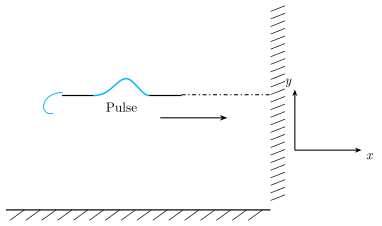
Fig. 14.2 is a simple but essential sketch that establishes the geometry of a wave on a string. The string is stretched horizontally between a hand on the left and a fixed point on a wall at the right. The hand has just given a quick upward flick, creating a single hump — a pulse — that is already moving to the right. The pulse is drawn as a smooth bump above the string’s equilibrium line, and an arrow above it labels the direction of travel (the -direction). The axes are placed at the bottom-left: the -axis runs horizontally along the string’s rest position, and the -axis points vertically upward.
What the figure drives home is the distinction between the direction of the wave’s motion and the direction in which the string’s particles move. The pulse travels along the -axis, but each small element of the string (a tiny segment) only moves up and down — that is, along the -axis. No piece of string moves horizontally with the pulse; they simply rise and then fall back as the disturbance passes. This is the defining feature of a transverse wave: the particle displacement is perpendicular to the wave velocity.
The textbook uses this figure to introduce the wave function , which describes the vertical displacement of a string element at position at time . For a pulse that keeps its shape as it moves, the wave function takes the form
for a pulse travelling to the right with speed , or for one travelling left. Here is the shape of the pulse at . The argument means that the entire shape shifts rightward by after time — the pulse moves, but the string elements only oscillate vertically.
The key physical idea: the wave transports energy and momentum, not matter. The string’s mass does not pile up at the wall; each particle simply vibrates about its equilibrium position.
The figure also sets up the coordinate system used throughout the chapter. The -axis is the undisturbed string line, and measures the displacement from that line. The hand at the left end is the source of the disturbance; the fixed wall at the right is a boundary where the pulse will later reflect. In later sections, the same geometry is used to derive the wave equation for a stretched string:
where , with the tension in the string and its mass per unit length. That equation emerges directly from applying Newton’s second law to a small segment of the string — the same segment that Fig. 14.2 shows oscillating up and down. …
Drawn by us to help you understand the concept clearly, and verified to make sure it's accurate. For exams, practice from your NCERT textbook's own diagram.
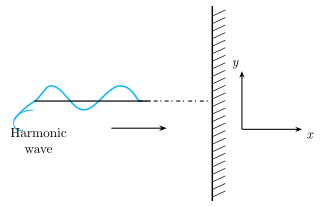
Fig. 14.3 is a snapshot of a sinusoidal wave on a string at one instant of time. The string is stretched horizontally from a hand on the left to a fixed wall (shown hatched) on the right. A horizontal arrow labelled "Harmonic wave" points from left to right, indicating the direction in which the wave pattern moves. Two axes are drawn: the -axis runs along the string's equilibrium (undisturbed) position, and the -axis points perpendicular to it, measuring the displacement of each point on the string from its rest position.
The curve itself is a smooth, continuous sine wave. Each small element of the string oscillates up and down (along ) while the wave travels rightward (along ). This is the defining feature of a transverse wave: the motion of the medium is perpendicular to the direction of energy transfer. The figure makes this distinction visually — the hand at left provides the disturbance, the wall at right is a fixed end, and the wave shape moves between them without any net motion of the string itself to the right.
The textbook uses this figure to introduce the mathematical description of a harmonic wave. For a wave travelling in the positive -direction, the displacement of a point at position at time is given by
where:
- is the amplitude — the maximum displacement from equilibrium (the peak height of the curve).
- is the angular wave number, with the wavelength (the distance between two successive crests or troughs).
- is the angular frequency, with the time period of oscillation.
- is the initial phase (often set to zero for simplicity).
The argument is called the phase of the wave. The minus sign indicates propagation to the right; a plus sign would give a wave moving left. The wave speed is related to these parameters by , where is the frequency.
In the figure, the -axis shows the instantaneous displacement of the string. The -axis is the position along the string. The curve is a "frozen" picture — at a later time, the entire sine wave would have shifted to the right, but each point on the string would have moved up or down, not sideways. …
Drawn by us to help you understand the concept clearly, and verified to make sure it's accurate. For exams, practice from your NCERT textbook's own diagram.
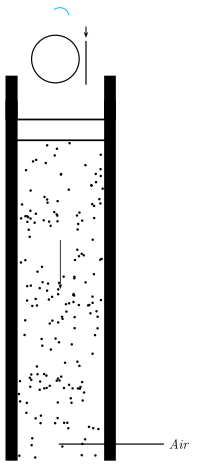
Fig. 14.4 is a schematic of a vertical pipe, open at the top and closed at the bottom by a movable piston. The pipe is filled with air, shown as a stippled region. The piston has a circular handle and is marked with an up-down arrow, indicating it oscillates vertically. Inside the pipe, the stippling is not uniform: there are alternating bands of denser stippling (compressions) and sparser stippling (rarefactions). The entire assembly is labelled "Air".
The figure teaches the core idea of a longitudinal wave. As the piston moves up and down, it alternately pushes the air layer next to it (compression) and pulls it apart (rarefaction). This disturbance travels along the pipe, not as a sideways wiggle but as a sequence of crowded and spread-out regions. The volume elements of air — small imaginary chunks — oscillate back and forth parallel to the direction the wave travels (vertically). That is the defining feature of a longitudinal wave: the particle displacement is along the line of propagation, not perpendicular to it.
The textbook uses this figure to introduce the mathematical description of a longitudinal wave. For a wave travelling in the direction, the displacement of a particle from its equilibrium position at time is given by the same sinusoidal form used for transverse waves:
Here:
- is the instantaneous displacement of a particle from its mean position (positive means forward along , negative means backward).
- is the amplitude — the maximum displacement of any particle.
- is the angular frequency, where is the frequency of the piston's oscillation.
- is the angular wavenumber, where is the wavelength — the distance between two successive compressions (or rarefactions).
- is the initial phase, set by the piston's position at .
In a longitudinal wave, is not a vertical height; it is a horizontal (or axial) displacement along the pipe. Do not confuse the displacement with the spatial coordinate — labels the equilibrium position of a particle, while tells you how far that particle has moved from at a given instant.
The figure also leads to the relation between the wave speed , frequency , and wavelength :
…