Physical Education · Ch 2 — Children and Women in Sports
Scoliosis
Scoliosis
What Is Scoliosis?
Scoliosis is a lateral (sideways) curvature of the spine. Instead of the normal straight vertical line when viewed from behind, the spine bends to the left or the right. In some cases the curve is a single C-shaped bend; in others the spine develops two compensating curves, one to the left and one to the right, producing an S-shaped deformity. The curvature may be mild or severe, and it can occur in the thoracic (upper back), lumbar (lower back), or both regions.
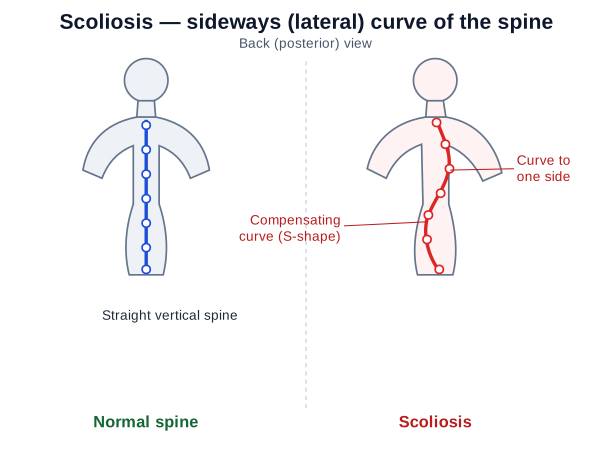
Drawn by us to help you understand the concept clearly, and verified to make sure it's accurate. For exams, practice from your NCERT textbook's own diagram.
A posterior (rear) view of a human torso with the spine and pelvis drawn in, curving sideways off the vertical midline into a C or S shape - the lateral curvature that defines Scoliosis, with …
The key point is direction: scoliosis is a side-to-side deviation, not the forward rounding of kyphosis or the hollow-back of lordosis. A normal spine viewed from behind should appear straight; any lateral bend of more than about 10 degrees (measured on an X-ray by Cobb's angle) is considered scoliosis.
Scoliosis is a lateral curvature of the spine — the spine bends sideways, not forward or backward. It is the most common spinal deformity seen in school-age children.
How Scoliosis Is Recognised
The deformity is often first noticed by a parent, teacher, or during a school health screening. Several visible signs point to its presence.
Uneven shoulders and hips. One shoulder sits higher than the other, or one shoulder blade protrudes more. The waist may appear asymmetrical, with a crease on one side that is deeper than on the other. The hips may also be uneven, with one hip appearing higher or more prominent.
The forward-bend test (Adam's test). This is the standard screening test. The student stands with feet together and bends forward at the waist, arms hanging loose, as if trying to touch the toes. The examiner stands behind and looks along the line of the back. In a normal spine the two sides of the back rise evenly. In scoliosis, one side of the rib cage or lower back rises higher than the other — a "rib hump" or "lumbar hump" — because the rotated vertebrae push the ribs on the convex side of the curve upward.
The forward-bend test is quick, requires no equipment, and is the most reliable way to spot scoliosis during a school screening. Any asymmetry seen from behind should be referred for a medical X-ray.
Clothing fit. A child with scoliosis may complain that clothes hang unevenly — one trouser leg seems longer, or a shirt pulls to one side.
Causes of Scoliosis
Most cases of scoliosis are idiopathic — meaning the cause is unknown. However, several known factors can contribute to or cause the deformity.
Carrying a load always on one shoulder. A school bag or heavy load carried habitually on the same shoulder pulls the spine into a lateral curve. The muscles on the loaded side tighten and shorten, while those on the opposite side stretch and weaken. Over months and years this muscular imbalance can become a fixed structural curve.
Unequal leg length. If one leg is shorter than the other (by even a small amount), the pelvis tilts downward on the short-leg side. The spine must curve sideways to keep the head level. This is called functional scoliosis — it is a postural adaptation, not a fixed spinal deformity, and it often disappears when the person sits or when the leg-length difference is corrected with a shoe lift.
Diseased or weak muscles on one side. Conditions such as polio, muscular dystrophy, or cerebral palsy can cause muscle weakness on one side of the trunk. The unbalanced muscle pull allows the spine to collapse into a curve. This is neuromuscular scoliosis.
Wrong standing posture. Habitually standing with most weight on one leg, or sitting twisted to one side for long hours, can gradually train the spine into a lateral curve. Poor posture alone rarely causes a severe curve, but it can worsen an existing tendency.
Do not confuse functional scoliosis (caused by poor posture or leg-length difference) with structural scoliosis (a fixed curve with vertebral rotation). Functional scoliosis is reversible with correction of the underlying cause; structural scoliosis is not.
Problems Created by Scoliosis
A mild curve may cause no symptoms at all. As the curve progresses, several problems appear.
Pain. Back pain, especially in the lower back, is common. The muscles on the convex side of the curve are overstretched and fatigued; those on the concave side are tight and cramped. This muscular imbalance produces chronic ache.
Reduced lung function. A severe thoracic curve (above 50–60 degrees) compresses the rib cage on one side, reducing the space available for the lungs. Vital capacity — the amount of air a person can exhale — can be significantly reduced, leading to shortness of breath during exercise.
Cosmetic deformity and psychological impact. Uneven shoulders, a prominent rib hump, and an asymmetrical waist can cause self-consciousness, especially in adolescents. Body image issues, avoidance of physical activity, and social withdrawal are common.
Progression during growth. The most dangerous period is the adolescent growth spurt. A curve that is stable at 20 degrees can worsen rapidly to 50 degrees or more during the teenage years if left untreated.
Corrective Measures for Scoliosis
Treatment depends on the severity of the curve, the age of the child, and whether the curve is progressing. The goal is to stop progression, correct the curve where possible, and improve function.
Observation. For curves under 20 degrees in a growing child, the doctor may simply monitor the curve with X-rays every 4–6 months. No active treatment is needed unless the curve worsens.
Bracing. For curves between 20 and 40 degrees in a child who is still growing, a back brace (such as a Boston brace or a Milwaukee brace) is worn for most of the day. The brace applies pressure to the convex side of the curve and holds the spine straighter. Bracing does not correct the curve permanently, but it prevents it from worsening during growth.
Surgery. For curves above 40–50 degrees that are progressing despite bracing, spinal fusion surgery may be recommended. Metal rods, hooks, and screws are attached to the vertebrae to straighten and stabilise the spine. This is a major operation with a long recovery.
Corrective exercises. For mild curves (under 20 degrees) and for postural (functional) scoliosis, specific exercises are the primary treatment. These exercises aim to strengthen the weak muscles on the convex side, stretch the tight muscles on the concave side, and improve overall posture.
Corrective Exercises for Scoliosis
Each exercise is chosen to work against the direction of the curve. The general principle: stretch the concave side, strengthen the convex side. For a right thoracic curve (the spine bends to the right in the upper back), the exercises focus on bending the trunk to the left and stretching the right side.
Trikonasana (Triangle Pose)
This standing posture involves bending sideways to one side while keeping the legs straight.
How to perform: Stand with feet about 3–4 feet apart. Turn the right foot out 90 degrees and the left foot slightly in. Extend both arms sideways at shoulder height. Exhale and bend the trunk to the right, placing the right hand on the right shin, ankle, or the floor beside the right foot. The left arm extends straight up. Hold the pose for 20–30 seconds, breathing normally. Repeat on the left side.
How it helps scoliosis: Trikonasana stretches the side of the trunk that is bent. For a right thoracic curve, practising the pose on the left side (bending to the left) stretches the tight right side and strengthens the weak left side. The lateral stretch helps lengthen the shortened muscles on the concave side of the curve.
The side to which you bend matters. For scoliosis, the student should spend more time bending away from the curve — that is, toward the convex side — to stretch the tight concave side.
Ardha Chakrasana (Half Wheel Pose)
This is a gentle backward bend performed standing.
How to perform: Stand straight with feet together. Raise both arms overhead. Slowly bend backward from the upper back, pushing the hips forward and arching the spine. Keep the knees straight. Hold for a few seconds, then return to the starting position.
How it helps scoliosis: Ardha Chakrasana opens the chest and stretches the entire front of the body. In scoliosis, the rib cage is often rotated and compressed on one side. This pose helps expand the compressed side and improves the symmetry of the rib cage. It also strengthens the back extensor muscles, which support the spine.
Hanging and Bending on the Side Opposite the Curve
This is a simple but effective exercise that uses gravity to help straighten the spine.
How to perform: The student hangs from a horizontal bar (or a sturdy door frame bar) with arms fully extended, feet off the ground. While hanging, the student gently bends the trunk to the side opposite the curve — that is, toward the convex side. For a right thoracic curve, the student bends the trunk to the left while hanging. Hold for 10–15 seconds, rest, and repeat.
How it helps scoliosis: Hanging decompresses the spine — it takes the weight off the vertebrae and allows the discs to rehydrate. The sideways bend while hanging applies a gentle traction force that encourages the spine to straighten. This exercise is especially useful for mild curves and for relieving back pain.
Hanging exercises are best done in short, frequent sessions — 3–5 repetitions, several times a day. Overdoing it can strain the shoulder joints.
Swimming
Swimming is one of the best overall exercises for scoliosis because it involves symmetrical, rhythmic movement with the spine in a horizontal, weightless position.
How it helps scoliosis: The buoyancy of water removes gravitational compression on the spine. The alternating arm and leg movements of strokes like freestyle and backstroke strengthen the back and abdominal muscles evenly. The breaststroke, however, should be used with caution — the strong leg kick can increase the lumbar curve in some cases. …