Mathematics · Ch 11 — Three-Dimensional Geometry
Distance Between Parallel Lines
Distance Between Parallel Lines
11.5.2 Distance Between Parallel Lines
When two lines in space are parallel, the shortest distance between them is the length of the perpendicular segment connecting a point on one line to the other. This distance is constant — it does not depend on which point you choose.
Why the perpendicular distance?
For parallel lines, a single perpendicular to one line is automatically perpendicular to the other, so the shortest distance is simply the perpendicular distance from any point on one line to the other line.
Formula for the distance between two parallel lines
Let the two parallel lines be given in vector form:
Here and are position vectors of points on the two lines, and is the common direction vector. The shortest distance is:
Derivation of the formula
›Proof
Let (position ) be a point on the first line and (position ) on the second, so . The magnitude equals the area of the parallelogram formed by and . With as base, the perpendicular distance from to the line is the height of this parallelogram:
Alternative form using unit vector
If is the unit direction vector, the distance can also be written as:
Important observation
The distance is independent of the choice of points and . Picking different points changes , but its component perpendicular to stays the same.
This formula is valid only when the lines are parallel. For skew lines (non-parallel, non-intersecting), a different formula is used.
Worked example
Problem: Find the shortest distance between the parallel lines
and
Solution:
Here , , and .
So and .
Therefore:
Key formulas recap …
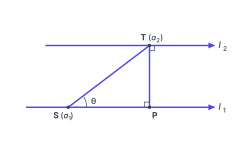
Drawn by us to help you understand the concept clearly, and verified to make sure it's accurate. For exams, practice from your NCERT textbook's own diagram.
Figure 11.7 is the key visual for understanding the shortest distance between two parallel lines in space. The diagram shows two horizontal, parallel lines: the lower line is labelled and the upper line is labelled . Both are drawn as indigo arrows pointing to the right, indicating that they extend infinitely in that direction.
On , a point is marked. Its position vector from the origin is . On , a point is marked, with position vector . The segment is drawn connecting these two points, and at it makes an angle with . From , a perpendicular is dropped onto , meeting it at point . Right-angle marks are shown at both and , confirming that is perpendicular to . The length is the perpendicular distance between the two parallel lines — this is the shortest distance.
The physical idea is straightforward: for two parallel lines, the shortest distance between them is the length of the perpendicular segment from any point on one line to the other line. The segment is not the shortest distance because it is slanted; only when does coincide with . The figure makes clear that the perpendicular distance is unique and independent of which point you choose on or .
For parallel lines, the shortest distance is always the perpendicular distance. The slanted segment is longer than unless .
The textbook uses this figure to derive the formula for the shortest distance between two parallel lines. If the lines are given in vector form as
where is the common direction vector, then the shortest distance is
Here, is the vector from to (the slanted segment). The cross product gives a vector whose magnitude equals the area of the parallelogram formed by and . Dividing by gives the height of that parallelogram — which is exactly the perpendicular distance .
In the figure, is the length , and is the magnitude of the direction vector along the lines. The angle between and satisfies , which is exactly what the cross product formula captures: , so dividing by yields . …