Mathematics · Ch 11 — Three-Dimensional Geometry
Equation of a Line Through a Given Point and Parallel to Given Vector
Equation of a Line Through a Given Point and Parallel to Given Vector
Equation of a Line Through a Given Point and Parallel to a Given Vector
The fundamental problem is to find the equation of a line when we know one point it passes through and its direction. In three-dimensional space, a line is completely determined by a point on it and a vector parallel to it. This vector gives the line its orientation, while the point fixes its location.
Vector Form of the Equation
Let be the origin of the rectangular coordinate system. Let be the given point on the line, with position vector . Let be a given vector parallel to the line . Now consider any arbitrary point on the line , with position vector .
The vector is the vector from point to point . Since the line passes through and , and the line is parallel to , the vector must also be parallel to . Therefore, there exists some real number such that:
But we can express in terms of position vectors:
Equating these two expressions gives:
Rearranging, we obtain the vector equation of the line:
Here, is a parameter that can take any real value. For each distinct value of , this equation gives the position vector of a different point on the line. When , we get the given point itself.
Vector equation of a line through point parallel to :
If , then the numbers , , are called the direction ratios of the line. Conversely, if , , are the direction ratios of a line, then the vector is parallel to that line. Do not confuse with its magnitude .
Cartesian Form of the Equation
We now derive the Cartesian (or scalar) form from the vector equation. Let the coordinates of the given point be . Let the direction ratios of the line be , , . Let the coordinates of any point on the line be .
Then we can write the position vectors as:
Substituting these into the vector equation :
Equating the coefficients of , , and on both sides gives the parametric equations of the line:
These are called parametric equations because the coordinates , , are expressed in terms of the parameter .
›Proof
Derivation of the Cartesian equation by eliminating :
From the parametric equations, we can solve for in each case:
From : , provided
From : , provided
From : , provided
Since is the same in all three equations, we equate these expressions:
This is the Cartesian equation of the line. …
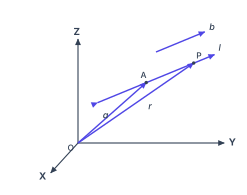
Drawn by us to help you understand the concept clearly, and verified to make sure it's accurate. For exams, practice from your NCERT textbook's own diagram.
Fig 11.3 is the foundational picture for the entire topic of lines in 3D. It shows a standard rectangular coordinate system with axes , , meeting at the origin . The key object is a straight line (drawn in indigo, with arrows on both ends to show it extends infinitely in both directions) that does not pass through . Instead, it sits somewhere in space, offset from the origin.
Two points are marked on this line. Point is a fixed, given point on . Its position vector from is labelled . Point is an arbitrary (any) point on the same line, with position vector . The figure also shows a separate arrow labelled , drawn floating above the line (not attached to or ). This arrow represents the direction vector of the line — it is parallel to and gives the line its orientation in space.
The physical idea is simple: to describe every point on , you start at and move some distance along the direction . The vector from to is . Since lies along the line, it must be parallel to . That means is a scalar multiple of : , where is a real number (the parameter). Rearranging gives the central result.
This is the vector equation of a line through point (position ) parallel to direction . Every value of gives a different point on : gives itself, gives points on one side of , and gives points on the other side.
From this vector form, the textbook derives the Cartesian form. If and (where are the direction ratios), then equating components of with gives the parametric equations:
Eliminating yields the symmetric Cartesian form:
…