Q.Represent graphically a displacement of 40 km, west of south.
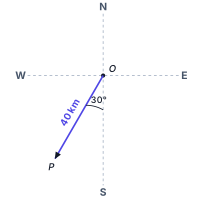
Draw an arrow long (scale ) from a point , pointing to the west of the due-south direction. That arrow represents the displacement.
Reading the direction: "west of south"
In a phrase like " west of south", the second word is the reference you start from, and the first tells you which way to swing. So you face south first, then rotate towards the west. The final arrow lies in the south-west region, but nearer to south than to west.
Do not confuse " west of south" with " south of west". The reference (starting) direction is the second word — here it is south, so measure the from the south line.
Construction
1. Choose a scale. A displacement of is convenient at , giving a arrow.
2. Set up the compass directions. Mark a point . Take north as up, south as down, east as right and west as left. Draw the due-south line vertically downward from .
3. Measure the angle. Place a protractor at with its along the south line and mark on the west (left) side.
4. Draw the arrow. From , draw a straight segment through the mark and put an arrowhead at the far end. Label the length "" and show the angle between the arrow and the south line.
What the diagram shows
The arrow points down and slightly to the left of straight-down: it makes a angle with due south, opening towards the west. Its length stands for the magnitude.
A arrow (scale ) from , making a angle with the due-south direction on its western side, represents the displacement of , west of south.
Unlock everything free for 14 days
- Full step-by-step solutions
- Concept-first explanations
- Methods, shortcuts & mistakes
- PYQ mapping + timed mock tests
Full access for 14 days. No credit card required.