Physics · Ch 4 — Moving Charges and Magnetism
Magnetic Field on the Axis of a Circular Current Loop
Magnetic Field on the Axis of a Circular Current Loop
Why the Field Points Along the Axis
A circular current loop produces a magnetic field that is symmetric about its axis. For any small current element on the loop, the Biot-Savart law gives a field contribution that is perpendicular to both and the displacement vector from the element to the point on the axis.
Because the loop is symmetric, the components of perpendicular to the axis cancel in pairs (e.g., from diametrically opposite elements). Only the component along the axis survives. The net field at a point on the axis is therefore directed along the axis itself.
Derivation of the Magnetic Field
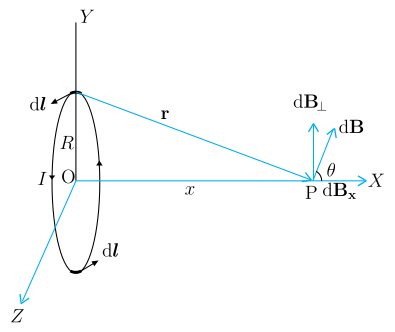
Consider a circular loop of radius carrying a steady current , lying in the -plane with its centre at the origin . The -axis is the axis of the loop. Let be a point on this axis at a distance from .
- Biot-Savart law for a current element For a small element on the loop, the magnitude of the magnetic field at is
where is the vector from the element to , and .
-
Geometry of the loop
- The distance from any element to is .
- Every element is perpendicular to (since lies in the -plane and has components in the - or -plane). Hence .
Therefore,
- Component along the axis From the geometry, the angle between and the axis satisfies
The axial component of is
- Integrate over the entire loop Summing around the loop gives the circumference: . The net magnetic field at is
Thus,
where is the unit vector along the axis (direction given by the right-hand thumb rule).
Special Case: Field at the Centre …
Drawn by us to help you understand the concept clearly, and verified to make sure it's accurate. For exams, practice from your NCERT textbook's own diagram.
The figure shows a circular loop of radius lying in the Y–Z plane, with its centre at the origin . The X-axis is the axis of the loop, pointing to the right. The loop carries a steady current (direction indicated by arrows on the loop). A point is marked on the X-axis at a distance from .
Two specific current elements are highlighted:
- A line element at the top of the loop (in the Y–Z plane).
- Another diametrically opposite at the bottom of the loop.
From the top , a displacement vector (shown in blue) runs to point . The magnitude of is .
At point , the magnetic field due to the top is drawn perpendicular to (as required by the Biot–Savart law). This is then resolved into two components:
- — along the X-axis (to the right).
- — perpendicular to the X-axis (vertical up).
The angle is marked at between and . From geometry, .
The key physical idea is that the perpendicular components from diametrically opposite elements cancel (the bottom element gives a pointing vertically down, cancelling the top one). Only the axial components add up, giving a net field along the X-axis.
The textbook derives the net magnetic field on the axis using this figure:
Since , . The axial component is , so:
Integrating around the loop (circumference ) gives the final formula:
where: …
Drawn by us to help you understand the concept clearly, and verified to make sure it's accurate. For exams, practice from your NCERT textbook's own diagram.
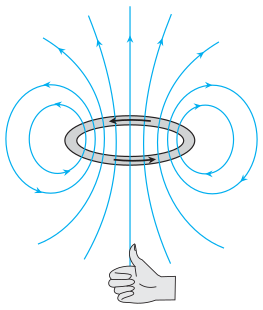
What the figure shows
The figure depicts a single horizontal current loop — drawn as a flat ring or ellipse — carrying a steady current. Arrows on the loop indicate the direction of the current. Around the loop, blue magnetic field lines form closed loops that thread through the ring: they emerge upward from the top of the loop, fan outward, curve around the sides, and re-enter the bottom of the loop. This pattern is identical to the field of a bar magnet. The upper side of the loop is labelled as the north pole and the lower side as the south pole. Below the loop, a small stylised right hand is shown with fingers curled in the direction of the current and the thumb pointing upward — illustrating the right-hand thumb rule for the direction of the magnetic field.
Physical idea taught
The figure teaches that a current-carrying circular loop behaves like a magnetic dipole. The magnetic field lines are closed loops, just like those of a bar magnet. The direction of the field at any point is given by the right-hand thumb rule: if you curl the fingers of your right hand in the direction of the current, your thumb points in the direction of the magnetic field (out of the north pole). This analogy helps visualise the field pattern and understand that the loop has a north pole (where field lines emerge) and a south pole (where field lines re-enter).
Key formula developed with this figure
The textbook derives the magnetic field on the axis of a circular current loop using the Biot-Savart law. For a loop of radius carrying current , the magnetic field at a point on the axis at distance from the centre is:
where:
- is the permeability of free space ()
- is the steady current in the loop
- is the radius of the loop
- is the distance from the centre of the loop along the axis
- is the unit vector along the axis (direction given by the right-hand thumb rule)
At the centre of the loop (), the formula simplifies to: …