Physics · Ch 4 — Moving Charges and Magnetism
Ampere's Circuital Law
Ampere's Circuital Law
What Ampere's Circuital Law Says
Ampere’s circuital law is an alternative, often simpler, way to express the same physics as the Biot-Savart law. It relates the magnetic field along a closed loop to the total current passing through any surface bounded by that loop.
Physical idea:
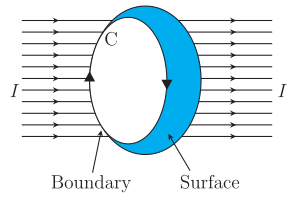
Imagine any open surface with a closed boundary (like a soap film stretched over a wire ring). If a steady current passes through that surface, then the line integral of the magnetic field around the boundary is proportional to .
The Law in Integral Form
Consider a closed loop (the boundary) made of many tiny line elements . At each element, take the component of tangential to the loop, , and multiply by the length . The sum of all such products, in the limit of infinitesimally small elements, becomes the line integral:
Here:
- means the integral is taken over the entire closed loop.
- is the magnetic field at each point on the loop.
- is a tiny vector along the loop, tangent to it.
- is the permeability of free space.
- is the total steady current passing through any surface whose boundary is the loop.
Sign convention (right-hand rule):
Curl the fingers of your right hand in the direction you traverse the loop. Your thumb then points in the direction of the current that is taken as positive.
Simplified Form for Symmetric Situations
In many practical cases, we can choose a special loop (called an Amperian loop) such that at every point on the loop, one of these holds:
- is tangential to the loop and has constant magnitude , or
- is normal to the loop (so ), or
- .
If is the total length of the loop where is tangential and constant, and is the current enclosed by the loop, then the law reduces to:
This is the form used for quick calculations when symmetry is present.
Application: Magnetic Field of an Infinite Straight Wire
Consider an infinitely long, straight wire carrying a steady current . By symmetry, the magnetic field at a distance from the wire is tangential to circles centered on the wire and has the same magnitude at all points on a given circle.
Choose an Amperian loop that is a circle of radius , centered on the wire. Then:
- (the circumference)
- (the entire current passes through the loop)
Ampere’s law gives:
Thus:
Key points about this result:
- The field has cylindrical symmetry — it depends only on , not on angle or position along the wire.
- The field lines form concentric circles around the wire. They are closed loops (unlike electric field lines which start and end on charges).
- The field is directly proportional to and inversely proportional to .
- It becomes infinite only as (very close to the wire).
Direction (right-hand rule for a straight wire):
Grasp the wire with your right hand, thumb pointing in the direction of the current. Your fingers curl in the direction of .
Example: Wire of Finite Radius (Uniform Current Density)
A long straight wire has circular cross-section of radius and carries a steady current uniformly distributed over its cross-section.
Case 1: Outside the wire ()
Amperian loop is a circle of radius . The enclosed current is the full . So:
This is the same as for an infinitely thin wire. The field falls off as .
Case 2: Inside the wire ()
Amperian loop is a circle of radius . The current enclosed is only the fraction of that lies inside radius . Since the current is uniform: …
Drawn by us to help you understand the concept clearly, and verified to make sure it's accurate. For exams, practice from your NCERT textbook's own diagram.
What the Figure Shows
The figure depicts an open surface (shown as a blue dish or membrane) whose boundary is a closed loop labelled C. The loop has a circulation arrow indicating the direction in which the line integral is taken. Horizontal arrows (representing current or magnetic field lines) pass through the surface from left to right; these are labelled I at both ends, signifying the total current threading the surface. The rim of the surface is marked Boundary, and the membrane itself is labelled Surface.
The Physical Idea
The figure illustrates Ampere’s circuital law: the line integral of the magnetic field around a closed loop equals times the total current passing through any surface bounded by that loop. The key insight is that the current must pierce the surface — it is not enough for the loop to simply enclose the wire; the surface must be chosen so that the current actually goes through it. This is why the figure shows the current lines crossing the membrane.
The Key Formula
Ampere’s law is written as:
where:
- denotes the line integral around the closed loop C (the boundary),
- is the magnetic field,
- is an infinitesimal element of the loop,
- is the permeability of free space,
- is the total current passing through the surface bounded by C.
The right-hand rule gives the sign convention: curl the fingers of your right hand in the direction the loop is traversed; your thumb then points in the direction of positive current.
Simplified Form for Symmetric Cases
When the loop can be chosen so that is tangential and constant along part of its length (length ), the law reduces to:
…