Concept understanding — Plastids And Chloroplast Structure
Plastids and Chloroplast Structure
Imagine a plant cell that needs to do something no animal cell can: turn sunlight into food. That job requires a specialised factory. Plastids are that factory — a family of double-membraned organelles found only in plant cells and some algae. Each type of plastid has a different role, but they all share a common ancestor inside the cell.
The Big Idea: Why Two Membranes?
Every plastid is wrapped in two membranes. The outer membrane is like the factory gate — it lets small molecules pass freely. The inner membrane is picky; it controls what enters and leaves the internal space. This double envelope is a signature of plastids and mitochondria alike, and it hints at their ancient origin as bacteria that once lived inside larger cells.
Chloroplasts: The Solar Panels
The most famous plastid is the chloroplast. Its job is photosynthesis — capturing light energy and storing it in chemical bonds. If you slice open a chloroplast, you find three distinct regions:
Stroma — the fluid-filled matrix inside the inner membrane. This is where the dark reactions (Calvin cycle) happen, turning carbon dioxide into sugar.
Thylakoids — flattened, disc-like sacs that float in the stroma. Their membranes are packed with chlorophyll and other pigments. This is where light energy is absorbed.
Grana (singular: granum) — stacks of thylakoids, like a pile of coins. Stacking increases surface area, allowing more light capture in less space.
6CO2+6H2OlightC6H12O6+6O2
The thylakoid membrane holds the machinery for the light reactions: photosystems, electron carriers, and the enzyme that splits water. The stroma holds the enzymes for the Calvin cycle. The two membranes keep these processes organised and efficient.
Other Plastids: Chromoplasts and Leucoplasts
Not all plastids are green. Plants need colour and storage too.
Chromoplasts lack chlorophyll but contain red, orange, and yellow pigments (carotenoids). They give ripe tomatoes their red colour, carrots their orange, and autumn leaves their fiery hues. Their job is often to attract pollinators or seed dispersers.
Leucoplasts are colourless and found in roots, seeds, and underground stems. They store starch (amyloplasts), oils (elaioplasts), or proteins (proteinoplasts). A potato tuber is packed with amyloplasts full of starch — that's why it feels starchy and white.
Important
All plastids develop from small, undivided precursors called proplastids in meristematic (growing) tissues. Depending on the cell's needs, a proplastid can become a chloroplast in a leaf, a chromoplast in a fruit, or a leucoplast in a root. This is reversible in some cases — a chloroplast can turn into a chromoplast as a fruit ripens.
Yes, plastid types are interchangeable, since they are all variations built around the same basic organelle and can convert from one form to another as conditions change.
Leucoplasts, colourless storage plastids, can convert into chloroplasts when a normally underground or covered plant part is exposed to light — this is why a potato that has been left exposed to sunlight develops a green tinge as its amyloplasts turn into chloroplasts. …
Plastid types are interchangeable — leucoplasts can become chloroplasts on exposure to light, and chloroplasts can become chromoplasts as fruit ripens.
Chloroplasts, chromoplasts and leucoplasts are described as three kinds of plastid distinguished by the pigments they carry, but they are not permanently fixed, separate categories. A plastid of one type can convert into another as the needs and conditions of the plant tissue change.
A familiar example is the leucoplast, a colourless plastid that stores nutrients such as starch, as in the amyloplasts of a potato tuber growing underground away from light. If such a tuber is instead exposed to sunlight, its leucoplasts respond by converting into chloroplasts, which is why an exposed potato develops a visible green tinge on its skin. …
Method: Answering "Are They Interchangeable" With Concrete, Directional Examples
For a question asking whether categories of a structure can convert into one another, commit to the yes/no answer first, then support it with the strongest, most memorable real examples you know -- abstract claims about interconversion are unconvincing without a concrete case showing it actually happening. …
Same / Similar Concept — real previous-year questions on the same or a closely similar concept, not this exact question.
AP EAPCET 2025Set ap-2025-05-20-FN1 markMCQ
Q.Study the following table and identify the correct combination
S.No. / List - I / List - II / List - III
I. Stroma of the Chloroplast / Circular, double stranded DNA / 80 S Ribosomes
II. Chromoplasts / Carotenoid pigments / Water soluble
III. Chloroplast / Grana Thylakoids / Stroma lamellae
IV. Microbodies / Glyoxysomes / Peroxisomes
(A) I, II
(B) II, III
(C) III, IV
(D) IV, I
›Reveal solutionSolution
Checking each row of the table for internal consistency: III (chloroplast/grana/stroma-lamellae) and IV (microbodies/glyoxysomes/peroxisomes) are correct; I and II each contain a factual error — option (C).
Concept and Intuition
This is a fact-checking exercise across cell organelle features: ribosome type in semi-autonomous organelles, pigment solubility, chloroplast internal architecture, and the microbody family.
Step-by-Step Solution
Row I: Chloroplast stroma does contain circular, double-stranded DNA, but its ribosomes are 70S (prokaryote-type, since chloroplasts are semi-autonomous organelles), not 80S. So Row I is incorrect.
Row II: Chromoplasts do contain carotenoid pigments, but carotenoids are lipid/fat-soluble pigments, not water-soluble. So Row II is incorrect.
Row III: Chloroplasts have stacks of thylakoid membranes called grana, interconnected by flat membranous tubules called stroma lamellae — this is accurately stated. Row III correct. …
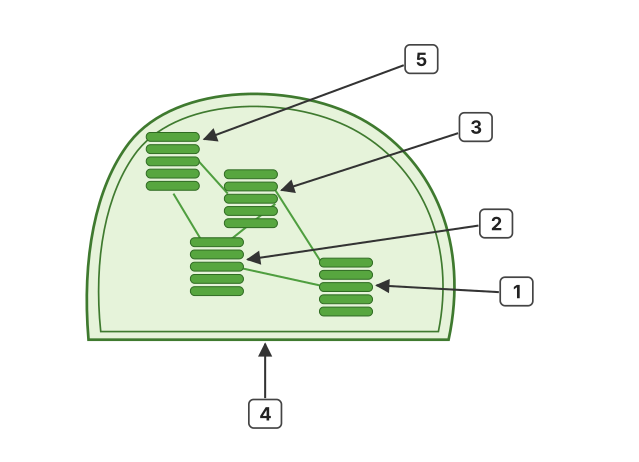
Q.Identify the labelled parts as 1, 2, 3, 4, 5 in the below Sectional view of chloroplast? [FIGURE] (a half-sectional drawing of a chloroplast showing stacked green granum thylakoids surrounded by stroma and bounded by an outer double membrane, with five numbered leader lines: 5 to a region near the top, 3 to a thylakoid stack near the top, 2 to a granum stack in the middle, 1 to peripheral thylakoids on the right, 4 to the boundary membrane at the bottom)
(A) 1 – Stroma, 2 – Granum, 3 – Stroma Lamellae, 4 – Inner membrane, 5 – Outer membrane
(B) 1 – Stroma Lamellae, 2 – Granum, 3 – Inner membrane, 4 – Stroma, 5 – Outer membrane
(C) 1 – Stroma Lamellae, 2 – Stroma, 3 – Granum, 4 – Outer membrane, 5 – Inner membrane
(D) 1 – Granum, 2 – Stroma, 3 – Outer membrane, 4 – Inner membrane, 5 – Stroma Lamellae
›Reveal solutionSolution
Reading the sectional view of the chloroplast: the peripheral inter-granal thylakoids are the stroma lamellae (1), the disc-stacks are grana (2), the innermost bounding membrane is the inner membrane (3), the fluid matrix is the stroma (4) and the outermost bounding membrane is the outer membrane (5). Option (B).
Structure of the chloroplast. The organelle is bounded by an envelope of two membranes — an outer membrane (5) and an inner membrane (3) — enclosing a proteinaceous ground substance, the stroma (4). Within the stroma the thylakoids are organised as stacked discs called grana (2), and the flat unstacked thylakoids that interconnect adjacent grana are the **stroma (inter- …
Leucoplasts (general nutrient storage) subdivide into amyloplasts (carbohydrates), elaioplasts (oils & fats), and aleuroplasts (proteins) — matching option (A).
Concept and Intuition
Leucoplasts are colourless plastids found in non-photosynthetic tissues, specialised for storing different reserve materials. They are classified by what they store: amyloplasts store starch (carbohydrates), elaioplasts store lipids (oils and fats), and aleuroplasts store proteins.
Step-by-Step Solution
Leucoplasts (a) — the umbrella storage-plastid category → general "Nutrients" (iii).
Amyloplasts (b) — store carbohydrates/starch → (i).