Q.In both water and dimethyl ether (CH3—O—CH3), oxygen atom is central atom, and has the same hybridisation, yet they have different bond angles. Which one has greater bond angle? Give reason.
🔒You're viewing a preview — the full solution, concept, methods & PYQ mapping are locked.
🔒 Start your 14-day free trial to unlock the full solution →Concept understanding — VSEPR Theory
VSEPR Theory: Why Molecules Have the Shapes They Do
Imagine you're in a crowded room. Everyone wants their personal space. If you're standing with a few friends, you'll naturally spread out so no one is too close to anyone else. That's exactly what happens inside a molecule.
The Core Intuition
Electron pairs are negatively charged. They repel each other. In a molecule, the electron pairs around a central atom will arrange themselves as far apart as possible — just like those people in the room. This simple idea is the entire foundation of VSEPR (pronounced "ves-per") Theory.
VSEPR stands for Valence Shell Electron Pair Repulsion. The name tells you exactly what it's about: the repulsion between electron pairs in the valence shell.
The Precise Statement
VSEPR Theory states that the geometry around a central atom is determined by minimizing the repulsion between all electron pairs (both bonding and lone pairs) in its valence shell.
Two key points to hold onto:
- All electron pairs repel — whether they are shared (bonding pairs) or unshared (lone pairs).
- Lone pairs repel more strongly than bonding pairs. A lone pair is "fatter" — it's only attracted to one nucleus, so it spreads out more and pushes harder on its neighbours.
How to Predict Shape in 3 Steps
Step 1: Count the total electron pairs around the central atom.
Add the number of atoms bonded to the central atom plus the number of lone pairs on it. This gives you the steric number.
Step 2: Arrange those pairs as far apart as possible.
This gives you the electron-pair geometry — the shape if you pretend all pairs are identical.
Step 3: Replace lone pairs with "invisible" space.
The actual molecular geometry is the shape formed by the atoms alone, ignoring lone pairs.
The Common Geometries at a Glance
| Steric Number | Electron-Pair Geometry | Lone Pairs | Molecular Geometry | Example | Bond Angle |
|---|---|---|---|---|---|
| 2 | Linear | 0 | Linear | CO2 | 180° |
| 3 | Trigonal planar | 0 | Trigonal planar | BF3 | 120° |
| 3 | Trigonal planar | 1 | Bent | SO2 | ~119° |
| 4 | Tetrahedral | 0 | Tetrahedral | CH4 | 109.5° |
| 4 | Tetrahedral | 1 | Trigonal pyramidal | NH3 | ~107° |
| 4 | Tetrahedral | 2 | Bent | H2O | ~104.5° |
| 5 | Trigonal bipyramidal | 0 | Trigonal bipyramidal | PCl5 | 90°, 120° |
| 6 | Octahedral | 0 | Octahedral | SF6 | 90° |
A common mistake: thinking that NH3 is tetrahedral. It has tetrahedral electron-pair geometry, but because one position is a lone pair, the molecular shape is trigonal pyramidal. The bond angle is 107°, not 109.5°.
Why Lone Pairs Squeeze Bond Angles
Take water (H2O). The central oxygen has 4 electron pairs: 2 bonding (to H atoms) and 2 lone pairs. The ideal tetrahedral angle is 109.5°. But the two lone pairs push harder on the bonding pairs, compressing the H–O–H angle to about 104.5°.
In ammonia (NH3), there's only one lone pair, so the compression is less — the H–N–H angle is about 107°. …
The key idea is VSEPR Theory: bond angles are determined by the repulsion between electron pairs around the central atom, and lone pairs repel more strongly than bonding pairs.
- In water (H2O), oxygen has 2 bond pairs and 2 lone pairs — a tetrahedral electron-pair geometry. The lone-pair–lone-pair repulsion compresses the H−O−H angle to about 104.5°.
- In dimethyl ether (CH3−O−CH3), oxygen again has 2 bond pairs and 2 lone pairs, so the same tetrahedral arrangement. However, the two bonding pairs are attached to bulky methyl groups (−CH3). …
Both molecules have sp3 hybridised oxygen, but the bond angle in dimethyl ether (≈111.7∘) is larger than in water (104.5∘) because the two methyl groups are bulkier than hydrogen atoms, causing greater repulsion between bonded pairs and widening the angle.
The key to this question lies in VSEPR (Valence Shell Electron Pair Repulsion) Theory. This theory states that electron pairs around a central atom arrange themselves to minimise repulsion. But not all repulsions are equal — the strength of repulsion follows a clear hierarchy: lone pair–lone pair > lone pair–bond pair > bond pair–bond pair.
In both water (H2O) and dimethyl ether (CH3−O−CH3), the central oxygen atom has the same electronic geometry. Let's see why.
-
Count the electron pairs around oxygen.
Oxygen has 6 valence electrons. In water, it forms two single bonds with hydrogen atoms, using 2 electrons. The remaining 4 electrons form two lone pairs. That gives 2 bond pairs + 2 lone pairs — a total of 4 electron domains.
In dimethyl ether, oxygen forms two single bonds with carbon atoms (from the methyl groups). Again, 2 electrons are used in bonding, leaving 4 as two lone pairs. So the electron domain count is identical: 2 bond pairs + 2 lone pairs.
-
Determine the hybridisation.
Four electron domains around a central atom always correspond to sp3 hybridisation. The ideal bond angle for a perfect tetrahedron is 109.5∘. But the presence of lone pairs distorts this angle because lone pairs occupy more space and repel more strongly than bond pairs.
-
Compare the bond pair repulsions.
In water, the two bond pairs are attached to small hydrogen atoms. The repulsion between the two O–H bond pairs is relatively modest. The dominant repulsion comes from the two lone pairs pushing the bond pairs closer together, resulting in the well-known bond angle of 104.5∘.
In dimethyl ether, the bond pairs are attached to methyl groups (−CH3). These are much bulkier than hydrogen atoms. The bond pair–bond pair repulsion between the two O–C bonds is significantly stronger because the electron clouds of the methyl groups are larger and more polarisable. This increased repulsion pushes the two bond pairs further apart, opening the bond angle.
-
The result. …
Showing the 12 most recent of 51 on this concept.
- AP EAPCET 2026Set eng-2026-05-13-FN1 markMCQQ.In gas phase structure of H2O2, the dihedral angle is (A) 94.5° (B) 101.9° (C) 111.5° (D) 90.2°
›Reveal solutionSolution
This tests the gas-vs-solid structural difference of H2O2; the gas-phase dihedral (twist) angle is 111.5°.
Concept and Intuition
H2O2 has a non-planar, "open book" structure: two O–H bonds are twisted out of the O–O plane by a dihedral angle. This angle is not fixed — it changes with the environment because the molecule is fairly flexible about the O–O axis, and intermolecular hydrogen bonding (present in the solid/liquid, absent in isolated gas-phase molecules) changes the preferred twist to minimize lattice energy.
Step-by-Step Solution
- In the gas phase, H2O2 molecules are essentially isolated (no significant H-bonding to neighbours), so the molecule adopts its intrinsic minimum-energy skew conformation.
- This intrinsic (gas-phase) dihedral angle is experimentally found to be 111.5°. …
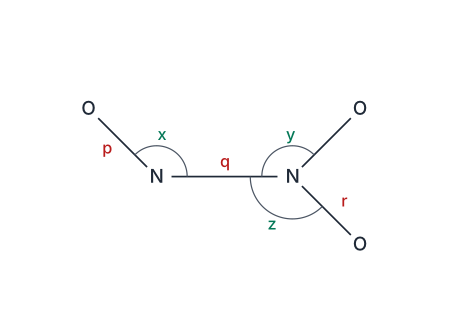
- AP EAPCET 2026Set eng-2026-05-14-FN1 markMCQQ.Following is the structural representation of N2O3 molecule in which x, y, z are bond angles and p, q, r are bond lengths [FIGURE: structural diagram of N2O3 showing two N atoms bonded to each other (bond length q), left N bonded to two O atoms (bond lengths p, with angle x between the two O-N bonds), right N bonded to two O atoms (one via angle y, bond length r), and z labelling the angle at the N-N bond region] The correct orders of bond angles and bond lengths respectively are (A) x<z<y & p<q<r (B) x<y<z & p<r<q (C) x<z<y & p<r<q (D) x<y<z & p<q<r
›Reveal solutionSolution
N2O3 (O=N−NO2) has a famously weak, long N–N bond (the reason it dissociates into NO + NO2), a short true N=O double bond on the nitroso end, and an intermediate resonance-delocalised N–O bond on the nitro end — giving p<r<q for lengths, and x<z<y for the angles once lone-pair and steric effects are accounted for.
Concept and Intuition
N2O3 is best understood as two fragments joined by a single N–N bond: a nitrosyl-type nitrogen (−N=O, one oxygen, one lone pair) bonded to a nitro-type nitrogen (−NO2, two oxygens, delocalised over both N–O bonds). Bond length tracks bond order: a genuine double bond (the terminal N=O on the nitrosyl end) is shorter than a bond with partial (resonance-averaged, ~1.5) double-bond character (the N–O bonds on the nitro end), which in turn is much shorter than the N–N bond joining the two halves. That N–N bond is a classic textbook weak point — it is this unusually long, weak single bond that makes N2O3 thermally unstable and prone to falling apart into NO and NO2.
Bond angle is governed by electron-domain geometry (VSEPR) and steric crowding. At the nitrosyl nitrogen, one of its three electron domains is a lone pair, which compresses the O–N–N angle below the ideal trigonal value. At the nitro nitrogen, all three domains are bonding pairs (to N and to two O's), so its angles stay closer to trigonal (~120°), but they're not identical to each other — whichever oxygen sits on the same side as (syn/closer to) the nitrosyl oxygen across the N–N bond experiences more steric repulsion and is pushed to a wider angle, while the oxygen on the far side keeps a more moderate angle.
Step-by-Step Solution
- Identify the two nitrogens: the nitrosyl N (one O, one lone pair, bonded to the other N) and the nitro N (two O's, bonded to the other N). …
- AP EAPCET 2026Set eng-2026-05-14-FN1 markMCQQ.Which of the following statement is not correct about the structures of ozone and sulphur dioxide? (A) Both have angular shape (B) Both have resonance structures (C) Both have same hybridization (D) Both have same bond angles
›Reveal solutionSolution
O3 and SO2 share angular shape, sp2 hybridization and resonance, but NOT the same bond angle — so (D) is the incorrect statement.
Concept and Intuition
Both molecules have a central atom with one lone pair and two bonded oxygens in a bent (angular) AX2E arrangement, both delocalize their central atom's p-electron density across resonance structures, and both use sp2 hybrid orbitals. But the exact bond angle depends on subtle differences in lone-pair/bond-pair repulsion and the electronegativity/size of the central atom (O vs S), so the specific angles are not identical.
Step-by-Step Solution
- (A) Both angular — TRUE for both O3 and SO2.
- (B) Both have resonance structures — TRUE; each is a resonance hybrid of two equivalent canonical forms.
- (C) Both have same hybridization — TRUE; central atom is sp2 in both cases. …
- AP EAPCET 2026Set eng-2026-05-18-FN1 markMCQQ.Which of the following sets contain isostructural molecules? I. H2O, OF2, SCl2 II. CO2, BeCl2, HgCl2 III. SiCl4, SF4, XeF4 Correct answer is (A) I, II, III (B) I, III only (C) II, III only (D) I, II only
›Reveal solutionSolution
Isostructural means same shape/geometry class; sets I (H2O/OF2/SCl2, all bent) and II (CO2/BeCl2/HgCl2, all linear) qualify, but set III's members have three different shapes.
Concept and Intuition
Two species are isostructural when they share the same molecular geometry — which, by VSEPR, is decided by the total number of electron domains (bond pairs + lone pairs) around the central atom, not just its identity. Same central-atom electron-domain "formula" (like AX2E2 or AX2) means same shape, even across different elements.
Step-by-Step Solution
- Set I: H2O (O: 2 bond pairs + 2 lone pairs), OF2 (O: 2 bond pairs + 2 lone pairs), SCl2 (S: 2 bond pairs + 2 lone pairs). All are AX2E2, sp3, bent/angular. Isostructural.
- Set II: CO2 (C: sp, 2 σ + no lone pair), BeCl2 (Be: sp, 2 σ, no lone pair, gas-phase monomer), HgCl2 (Hg: sp, 2 σ, no lone pair). All linear AX2. Isostructural. …
- AP EAPCET 2026Set ap-2026-05-19-FN1 markMCQQ.Match the following. List – I (Molecule) : (A) SO2 (B) NO2 (C) O3 (D) S8 List – II (Bond angle in degrees) : (I) 134 (II) 117 (III) 90 (IV) 119.5 (V) 107 The correct answer is: (A) A-IV, B-I, C-II, D-V (B) A-V, B-IV, C-II, D-III (C) A-IV, B-I, C-III, D-V (D) A-V, B-I, C-IV, D-III
›Reveal solutionSolution
Matching each molecule to its known bond angle — SO₂ 119.5°, NO₂ 134°, O₃ 117°, S₈ 107° — gives A-IV, B-I, C-II, D-V.
Concept and Intuition
Bond angle in a bent/angular molecule is set by the balance of lone-pair and bonding-pair repulsions (VSEPR) around the central atom, and for radicals, by the presence of a single unpaired electron instead of a full lone pair (which repels less than a lone pair, widening the angle).
Step-by-Step Solution
- NO2: nitrogen has one unpaired electron (not a full lone pair) besides two bonding regions; the reduced repulsion from a single electron (vs. a lone pair) widens the angle to about 134∘ — matches (I).
- O3 (ozone): central O has one lone pair plus resonance-delocalised bonding — bond angle is close to 117∘ — matches (II).
- SO2: sulfur has one lone pair, similar bent geometry to ozone but slightly more open — bond angle ≈119.5∘ — matches (IV). …
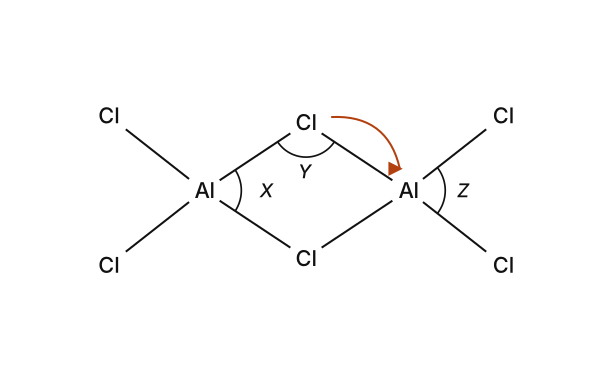
- AP EAPCET 2026Set eng-2026-05-18-AN1 markMCQQ.The structure of Al2Cl6 is given below [FIGURE] (a dimeric Al2Cl6 structure: two Al atoms each bonded to two terminal Cl atoms, bridged by two Cl atoms between the Al centres, with curved arrows showing the dative bonding of the bridging chlorines; angle X is the Cl-Al-Cl angle at the bridging chlorines on the left Al, angle Y is the Al-Cl-Al bridging bond angle, and angle Z is the terminal Cl-Al-Cl angle on the right Al) The correct order of bond angles X, Y and Z is (A) X>Y>Z (B) Z>X>Y (C) Y>X>Z (D) Z>Y>X
›Reveal solutionSolution
Terminal angle (Z) is largest, ring angle at Al (X) next, bridge angle at Cl (Y) smallest: Z>X>Y.
Concept and Intuition
Al2Cl6 is a dimer in which two AlCl3 units join through two bridging chlorines, forming a puckered 4-membered Al-Cl-Al-Cl ring. Each Al is roughly sp3. The terminal Cl atoms are held by ordinary covalent bonds and spread apart to reduce repulsion, so the terminal Cl-Al-Cl angle opens out to about 120∘. The angles inside the strained ring are forced to be much smaller.
Step-by-Step Solution
- Identify the three angles: X = Cl-Al-Cl at Al between the two bridging chlorines (ring angle at Al); Y = Al-Cl-Al at the bridging chlorine; Z = terminal Cl-Al-Cl at Al. …
- AP EAPCET 2026Set ap-2026-05-20-FN1 markMCQQ.Consider the following molecules PF5, H2O, NH3, XeF2, BF3, SF6, IF7 In how many of the above molecules, the ratio between the number of bond pairs of electrons and lone pairs of electrons is 1 : 3? (A) 4 (B) 3 (C) 2 (D) 5
›Reveal solutionSolution
Counting ALL bond pairs and ALL lone pairs in each whole molecule (not just on the central atom) reveals a pattern: whenever the central atom has zero lone pairs and is surrounded only by fluorine atoms (each contributing 3 lone pairs), the bond-pair:lone-pair ratio is always exactly 1:3.
Concept and Intuition
Each terminal fluorine atom in these molecules is singly bonded and carries 3 lone pairs (since F has 7 valence electrons, 1 used in the bond, 6 left = 3 lone pairs). So if a central atom has n bonds to fluorine and 0 lone pairs of its own, the whole molecule has n bond pairs and 3n lone pairs — an automatic 1:3 ratio, regardless of n. Molecules with lone pairs on the central atom, or with non-F terminal atoms (like H, which has no lone pairs), break this neat pattern.
Step-by-Step Solution
- PF5: P has 5 bonds to F, 0 lone pairs on P. Bond pairs = 5; lone pairs (on the 5 F atoms) = 5×3=15. Ratio 5:15=1:3. ✓
- H2O: O has 2 bonds to H, 2 lone pairs on O; H atoms have no lone pairs. Bond pairs = 2; lone pairs = 2. Ratio 2:2=1:1. ✗
- NH3: N has 3 bonds to H, 1 lone pair on N. Bond pairs = 3; lone pairs = 1. Ratio 3:1. ✗
- XeF2: Xe has 2 bonds to F, 3 lone pairs on Xe; each F has 3 lone pairs (2×3=6). Bond pairs = 2; lone pairs = 3+6=9. Ratio 2:9. ✗
- BF3: B has 3 bonds to F, 0 lone pairs on B. Bond pairs = 3; lone pairs = 3×3=9. Ratio 3:9=1:3. ✓ …
- AP EAPCET 2026Set ap-2026-05-20-FN1 markMCQQ.White phosphorus reacts with sulphuryl chloride and forms a solid substance A and a gas D. When A is heated at high temperature, it decomposes to give a colorless oily liquid 'X' and a gas C. The shape of X is (A) Pyramidal (B) Trigonal bipyramidal (C) Square planar (D) Tetrahedral
›Reveal solutionSolution
The sequence identifies A as solid PCl5 and X as PCl3, whose shape (like NH3) is trigonal pyramidal due to phosphorus's lone pair.
Concept and Intuition
White phosphorus reacts with excess sulphuryl chloride to fully chlorinate to PCl5, a solid, releasing SO2 gas as a byproduct. PCl5 is thermally unstable and readily dissociates on heating into PCl3 (a colourless, fuming, oily liquid at room temperature) and chlorine gas. The shape of any AX3E species (3 bond pairs + 1 lone pair around the central atom, sp3 hybridised) is trigonal pyramidal — the classic example being NH3, and PCl3 is directly analogous since P has 5 valence electrons, uses 3 to bond to Cl and retains one lone pair.
Step-by-Step Solution
- White phosphorus + excess SO2Cl2 (a chlorinating agent) → solid A =PCl5 + gas D =SO2.
- Heating A (PCl5) at high temperature causes thermal dissociation: PCl5→PCl3+Cl2.
- X =PCl3 (the 'colourless oily liquid'), C =Cl2 (the gas). …
- AP EAPCET 2025Set eng-2025-05-21-AN1 markMCQQ.The increasing order of number of lone pair of electrons on the central atom of the following molecules is I) ClF3 II) XeF2 III) SF4 IV) SiH4 (A) IV < III < II < I (B) I < II < III < IV (C) II < I < III < IV (D) IV < III < I < II
›Reveal solutionSolution
This tests VSEPR lone-pair counting on the central atom of four molecules. The increasing order of lone pairs is SiH4(0)<SF4(1)<ClF3(2)<XeF2(3), i.e. IV < III < I < II.
Concept and Intuition
For a central atom, total electron domains = bonding pairs + lone pairs. Central-atom valence electrons plus contributions from surrounding atoms (minus charge adjustments) give the steric number; subtracting the number of σ-bonds (= number of surrounding atoms, since none of these molecules has multiple bonds to the central atom) leaves the lone pairs. This is a standard VSEPR bookkeeping exercise.
Step-by-Step Solution
- SiH4: Si (group 14, 4 valence e−) bonds to 4 H atoms using all 4 electrons in 4 bond pairs. Lone pairs =0. Shape: tetrahedral.
- SF4: S (group 16, 6 valence e−) forms 4 S–F bonds (using 4 electrons, one each) leaving 6−4=2 electrons =1 lone pair. Shape: see-saw.
- ClF3: Cl (group 17, 7 valence e−) forms 3 Cl–F bonds (using 3 electrons) leaving 7−3=4 electrons =2 lone pairs. Shape: T-shaped.
- XeF2: Xe (group 18, 8 valence e−) forms 2 Xe–F bonds (using 2 electrons) leaving 8−2=6 electrons =3 lone pairs. Shape: linear. …
- AP EAPCET 2025Set eng-2025-05-22-AN1 markMCQQ.How many of the following molecules have two lone pairs of electrons on central atom? SF6,BF3,ClF3,PCl5,BrF5,XeF4,H2O,SF4 (A) 5 (B) 4 (C) 3 (D) 2
›Reveal solutionSolution
This tests VSEPR-based lone-pair counting on the central atom of eight species; three of them (ClF3, XeF4, H2O) carry exactly two lone pairs.
Concept and Intuition
The number of lone pairs on a central atom = (its group valence electrons − electrons used in bonds actually shown, since AP EAPCET options here are for simple single-bonded species) worked out via the standard VSEPR electron-pair count: total electron pairs around the central atom = bond pairs + lone pairs, and total electron pairs = (central atom valence electrons + electrons contributed by bonded halogens counted as one shared pair each)/2 for these AX_n type halides.
Step-by-Step Solution
- SF6: S is sp3d2 hybridised, forms 6 S–F bonds, uses all 6 valence electrons of S in bonding → 0 lone pairs (octahedral).
- BF3: B has 3 valence electrons, all used in 3 B–F bonds → 0 lone pairs (trigonal planar).
- ClF3: Cl has 7 valence electrons; 3 are used in the 3 Cl–F bonds, leaving 4 electrons = 2 lone pairs (T-shaped, sp3d).
- PCl5: P has 5 valence electrons, all used in 5 P–Cl bonds → 0 lone pairs (trigonal bipyramidal).
- BrF5: Br has 7 valence electrons; 5 used in the 5 Br–F bonds, leaving 2 electrons = 1 lone pair (square pyramidal, sp3d2).
- XeF4: Xe has 8 valence electrons; 4 used in the 4 Xe–F bonds, leaving 4 electrons = 2 lone pairs (square planar, sp3d2). …
- AP EAPCET 2025Set eng-2025-05-22-FN1 markMCQQ.How many of the following molecules / ions have trigonal planar structure ? BO33−,NH3,PCl3,BCl3,ClF3,XeO3 (A) 5 (B) 2 (C) 4 (D) 3
›Reveal solutionSolution
Tests VSEPR shape prediction; only BO33− and BCl3 (both central atoms with 3 bond pairs, 0 lone pairs) are trigonal planar — a count of 2.
Concept and Intuition
VSEPR theory says molecular shape depends on the total number of electron domains (bond pairs + lone pairs) around the central atom. A species is trigonal planar only when the central atom has exactly 3 bonding domains and zero lone pairs (sp² hybridization with no lone pair distorting the geometry). If a lone pair is present alongside 3 bond pairs, the shape becomes pyramidal instead.
Step-by-Step Solution
- BO33−: B has 3 bonds to O and no lone pair (B contributes 3 valence electrons, all used in bonding) → trigonal planar.
- NH3: N has 3 bond pairs + 1 lone pair → trigonal pyramidal, not planar.
- PCl3: P has 3 bond pairs + 1 lone pair → trigonal pyramidal, not planar.
- BCl3: B has 3 bonds, no lone pair → trigonal planar.
- ClF3: Cl has 3 bond pairs + 2 lone pairs → T-shaped, not planar. …
- AP EAPCET 2025Set eng-2025-05-23-FN1 markMCQQ.A molecule has T-shape. The total number of electron pairs in the valence shell of central atom of it is (A) 4 (B) 5 (C) 6 (D) 3
›Reveal solutionSolution
This tests VSEPR geometry-to-electron-pair-count mapping; a T-shape needs 5 electron pairs on the central atom, option (B).
Concept and Intuition
VSEPR theory says molecular shape is decided by the total number of electron pairs (bonding + lone) around the central atom, arranged to minimize repulsion. A T-shape arises from a trigonal bipyramidal electron-pair arrangement (AX5-type, 5 pairs) where 2 of the 5 positions (the equatorial ones, which have least repulsion) are occupied by lone pairs instead of bonds, leaving 3 bonds arranged in a T (classic example: ClF3).
Step-by-Step Solution
- A T-shaped molecule has 3 bonding pairs (giving the 3 visible bonds) with the shape distorted from trigonal planar/pyramidal by lone-pair repulsion. …
🎓Unlock everything free for 14 days
- ✓Full step-by-step solutions
- ✓Concept-first explanations
- ✓Methods, shortcuts & mistakes
- ✓PYQ mapping + timed mock tests
Full access for 14 days. No credit card required.