Q.Which of the following angle corresponds to sp^2 hybridisation?
🔒You're viewing a preview — the full solution, concept, methods & PYQ mapping are locked.
🔒 Start your 14-day free trial to unlock the full solution →Concept understanding — Hybrid Orbital Overlap
The Intuition: Why Atoms Don't Just Use Their "Natural" Orbitals
Imagine you're trying to build a stable molecule. Carbon has four valence electrons — two in the 2s orbital and two in the 2p orbitals. If carbon used its pure s and p orbitals to form bonds, you'd expect two identical bonds (from the two p electrons) and two different, weaker bonds (from the s electrons). But experiment shows methane (CH4) has four identical bonds, all at 109.5∘ angles.
Nature has a trick: before bonding, the atom's orbitals mix — like blending primary colours to get new shades. This mixing is called hybridisation, and the resulting orbitals are hybrid orbitals.
Hybridisation is a mathematical model, not a physical event. The atom doesn't "decide" to hybridise — we use hybrid orbitals to explain the observed geometry and bond equivalence.
The Precise Statement
Hybrid orbital overlap is the process where two atoms form a covalent bond by overlapping their hybrid orbitals along the internuclear axis. The strength of the bond depends on how well the orbitals overlap — more overlap means a stronger bond.
The key idea: hybrid orbitals are directional and concentrated in specific regions of space, which allows them to overlap more effectively than pure s or p orbitals.
How Hybrid Orbitals Are Constructed
Take sp3 hybridisation (as in methane):
- One 2s orbital + three 2p orbitals → four equivalent sp3 hybrid orbitals
- Each sp3 orbital has 25% s-character and 75% p-character
- They point toward the corners of a tetrahedron (109.5∘ apart)
The mathematical form for an sp3 hybrid orbital is:
ψsp3=21ψ2s+21ψ2px+21ψ2py+21ψ2pz
General hybridisation: spn means one s orbital mixes with n p orbitals.
sp (linear, 180∘), sp2 (trigonal planar, 120∘), sp3 (tetrahedral, 109.5∘)
Overlap in Action: Methane
When a hydrogen 1s orbital approaches a carbon sp3 hybrid orbital along the line joining the nuclei:
- The sp3 lobe points directly at the hydrogen — maximum overlap
- The electron density concentrates between the nuclei
- A sigma (σ) bond forms — cylindrical symmetry about the bond axis
Compare this to using a pure carbon 2p orbital: the p orbital has a node at the nucleus and lobes pointing in two opposite directions. Overlap with hydrogen would be weaker and less directional.
Hybrid orbitals do not exist in isolated atoms. They are a mathematical convenience for bonded atoms. An isolated carbon atom has pure s and p orbitals — hybridisation only makes sense in the context of bonding.
Why Hybridisation Matters for Overlap
| Property | Pure p orbital | sp3 hybrid |
|---|---|---|
| Shape | Dumbbell (two lobes) | One large lobe, one small lobe |
| Directionality | Two opposite directions | One concentrated direction |
| Overlap with H 1s | Moderate (sideways) | Maximum (head-on) |
| Bond strength | Weaker | Stronger |
The key idea is that hybrid orbital overlap determines molecular geometry: the angle between hybrid orbitals is set by their symmetry to minimise repulsion.
- In sp2 hybridisation, one s orbital mixes with two p orbitals, giving three equivalent hybrid orbitals.
- These three orbitals lie in a plane and point toward the vertices of an equilateral triangle. …
The bond angle in sp2 hybridisation is 120∘, arising from the trigonal planar arrangement of three equivalent hybrid orbitals that minimise repulsion.
The key to understanding hybridisation angles is to remember that hybrid orbitals are formed by mixing atomic orbitals to create new, equivalent orbitals that point in specific directions. The geometry and bond angles are determined by the number of hybrid orbitals and the need to maximise their separation in space.
For sp2 hybridisation, one s orbital mixes with two p orbitals (say px and py). This produces three equivalent sp2 hybrid orbitals. These three orbitals lie in a plane and point toward the corners of an equilateral triangle. The angle between any two of them is exactly 120∘.
-
Why 120∘?
The three hybrid orbitals repel each other equally. The only way to place three identical objects around a central point so that they are as far apart as possible is to space them at 120∘ intervals in a plane. This is the trigonal planar geometry.
-
Contrast with other hybridisations:
- sp hybridisation gives two orbitals at 180∘ (linear). …
Showing the 12 most recent of 19 on this concept.
- AP EAPCET 2026Set eng-2026-05-13-FN1 markMCQQ.Total number of electrons involved in the formation of bridge bonds in the structure of diborane is (A) 6 (B) 2 (C) 4 (D) 3
›Reveal solutionSolution
This tests the electron-deficient bonding in diborane; the two 3c–2e bridge bonds together involve 4 electrons.
Concept and Intuition
Diborane is the classic example of electron-deficient, multicentre bonding. Each boron is sp3 hybridized, using 4 terminal B–H bonds (normal 2c–2e bonds, 2 per boron) plus two bridging hydrogens that sit between the two borons. Because there aren't enough electrons for two ordinary 2c–2e bonds to the bridging H atoms, each bridging H instead forms a single 3-centre–2-electron bond spanning B–H–B (a "banana bond"), where 2 electrons are delocalized over 3 nuclei (B, H, B).
Step-by-Step Solution
- Total valence electrons in B2H6: 2(3)+6(1)=12 electrons available for bonding.
- Four terminal B–H bonds (2 per boron) are normal 2c–2e bonds, using 4×2=8 electrons.
- The remaining 12−8=4 electrons form the two bridge (3c–2e) bonds — each bridge bond is a single bonding unit holding 2 electrons shared over B–H–B. …
- AP EAPCET 2026Set eng-2026-05-18-FN1 markMCQQ.The number σ, π – bonds and lone pairs of electrons present in the product C respectively are C2H5NO2Sn+HClACHCl3+KOHHeatBHgOC (A) 10,1,3 (B) 8,3,2 (C) 9,2,3 (D) 9,1,3
›Reveal solutionSolution
This chains nitro-reduction, the carbylamine reaction, and HgO-oxidation of an isocyanide to an isocyanate; counting bonds/lone pairs in the final ethyl isocyanate gives 9 σ, 2 π, 3 lone pairs — option (C).
Concept and Intuition
Sn/HCl is a standard reducing system for nitro groups, giving primary amines. Primary amines undergo the carbylamine (isocyanide) test with CHCl3/KOH, forming a foul-smelling isocyanide with one carbon lost from chloroform incorporated as the isocyanide carbon. Isocyanides (R−N≡C) can be oxidised by mercuric oxide (HgO) to the corresponding isocyanate (R−N=C=O), a cumulated-double-bond system analogous to CO2 (the central carbon is sp-hybridised, doubly bonded to both N and O, with no lone pair of its own on that carbon).
Step-by-Step Solution
- C2H5NO2Sn+HClA: reduction of the nitro group gives the primary amine ⇒ A = C2H5NH2 (ethylamine).
- ACHCl3+KOHHeatB: the carbylamine reaction on a primary amine gives an isocyanide ⇒ B = C2H5−NC (ethyl isocyanide).
- BHgOC: mercuric oxide oxidises the isocyanide's terminal carbon, converting R−N≡C into the isocyanate R−N=C=O ⇒ C = CH3CH2−N=C=O (ethyl isocyanate).
- Count σ bonds in CH3−CH2−N=C=O: 3 (methyl C–H) + 1 (C–C) + 2 (methylene C–H) + 1 (C–N single bond to the sp carbon system... here it's the alkyl-N single bond) + 1 (σ component of N=C) + 1 (σ component of C=O) = 9 σ bonds.
- Count π bonds: one in N=C, one in C=O (the central carbon is sp-hybridised with two mutually perpendicular π bonds, like in CO2) = 2 π bonds. …
- AP EAPCET 2026Set ap-2026-05-19-FN1 markMCQQ.The geometry and hybridisation of central atom of the volatile product formed when calamine is heated are respectively (A) sp2, angular (B) sp3, angular (C) sp3d, linear (D) sp, linear
›Reveal solutionSolution
Calamine (ZnCO₃) decomposes on heating to give solid ZnO and gaseous CO₂; CO₂'s central carbon is sp-hybridised, making the molecule linear.
Concept and Intuition
Metal carbonates thermally decompose to the metal oxide plus carbon dioxide gas — this is the "volatile product" being asked about, not the zinc compound. For CO₂, carbon forms two σ-bonds (to each oxygen) and has no lone pairs, so VSEPR predicts 2 electron domains ⇒ sp hybridisation ⇒ linear geometry (O=C=O, 180°).
Step-by-Step Solution
- Calamine = ZnCO₃ (zinc carbonate, an ore of zinc).
- Heating: ZnCO3ΔZnO+CO2↑.
- The volatile (gaseous) product is CO2.
- Central C atom: 2 bonding domains, 0 lone pairs ⇒ sp hybridisation, linear shape. …
- AP EAPCET 2026Set eng-2026-05-18-AN1 markMCQQ.The ratio of number of sp3 hybrid orbitals to number of sp2 hybrid orbitals in the major product (Z) of the given reaction sequence is CaC2H2OXRed hot Iron tube873KYAnhy. AlCl3Z where Y is [FIGURE] (a skeletal zigzag structure of a five-carbon chain with one C=C double bond and a terminal −CH2Cl group, i.e. 4-chloro-2-methylbut-1-ene-type chlorinated alkene chain) (A) 3 : 5 (B) 3 : 2 (C) 2 : 3 (D) 3 : 4
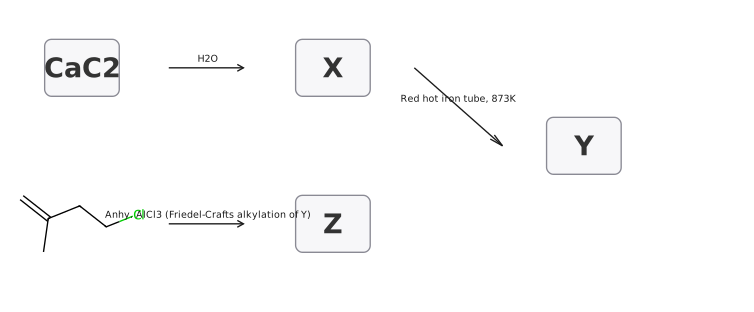
›Reveal solutionSolution
The reaction sequence is CaC2→ acetylene → (cyclic trimerization) benzene → (Friedel–Crafts alkylation, with carbocation rearrangement) an alkylbenzene. Counting hybrid orbitals in the major product gives sp3:sp2=2:3.
Concept and Intuition
This question strings together three classic named reactions: (1) the reaction of calcium carbide with water to give acetylene, (2) the cyclic trimerization of acetylene over a red-hot iron catalyst to give benzene, and (3) Friedel–Crafts alkylation of benzene, in which a primary alkyl-halide-derived carbocation is never used "as drawn" — it rearranges (via a hydride or alkyl shift) to whatever more stable carbocation is accessible, before it ever attacks the aromatic ring. This rearrangement is one of the best-known caveats of Friedel–Crafts alkylation.
Step-by-Step Solution
- CaC2+2H2O→Ca(OH)2+C2H2: so X=C2H2 (acetylene, ethyne).
- Passing ethyne through a red-hot iron tube at 873 K causes cyclic polymerization: 3C2H2→C6H6 (benzene). So Y=C6H6.
- Benzene + a primary alkyl chloride + anhydrous AlCl3 is a Friedel–Crafts alkylation. AlCl3 abstracts Cl− from the alkyl chloride to generate a carbocation.
- A primary carbocation is highly unstable; before it attacks the aromatic ring, it rearranges via a hydride shift to the nearest, more stable secondary carbocation.
- This rearranged (secondary) carbocation is what actually attacks the benzene ring, so the major product Z is the branched alkylbenzene (analogous to the textbook case of n-propyl chloride + AlCl3/benzene giving predominantly cumene, isopropylbenzene, rather than n-propylbenzene) — an aromatic ring bearing a branched alkyl substituent whose point of attachment carbon is now secondary. …
- AP EAPCET 2025Set eng-2025-05-21-AN1 markMCQQ.In the structure of diborane, the number of 2-centre-2-electron bonds is X and 3-centre-2-electron bonds is Y. The value of (X + Y) is (A) 5 (B) 6 (C) 4 (D) 8
›Reveal solutionSolution
This tests the classic bonding picture of diborane: 4 ordinary terminal B–H (2c-2e) bonds plus 2 bridging B–H–B (3c-2e) "banana" bonds, giving X+Y=4+2=6.
Concept and Intuition
Diborane (B2H6) is electron-deficient — there are not enough valence electrons for every B–H linkage to be a normal shared electron-pair bond. Its structure resolves this with two different bond types: four TERMINAL B–H bonds (two on each boron) that are perfectly normal 2-centre-2-electron bonds, and two BRIDGING hydrogens that each simultaneously bond to both borons using just one pair of electrons spread over three atoms — the famous 3-centre-2-electron "banana" bonds that hold the two BH2 units together.
Step-by-Step Solution
- Diborane's structure: each boron is bonded to 2 terminal H atoms (4 terminal H total) and shares 2 bridging H atoms with the other boron.
- Terminal B–H bonds: there are 4 of these (2 per boron), each a normal 2-centre-2-electron (2c-2e) bond. So X=4.
- Bridging B–H–B bonds: there are 2 bridge hydrogens, each forming a 3-centre-2-electron (3c-2e) bond spanning both borons and the one hydrogen. So Y=2.
- X+Y=4+2=6.
Common Mistakes …
- AP EAPCET 2025Set ap-2025-05-20-FN1 markMCQQ.Match the following List-I (complex) — List-II (hybridisation) A) [CoF6]3− — I) dsp2 B) [NiCl4]2− — II) d2sp3 C) [Ni(CN)4]2− — III) sp3 D) [Co(NH3)6]3+ — IV) sp3d2 The correct answer is (A) A-IV, B-I, C-III, D-II (B) A-II, B-I, C-III, D-IV (C) A-IV, B-III, C-I, D-II (D) A-II, B-III, C-I, D-IV
›Reveal solutionSolution
Matching each complex to its hybridisation using ligand field strength and metal d-electron count gives A-IV, B-III, C-I, D-II.
Concept and Intuition
Valence bond theory predicts hybridisation from whether a ligand is weak-field (high spin, uses outer d-orbitals or simple sp3/sp3d2 geometry) or strong-field (low spin, uses inner (n−1)d orbitals, e.g. dsp2/d2sp3). F⁻ and Cl⁻ are weak-field ligands; CN⁻ and NH₃ (for Co³⁺ specifically) are strong-field ligands.
Step-by-Step Solution
- A) [CoF6]3−: Co3+ is d6; F⁻ is weak field ⇒ high-spin, outer-orbital octahedral complex, hybridisation sp3d2 = IV.
- B) [NiCl4]2−: Ni2+ is d8; Cl⁻ is weak field, and with 4 ligands (no strong field to pair electrons) gives tetrahedral geometry, hybridisation sp3 = III.
- C) [Ni(CN)4]2−: Ni2+ is d8; CN⁻ is a strong-field ligand, forcing pairing of the two unpaired d-electrons, giving a square planar geometry, hybridisation dsp2 = I. …
- AP EAPCET 2023Set ap-2023-05-22-AN1 markMCQQ.Identify the correctly matched pair from the following (A) C−C --------120 pm (B) C=C --------110 pm (C) C≡C --------154 pm (D) C–C Bond length in Benzene --------139 pm
›Reveal solutionSolution
Of the four bond-length claims, only benzene's C–C bond length of 139 pm (intermediate between single and double bonds due to aromatic delocalization) is correct.
Concept and Intuition
Bond length decreases as bond order increases (more shared electron pairs pull the nuclei closer): a C–C single bond (~154 pm) is longer than a C=C double bond (~134 pm), which is longer than a C≡C triple bond (~120 pm). Benzene's bonds are all equal and intermediate (~139 pm) because of resonance delocalization of the π electrons around the ring — it's neither a pure single nor double bond.
Step-by-Step Solution
- (A) claims C–C = 120 pm — this is actually close to the triple bond length, not the single bond length (~154 pm). Incorrect.
- (B) claims C=C = 110 pm — the real C=C double bond length is about 134 pm. Incorrect.
- (C) claims C≡C = 154 pm — the real triple bond length is about 120 pm (this is actually the single-bond value, swapped). Incorrect. …
- AP EAPCET 2023Set eng-2023-05-16-FN1 markMCQQ.Hybridization of positively charged and negatively charged carbons of the following respectively are (CH3)3C+ CH3C≡C− (A) sp2, sp (B) sp2, sp2 (C) sp3, sp3 (D) sp3, sp2
›Reveal solutionSolution
Tests hybridization of a carbocation vs. a carbanion in a triple-bond system. Answer: sp2 for the cation, sp for the anion (option A).
Concept and Intuition
Hybridization of a charged carbon is decided by the number of sigma-bonded/lone-pair "electron domains" around it. A carbocation with 3 sigma bonds and an empty orbital is sp2 (trigonal planar, like a carbon in an alkene minus one substituent). A carbanion that is part of a triple bond (as in an acetylide) already uses two of its hybrid orbitals for the two sigma bonds that make up part of the triple-bond framework — its geometry stays linear, so it remains sp hybridized, with the negative charge (lone pair) occupying an sp orbital, giving high s-character and hence high electronegative character (this is why terminal alkynes are acidic).
Step-by-Step Solution
- (CH3)3C+: central carbon bonded to 3 methyl groups via 3 sigma bonds, with an empty p orbital — 3 regions of electron density around it → sp2 hybridization, trigonal planar geometry. …
- AP EAPCET 2023Set eng-2023-05-17-AN1 markMCQQ.Match the following List-I (Molecule/ion) : List II (Number of lone pairs of electrons on the central atom) A) XeF2 : I) 2 B) XeO3 : II) 0 C) XeF4 : III) 3 D) PF6− : IV) 1 The correct answer is (A) A-III, B-IV, C-I, D-II (B) A-I, B-II, C-IV, D-III (C) A-II, B-I, C-III, D-IV (D) A-III, B-IV, C-II, D-I
›Reveal solutionSolution
Counting lone pairs via VSEPR gives XeF2=3, XeO3=1, XeF4=2, PF6-=0, matching List-II items III, IV, I, II respectively.
Concept and Intuition
For a central atom, total electron domains = bond pairs + lone pairs. Xenon starts with 8 valence electrons; each bond to F or O (Xe=O counted as one domain) uses one domain. Electrons not used in bonding remain as lone pairs. For PF6−, phosphorus's 5 valence electrons plus 1 extra from the negative charge give 6 pairs, all used in 6 P-F bonds.
Step-by-Step Solution
- XeF2: Xe (8 e-) makes 2 bond pairs, leaving 6 e- = 3 lone pairs (AX2E3, linear).
- XeO3: 3 Xe=O bonds use 3 domains, leaving 2 electrons = 1 lone pair (AX3E1, pyramidal).
- XeF4: 4 Xe-F bonds, leaving 4 electrons = 2 lone pairs (AX4E2, square planar). …
- AP EAPCET 2023Set eng-2023-05-18-AN1 markMCQQ.The hybridization of central atom of ClF3, NH3, SO3 are respectively (A) sp2,sp2,sp2 (B) sp3d,sp3,sp2 (C) sp2,sp3,sp3d (D) sp3d,sp3,sp3
›Reveal solutionSolution
Counting electron domains on the central atom of each molecule gives hybridisations sp3d (ClF₃), sp3 (NH₃), sp2 (SO₃).
Concept and Intuition
Hybridisation of a central atom is determined by the total number of electron domains (sigma bonds + lone pairs) around it, per VSEPR theory — not by the number of atoms bonded alone. Lone pairs count just as much as bonding pairs toward the domain total.
Step-by-Step Solution
- ClF3: Cl (7 valence electrons) forms 3 Cl–F sigma bonds and retains 2 lone pairs ⇒3+2=5 domains ⇒sp3d (T-shaped molecule).
- NH3: N forms 3 N–H sigma bonds and retains 1 lone pair ⇒3+1=4 domains ⇒sp3 (pyramidal).
- SO3: S forms 3 S=O bonds (with no lone pair left on S in the resonance-averaged structure) ⇒3 domains ⇒sp2 (trigonal planar). …
- AP EAPCET 2022Set ap-2022-07-12-AN1 markMCQQ.Assertion (A): Carbon can form pπ−pπ bonds with itself and with other small sized and high electronegative atoms. Reason (R): Other heavier elements of group 14 can also form pπ−pπ bonds. (A) Both (A) and (R) are correct and R is the correct explanation of A (B) Both (A) and (R) are correct, but R is not the correct explanation of A (C) (A) is correct but (R) is not correct (D) (A) is incorrect but (R) is correct
›Reveal solutionSolution
Carbon uniquely forms strong pπ-pπ bonds due to its small size and good orbital overlap, but heavier Group 14 elements cannot — so the Assertion is true and the Reason is false.
Concept and Intuition
Effective pπ−pπ (sideways) orbital overlap requires the two overlapping p-orbitals to be of comparable, small size, so their lobes can overlap efficiently at bonding distance. Carbon's small atomic radius makes this overlap strong (as in C=C, C=O, C=N). Descending group 14 (Si, Ge, Sn, Pb), atomic and orbital sizes increase substantially, degrading this overlap, so these elements essentially cannot form stable π bonds with themselves the way carbon can — they instead tend to catenate via single bonds or adopt higher coordination numbers.
Step-by-Step Solution
- Assess Assertion: carbon (2p orbitals, small size) readily forms π bonds with itself (C=C) and with other small electronegative atoms like N, O (C=N, C=O) via good pπ-pπ overlap. This is a well-established fact. TRUE. …
- AP EAPCET 2022Set eng-2022-07-05-FN1 markMCQQ.Calcium carbide + D2O→X+Ca(OD)2. The hybridization of carbon atom/s in X (A) sp2 (B) sp (C) sp3 (D) dsp2
›Reveal solutionSolution
Calcium carbide's hydrolysis (here with heavy water) gives (deutero)acetylene, whose carbons are triple-bonded and therefore sp hybridized — the isotope substitution (D for H) doesn't change the hybridization at all.
Concept and Intuition
Calcium carbide contains the carbide ion C22− (:C≡C:2−), which on hydrolysis picks up two protons (or deuterons) to form acetylene (HC≡CH) or its deuterated analogue (DC≡CD). Isotopic substitution (H → D) changes mass but not electronic structure or bonding, so the hybridization of carbon is unaffected.
Step-by-Step Solution
- Balanced reaction: CaC2+2D2O→C2D2+Ca(OD)2 (mirrors CaC2+2H2O→C2H2+Ca(OH)2).
- X =C2D2, structurally D−C≡C−D.
- Each carbon forms one σ bond to D, one σ bond to the other C, and two π bonds to the other C (triple bond) — 2 σ regions of electron density around each C. …
🎓Unlock everything free for 14 days
- ✓Full step-by-step solutions
- ✓Concept-first explanations
- ✓Methods, shortcuts & mistakes
- ✓PYQ mapping + timed mock tests
Full access for 14 days. No credit card required.