Q.A football is kicked into the air vertically upwards. What is its
🔒You're viewing a preview — the full solution, concept, methods & PYQ mapping are locked.
🔒 Start your 14-day free trial to unlock the full solution →Concept understanding — Projectile Motion Under Gravity
Projectile Motion Under Gravity
Imagine you throw a ball to a friend. It doesn't travel in a straight line — it curves upward, then arcs downward. That curve is a parabola, and the motion is called projectile motion.
The key insight: once the ball leaves your hand, the only force acting on it (ignoring air resistance) is gravity pulling it straight down. There is no force pushing it sideways or upward after release. That single downward force is what creates the beautiful curved path.
The Core Idea
A projectile is any object that is thrown, launched, or otherwise projected into the air and then moves under the influence of gravity alone. The motion has two independent parts happening simultaneously:
- Horizontal motion: constant speed (no horizontal force)
- Vertical motion: constant downward acceleration g≈9.8m/s2
These two motions are completely independent — they don't affect each other. This is the most important thing to understand.
The horizontal and vertical motions are independent. The horizontal speed stays constant; the vertical speed changes by 9.8m/s every second downward.
Breaking It Down Mathematically
Let's set up coordinates: x is horizontal, y is vertical (positive upward). The launch point is at (0,0) with initial speed u at angle θ above horizontal.
Initial velocity components:
ux=ucosθ
uy=usinθ
Horizontal motion (no acceleration):
x=uxt=(ucosθ)t
Vertical motion (constant downward acceleration g):
y=uyt−21gt2=(usinθ)t−21gt2
The minus sign is because gravity pulls downward, opposite to our positive y direction.
The Path Is a Parabola
Eliminate t between the x and y equations. From x=uxt, we get t=ucosθx. Substitute into the y equation:
y=(usinθ)(ucosθx)−21g(ucosθx)2
y=xtanθ−2u2cos2θgx2
This is of the form y=ax−bx2, which is a parabola opening downward. That's why every projectile under gravity follows a parabolic path.
y=xtanθ−2u2cos2θgx2
Key Quantities You'll Need
Time of Flight (T)
The total time the projectile stays in the air. Set y=0 (returns to launch height):
0=(usinθ)T−21gT2
Factor T: T(usinθ−21gT)=0
The non-zero solution:
T=g2usinθ
Maximum Height (H)
The highest point occurs when vertical velocity becomes zero: vy=usinθ−gt=0, so t=gusinθ.
Plug into y equation:
H=(usinθ)(gusinθ)−21g(gusinθ)2
H=gu2sin2θ−2gu2sin2θ=2gu2sin2θ
Range (R)
Horizontal distance traveled when it returns to launch height. Use x=uxT:
R=(ucosθ)⋅g2usinθ=g2u2sinθcosθ
Using sin2θ=2sinθcosθ:
R=gu2sin2θ
Maximum range occurs when sin2θ=1, i.e., 2θ=90∘ or θ=45∘. At this angle, Rmax=gu2.
Common Mistakes to Avoid
- Don't mix up horizontal and vertical equations. Horizontal has constant speed; vertical has constant acceleration. …
Concept: Projectile Motion Under Gravity
A ball thrown vertically upward is subject only to gravity throughout its flight, including at the highest point.
- Acceleration at the highest point: Gravity acts continuously downward with magnitude g=9.8m/s2 (or 10m/s2 approximately). At every instant during the motion—rising, at the peak, or falling—the acceleration remains a=−gj^ (taking upward as positive). The highest point is no exception; the ball is still in free fall.
- Velocity at the highest point: …
At every point of its flight—including the highest point—the ball experiences constant downward acceleration g≈9.8m/s2 due to gravity. The velocity at the highest point is zero (the ball stops momentarily before falling back), but the acceleration never vanishes.
Why acceleration persists even when velocity is zero
A common intuition says "if something stops, nothing is acting on it." That intuition fails here. Acceleration measures how quickly velocity changes, not whether the object is moving. Gravity pulls on the football throughout its journey—on the way up, at the peak, and on the way down—so the acceleration is the same everywhere: a=−gj^ (taking upward as positive).
The highest point is special only because the velocity passes through zero there. The ball decelerates (slows down) while rising, reaches zero speed at the top, then accelerates downward. The agent causing that deceleration and subsequent fall is gravity, which never switches off.
Step-by-step reasoning
- Identify the force acting on the ball. Once the ball leaves the foot, the only force is gravity (we neglect air resistance). By Newton's second law, F=ma, so
a=mFgravity=m−mgj^=−gj^.
This acceleration is constant in magnitude and direction throughout the flight.
-
Recognize that acceleration does not depend on velocity.
Gravity acts whether the ball is moving fast, slow, or not at all. At the highest point the velocity is zero, but F=ma still holds with F=−mgj^, so a=−gj^ there too.
-
Find the velocity at the highest point.
"Highest point" means the ball has stopped rising and is about to fall. At that instant the vertical component of velocity is zero:
vtop=0. …
Concept: Read Both Answers Off a Single v-t Line
Method: Velocity-Time Graph (Slope = Acceleration; Zero-Crossing = the Highest Point) -- No Force Argument Needed
Rather than invoking Newton's second law and separately arguing "acceleration doesn't switch off," this method sketches the vertical velocity v(t)=u−gt as a straight line on a v-t graph and reads both answers directly off its geometry: the graph's constant slope gives the acceleration everywhere, and the graph's zero-crossing gives the velocity at the highest point, as a single picture.
Step 1 -- Plot v(t)=u−gt as a straight line
Taking upward as positive, with u the launch speed: at t=0, v=u>0 (moving up); as t increases, v decreases linearly, crosses zero at some time t∗, and continues into negative values (moving down) beyond that. This is one continuous straight line on the v-t plane, with no kink, break, or change in slope anywhere -- including right at the point where it crosses the time axis.
Step 2 -- Read acceleration off the slope, everywhere on the line
The slope of a v-t graph is, by definition, the acceleration:
slope=dtdv=−g
Since the graph is one unbroken straight line with a single constant slope, the acceleration equals −g (magnitude g, downward) at literally every point on the graph -- including the point where v=0. A straight line's slope does not change value just because the line happens to cross the horizontal axis at that point; the slope is a property of the whole line, not of any one point on it.
Step 3 -- Read the velocity at the highest point directly as the graph's zero-crossing
"Highest point" is, by definition, the instant the ball stops rising and is about to start falling -- exactly the instant the v-t graph crosses from positive to negative, i.e. its zero-crossing. Solving 0=u−gt∗ gives t∗=u/g, and by construction of the graph, v(t∗)=0. …
Showing the 12 most recent of 14 on this concept.
- AP EAPCET 2026Set eng-2026-05-12-AN1 markMCQQ.If the vertical displacement of a body projected at an angle with the horizontal during the first second of its motion is 15 m, then the maximum height reached by it is (acceleration due to gravity = 10 ms−2) (A) 80 m (B) 60 m (C) 40 m (D) 20 m
›Reveal solutionSolution
The vertical displacement in the first second lets us back out the initial vertical velocity component, from which the maximum height follows directly. The answer is 20 m.
Concept and Intuition
For projectile motion, the vertical component behaves exactly like a ball thrown straight up with initial speed uy=usinθ. The displacement equation y=uyt−21gt2 applies regardless of the horizontal motion, so the given 15 m displacement in the first second is purely a vertical-motion fact that isolates uy.
Step-by-Step Solution
- Vertical displacement in time t: y=uyt−21gt2.
- Substitute t=1 s, y=15 m, g=10 ms−2: 15=uy(1)−21(10)(1)=uy−5.
- Solve: uy=20 ms−1. …
- AP EAPCET 2026Set eng-2026-05-14-AN1 markMCQQ.A balloon is raising vertically upwards with a velocity of 10 ms−1. When the balloon is at a height of 40 m from the ground, a stone is dropped from it. The time taken by the stone to reach the ground is (Acceleration due to gravity = 10 ms−2) (A) 10 s (B) 6 s (C) 8 s (D) 4 s
›Reveal solutionSolution
Tests projectile motion with a non-zero initial velocity (the stone inherits the balloon's upward velocity at the instant of release); the answer is 4 s.
Concept and Intuition
When the stone is 'dropped' from a moving balloon, it does NOT start from rest in the ground frame — it carries the balloon's instantaneous velocity at that moment, which is 10 ms−1 upward. After release, only gravity acts on it, so it first decelerates, rises a bit further, then falls back down past the release point and continues to the ground, 40 m below.
Step-by-Step Solution
- Set up a coordinate system with the release point as origin, upward positive.
- Initial velocity u=+10 ms−1, acceleration a=−10 ms−2 (gravity acts downward).
- The ground is 40 m below the release point, so the net displacement when the stone lands is s=−40 m.
- Use s=ut+21at2: −40=10t−5t2 …
- AP EAPCET 2025Set eng-2025-05-21-AN1 markMCQQ.If a ball projected vertically upwards with certain initial velocity from the ground crosses a point at a height of 25 m twice in a time interval of 4 s, then the initial velocity of the ball is (Acceleration due to gravity =10 ms−2) (A) 20 ms−1 (B) 30 ms−1 (C) 40 ms−1 (D) 25 ms−1
›Reveal solutionSolution
A projectile crosses a given height twice on the way up and down; the sum and product of those two times are fixed by u and h. Solving with the given 4 s gap gives u=30 m/s, option (B).
Concept and Intuition
For vertical motion under gravity, height as a function of time is y=ut−21gt2. Setting y=h (a fixed height reached twice — once going up, once coming down) gives a quadratic in t whose two roots t1,t2 are exactly those two crossing times. By Vieta's formulas for 21gt2−ut+h=0: sum of roots =2u/g, product of roots =2h/g. Knowing the difference of the roots (the time interval between the two crossings) then lets us solve for u.
Step-by-Step Solution
- Height equation: h=ut−21gt2 ⇒ 21gt2−ut+h=0, or t2−g2ut+g2h=0.
- Let the two crossing times be t1,t2 with t2>t1. Then:
- t1+t2=g2u
- t1t2=g2h
- We're given t2−t1=4 s. Use the identity (t2−t1)2=(t1+t2)2−4t1t2:
16=(g2u)2−4⋅g2h=g24u2−g8h.
- Substitute g=10 ms−2, h=25 m: …
- AP EAPCET 2025Set ap-2025-05-19-AN1 markMCQQ.A body of mass 2 kg starts moving from the origin (0, 0) with an initial velocity of (4i^+4j^) m s−1. A constant force of −20j^ N is applied on the body. When the Y-coordinate of the position of the body becomes zero again, then its X-coordinate is (A) 3.2 m (B) 4.2 m (C) 2.4 m (D) 2.8 m
›Reveal solutionSolution
This tests 2D kinematics under a constant force, analogous to projectile motion but with the roles of the axes swapped (constant velocity along x, decelerating-then-reversing motion along y). The answer is (A) 3.2 m.
Concept and Intuition
Since the only force applied is along −j^, the motion along the x-axis is completely unaffected (zero acceleration), so the x-velocity remains at its initial value throughout. Along y, the initial upward velocity is progressively cancelled and reversed by the constant "downward" force, analogous to projectile motion — the body's y-coordinate returns to zero exactly when this decelerating motion has run its full symmetric course (twice the time to reach the peak).
Step-by-Step Solution
- Acceleration: a=F/m=(−20j^)/2=−10j^ m/s2, so ax=0, ay=−10 m/s2.
- x-motion (no acceleration): x(t)=vx0t=4t. …
- AP EAPCET 2025Set ap-2025-05-19-FN1 markMCQQ.If a body is thrown vertically upwards from the ground with a velocity of 20 ms−1, then its displacement during the last second of upward motion is (Acceleration due to gravity =10 ms−2) (A) 5 m (B) 10 m (C) 15 m (D) 20 m
›Reveal solutionSolution
The last-second-of-ascent displacement is found by subtracting the displacement at t=1s from that at t=2s (the moment of maximum height). Answer: (A) 5 m.
Concept and Intuition
For a body thrown vertically upward with initial speed u under gravity g, it decelerates uniformly, momentarily coming to rest at the top of its trajectory at time ttop=u/g. The displacement at any time t (measured from the point of projection, taking upward as positive) is given by:
s(t)=ut−21gt2
The 'displacement during the last second of upward motion' is the distance covered between t=ttop−1 and t=ttop.
Step-by-Step Solution
- Compute the time to reach maximum height: ttop=u/g=20/10=2 s.
- Compute displacement at t=1 s: s(1)=20(1)−21(10)(1)2=20−5=15 m.
- Compute displacement at t=2 s (the top): s(2)=20(2)−21(10)(2)2=40−20=20 m.
- Displacement during the last second of upward motion (between t=1s and t=2s) =s(2)−s(1)=20−15=5 m. …
- AP EAPCET 2025Set eng-2025-05-26-FN1 markMCQQ.A ball projected vertically upwards with a velocity 'v' passes through a point P in its upward journey in a time of 'x' seconds. From there, the time in which the ball again passes through the same point P is (A) 2gv (B) g2v−x (C) 2gv−x (D) 2(gv−x)
›Reveal solutionSolution
This tests the time-symmetry of vertical projectile motion: the ball spends equal time above and below any fixed height P around the instant it reaches maximum height, so the two crossing times are mirror images about t=v/g.
Concept and Intuition
Under constant deceleration g, height as a function of time y(t)=vt−21gt2 is a downward parabola symmetric about its vertex at t=v/g (the instant of maximum height). Any horizontal line y=yP intersects this parabola at two times that are symmetric about the vertex — that's the key fact used here, rather than solving the quadratic explicitly.
Step-by-Step Solution
- Time of maximum height: T=gv.
- The ball first passes P (going up) at t=x. By the parabola's symmetry about t=T, it passes P again (coming down) at t′=2T−x=g2v−x. …
- AP EAPCET 2024Set eng-2024-05-21-FN1 markMCQQ.An object projected upwards from the foot of a tower. The object crosses the top of the tower twice with an interval of 8 s and the object reaches foot after 16 s. The height of the tower is [g = 10 ms−2] (A) 220 m (B) 240 m (C) 640 m (D) 80 m
›Reveal solutionSolution
Using the total time of flight to find launch speed, then symmetry of the two tower-crossing instants about the time of maximum height, the tower height comes out to 240 m.
Concept and Intuition
For a body thrown up and returning to the same launch point, its trajectory (height vs time) is a downward parabola, symmetric about the instant of maximum height ttop=u/g. Any horizontal line (a fixed height like the tower's top) is crossed at two times equally spaced before and after ttop.
Step-by-Step Solution
- Total time to go up and return to the foot: T=16s, so initial speed u=2gT=210×16=80 ms−1.
- Time to reach maximum height: ttop=u/g=80/10=8s.
- The tower's top is crossed twice with the two instants separated by 8 s and symmetric about ttop=8s, so the crossings are at t1=8−4=4s and t2=8+4=12s. …
- AP EAPCET 2023Set ap-2023-05-23-AN1 markMCQQ.A juggler throws balls vertically into air such that, he throws the next ball when the previous one is at its highest point. If he throws 3 balls each second then the maximum height reached by each ball is (Acceleration due to gravity = 10ms−2) (A) 910m (B) 92m (C) 94m (D) 95m
›Reveal solutionSolution
The interval between throws (1/3 s, from '3 balls per second') equals the time each ball takes to rise to its peak, which fixes the launch speed and hence the maximum height at 5/9 m.
Concept and Intuition
A ball thrown vertically upward with speed u takes time trise=u/g to reach its highest point (where velocity momentarily becomes zero). The juggler's timing condition — 'throw the next ball exactly when the previous one is at its highest point,' combined with 'throws 3 balls each second' (so the time between successive throws is 1/3 s) — directly tells us trise=1/3 s for every ball.
Step-by-Step Solution
- Frequency of throwing = 3 balls/second ⇒ time between successive throws =31 s.
- This interval equals the rise time of each ball to its peak: trise=31 s.
- Using v=u−gtrise with v=0 at the top: u=gtrise=10×31=310 m/s. …
- AP EAPCET 2023Set eng-2023-05-17-FN1 markMCQQ.Among the following, velocity(v) - time (t) graph representing the motion of a vertically projected body is (A) [FIGURE] (a v-t graph showing a small tent/triangular shape entirely above the t-axis near the origin: v rises from zero to a peak then falls back to zero, arrows on the rising and falling segments) (B) [FIGURE] (a v-t graph showing a single straight line with constant negative slope, starting at a high positive v on the v-axis, passing through the origin region, and continuing into negative v values below the t-axis; downward-pointing arrows on the line) (C) [FIGURE] (a v-t graph showing two triangles meeting at a single point on the t-axis, forming a bowtie/hourglass shape: an upper triangle above the axis with the line declining to that point, and a lower triangle below the axis diverging from the same point, with arrows on the segments) (D) [FIGURE] (a v-t graph showing a line declining from a high v on the v-axis down to zero at the t-axis, then rising again beyond that point to a value higher than where it started, with arrows on the declining and rising segments)
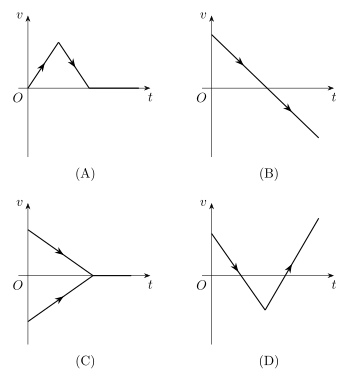
›Reveal solutionSolution
Since gravity gives constant acceleration throughout the whole motion (both the rise and the fall), the correct v-t graph must be one unbroken straight line of constant slope — that is option (B).
Concept and Intuition
For a body projected vertically (thrown straight up), the acceleration is −g at every instant of the motion — while going up, at the peak, and while coming back down. A constant acceleration means the velocity changes linearly with time throughout, with no change in slope. So the v-t graph must be one single straight line (starting positive, ending negative, or vice versa) — never a graph made of two differently-sloped segments, and never one that goes flat (implying zero acceleration) at any point during flight.
Step-by-Step Solution
- Take upward as positive. At the moment of projection, v=v0>0.
- Acceleration is a=−g (constant) throughout the flight — this doesn't change sign or magnitude between going up and coming down.
- So v(t)=v0−gt: a straight line with constant slope −g.
- This line starts at +v0, crosses zero at the highest point (t=v0/g), and continues to become negative as the body falls back down (speeding up downward).
- Compare with the options: (A) shows the line returning to a flat zero after falling — that would mean acceleration suddenly becomes zero, which is unphysical for constant gravity. (C) shows a kink/bowtie at the axis, implying a sudden change in slope — again unphysical. (D) shows the line reversing direction (bending back upward) after reaching a trough, implying a change in the sign or magnitude of acceleration — also unphysical. …
- AP EAPCET 2022Set ap-2022-07-12-FN1 markMCQQ.A ball of mass 1 kg is thrown from the top of a tower at t=0 with an initial velocity V=[10i^+20j^] ms−1. The change in potential energy of the ball between t=0 and t=5 s, while still freely falling is (Acceleration due to gravity = 10 ms−2) (A) -150 J (B) +50 J (C) -250 J (D) -275 J
›Reveal solutionSolution
This tests that only the vertical component of projectile motion affects gravitational PE, using ΔPE=mgΔy. Answer: −250 J.
Concept and Intuition
Potential energy near Earth's surface depends only on height, not on horizontal motion. Even though the ball has a horizontal velocity component 10i^, that plays no role in the PE calculation — only the vertical journey (rise then fall under gravity) matters.
Step-by-Step Solution
- Take upward as positive y, with y=0 at t=0 (launch point on the tower).
- Vertical velocity component at launch: vy0=20 ms−1 (upward).
- Vertical position: y(t)=vy0t−21gt2.
- At t=5s: y(5)=20(5)−21(10)(25)=100−125=−25 m.
- So the ball is 25m below the launch point at t=5s. …
- AP EAPCET 2021Set ap-2021-09-03-FN1 markMCQQ.For a body projected vertically upwards with a velocity v0 from the ground, match the following? Column-I:(a) vav (Average velocity)(b) uav (Average speed)(c) Tascent(d) Tdescent Column-II:(i) gv0(ii) 2v1+v2 over any time-interval(iii) 2v0 over the total time of its flight(iv) gv0 (A) (a-ii), (b-iii), (c-iv), (d-i) (B) (a-iii), (b-iv), (c-i), (d-ii) (C) (a-iv), (b-i), (c-ii), (d-iii) (D) (a-iv), (b-i), (c-iii), (d-ii)
›Reveal solutionSolution
This tests kinematics of vertical projectile motion under constant g: average velocity over any interval is always (v1+v2)/2, while average speed over the whole flight (up + down) works out to v0/2; both ascent and descent times equal v0/g.
Concept and Intuition
For motion with constant acceleration, the average velocity over ANY time interval [t1,t2] is exactly 2v(t1)+v(t2) — this is a general kinematic identity for uniformly accelerated motion, not something special to projectile motion. Average speed, however, is total distance travelled divided by total time, and for the round trip (up to the top and back down to the ground) the total distance is 2hmax while the total time is the full flight time T=2v0/g.
Step-by-Step Solution
- (a) Average velocity vav over any interval: for constant acceleration motion, vav=2v1+v2 — this matches item (ii) exactly.
- (b) Average speed uav over the total flight: Maximum height h=2gv02, so total distance travelled (up + down) =2h=gv02. Total time of flight T=g2v0. So uav=2v0/gv02/g=2v0 — this matches item (iii) exactly ("v0/2 over the total time of its flight").
- (c) Tascent: time to reach the highest point, where final velocity = 0: 0=v0−gTascent⇒Tascent=v0/g.
- (d) Tdescent: by symmetry of projectile motion under gravity (same g up and down), Tdescent=Tascent=v0/g as well. …
- AP EAPCET 2021Set ap-2021-09-07-FN1 markMCQQ.A bomb is dropped from an aeroplane flying horizontally with a velocity 720 kmph at an altitude of 980 m. The bomb will hit the ground after a time: (A) 1 s (B) 7.2 s (C) 14.15 s (D) 0.15 s
›Reveal solutionSolution
This is a projectile-motion question: the time to hit the ground for a horizontally launched projectile depends only on the vertical fall height, giving t≈14.14 s≈14.15 s.
Concept and Intuition
When an object is released with purely horizontal velocity (as from a plane flying level), its horizontal and vertical motions are independent. The horizontal velocity (720 km/h here) only determines how far it travels horizontally — it has no bearing on how long the fall takes. The time of fall is governed entirely by the vertical free-fall equation starting from rest in the vertical direction.
Step-by-Step Solution
- Vertical motion: initial vertical velocity =0 (horizontal flight), height h=980 m, so h=21gt2.
- Solve for t: t=g2h=9.82×980=9.81960=200.
- 200≈14.142 s, which rounds to 14.15 s among the given options. …
🎓Unlock everything free for 14 days
- ✓Full step-by-step solutions
- ✓Concept-first explanations
- ✓Methods, shortcuts & mistakes
- ✓PYQ mapping + timed mock tests
Full access for 14 days. No credit card required.