Q.A gun can fire shells with a maximum speed v0. On level ground the greatest horizontal range it can achieve (firing at 45∘) is R=gv02. A target lies farther away, a distance Δx beyond R — that is, at a horizontal distance R+Δx from the gun. Show that this target can still be hit with the same gun by raising the gun to a height of at least
[!FORMULA]
h=Δx[1+RΔx].
(Approach: place the gun at the top of a tower of height h; take the launch point as the origin with x horizontal and y vertically upward. The target then sits at x=R+Δx and y=−h. Fire at the angle that maximises horizontal reach, 45∘.)
🔒You're viewing a preview — the full solution, concept, methods & PYQ mapping are locked.
🔒 Start your 14-day free trial to unlock the full solution →Concept understanding — Projectile Motion
Projectile Motion — From Intuition to Precision
Imagine you throw a ball to a friend. It doesn't travel in a straight line — it rises, slows down, then curves downward and falls. That curved path is a projectile's trajectory. The ball is a projectile: any object that is launched into the air and then moves only under the influence of gravity (and air resistance, which we ignore for now).
The key intuition: once the ball leaves your hand, the only force acting on it is gravity pulling it straight down. There is no forward force after release. The ball keeps moving forward because of inertia — it wants to keep going in a straight line at constant speed. But gravity keeps pulling it down, so the forward motion and downward acceleration combine to produce a curved path.
The Precise Statement
Projectile motion is the two-dimensional motion of an object launched into the air, subject only to the constant downward acceleration due to gravity (g≈9.8m/s2). Air resistance is neglected.
We break the motion into two independent components:
- Horizontal motion: No acceleration (ax=0). So horizontal velocity vx is constant.
- Vertical motion: Constant downward acceleration (ay=−g). So vertical velocity vy changes linearly with time.
The independence of these components is the central idea — what happens vertically does not affect what happens horizontally, and vice versa.
The Equations (for a projectile launched with initial speed u at angle θ above horizontal)
First, resolve the initial velocity:
ux=ucosθ,uy=usinθ
Horizontal motion (constant velocity):
x=uxt=(ucosθ)t
Vertical motion (constant acceleration −g):
vy=uy−gt=usinθ−gt
y=uyt−21gt2=(usinθ)t−21gt2
Key Results You Must Know
Time of flight T: total time the projectile stays in the air (until y=0 again).
T=g2usinθ
Maximum height H: the highest vertical position reached (when vy=0).
H=2gu2sin2θ
Range R: the horizontal distance covered when it returns to launch height.
R=gu2sin2θ
The range is maximum when sin2θ=1, i.e., θ=45∘. For a given speed, 45∘ gives the farthest throw.
The Trajectory Equation (Path Shape)
Eliminate t from the x and y equations to get y as a function of x:
y=xtanθ−2u2cos2θgx2
This is a parabola — the signature shape of projectile motion.
Common Mistake to Avoid …
Raise the gun to height h and fire at 45∘ (the angle of maximum reach). Using the trajectory equation with v02=gR and demanding it pass through the target at (R+Δx,−h) gives h=R(R+Δx)2−(R+Δx)=Δx(1+RΔx). …
The gun's speed is fixed, so to reach farther than R we give the shell extra fall by raising the gun. Firing at 45∘ (maximum horizontal reach) from a tower of height h, we insert the target coordinates (R+Δx,−h) into the projectile's trajectory equation. Solving gives exactly h=Δx[1+Δx/R], and because 45∘ is optimal, no smaller height can work.
Concept
The launch speed cannot exceed v0, so on flat ground the farthest point is R=v02/g (at 45∘). To hit a point beyond R, we raise the launch point by h; the extra height gives the shell more time in the air, extending its horizontal travel. To need the smallest h, we should launch at the angle that carries the shell farthest horizontally, which is 45∘.
Setup and steps
Take the muzzle as origin, x horizontal, y upward. Launch at 45∘ with speed v0:
vx=v0cos45∘=2v0,vy=v0sin45∘=2v0.
The equation of the trajectory is
y=xtanθ−2v02cos2θgx2.
With θ=45∘ (tanθ=1, cos2θ=21) and using v02=gR:
y=x−2v02⋅21gx2=x−v02gx2=x−Rx2.
The target is on the ground a height h below the muzzle, at x=R+Δx, y=−h:
−h=(R+Δx)−R(R+Δx)2.
Therefore …
Concept: Use the Parabola's Vertex Form Instead of Plugging Directly Into the Standard Trajectory Equation
Method: Complete the Square on the 45∘ Trajectory
The direct method substitutes the target's coordinates straight into the standard trajectory formula and simplifies. This method first rewrites the 45∘ trajectory in vertex form (highlighting its peak point explicitly), then reads off the answer as a geometric offset from that peak.
Steps
- Write the 45∘ trajectory using v02=gR (from the given R=v02/g):
y=x−v02gx2=x−Rx2.
- Complete the square in x to expose the vertex (peak) explicitly:
y=−R1(x2−Rx)=−R1[(x−2R)2−4R2]=4R−R1(x−2R)2.
This vertex form confirms directly that the peak sits at (2R, 4R).
- Substitute the target's position, x=R+Δx, y=−h, into the vertex form:
−h=4R−R1(R+Δx−2R)2=4R−R1(2R+Δx)2.
- Expand the squared term (2R+Δx)2=4R2+RΔx+Δx2, so:
−h=4R−4R−Δx−RΔx2=−Δx−RΔx2.
- Flip the sign: h=Δx+RΔx2=Δx(1+RΔx). …
Showing the 12 most recent of 69 on this concept.
- AP EAPCET 2026Set eng-2026-05-14-FN1 markMCQQ.If the minimum velocity of a projectile during its motion is 40 ms−1 and the ratio of its vertical and horizontal displacements at a time of 2s is 1:2, then the angle of projection of the projectile is (Acceleration due to gravity =10 ms−2) (A) sin−1(0.6) (B) cos−1(0.6) (C) tan−1(0.6) (D) sec−1(0.6)
›Reveal solutionSolution
The minimum projectile speed equals the horizontal velocity component; combining that with the given displacement ratio at t=2s gives a 3-4-5 velocity triangle, so θ=sin−1(0.6).
Concept and Intuition
During projectile motion, the horizontal velocity component (ucosθ) stays constant throughout the flight, while the vertical component continuously changes (and is zero at the peak). The speed is minimum exactly at the peak, where the velocity is purely horizontal — so the minimum speed directly gives us ucosθ. Combined with a displacement-ratio condition at a specific time, we get two equations for usinθ and ucosθ, pinning down the angle via a right-triangle ratio.
Step-by-Step Solution
- Minimum velocity during projectile motion = horizontal component (constant throughout flight) = ucosθ=40 ms−1.
- At t=2s, horizontal displacement: x=(ucosθ)t=40×2=80 m.
- Given the ratio of vertical to horizontal displacement at t=2s is 1:2, so y=2x=40 m.
- Vertical displacement formula: y=usinθ⋅t−21gt2. Substituting t=2, g=10:
40=2usinθ−21(10)(4)=2usinθ−20
- Solve: 2usinθ=60⇒usinθ=30.
- Now we have ucosθ=40 and usinθ=30. So: u=(ucosθ)2+(usinθ)2=402+302=1600+900=2500=50 ms−1 …
- AP EAPCET 2026Set eng-2026-05-14-FN1 markMCQQ.A body is projected with a velocity of 153 ms−1 at an angle of 60∘ with the horizontal and another body is projected simultaneously from the same point in the same vertical plane with a velocity of 40 ms−1 at an angle of 30∘ with the horizontal. The time at which the velocity vector of the two bodies will be in the same direction is (Acceleration due to gravity =10 ms−2) (A) 3.2 s (B) 2.4 s (C) 1.2 s (D) 3.6 s
›Reveal solutionSolution
Setting the velocity-vector slopes of the two projectiles equal (same direction condition) and solving for t gives t=2.4 s.
Concept and Intuition
Two velocity vectors point in the same direction exactly when they are parallel, i.e. when their vertical-to-horizontal component ratios (slopes) are equal. Since each projectile's horizontal velocity is constant and its vertical velocity decreases linearly with time due to gravity, equating the two slopes as functions of t gives a single linear equation to solve.
Step-by-Step Solution
- Body A: uA=153 ms−1 at θA=60°.
- vxA=uAcos60°=153×21=7.53 (constant)
- vyA(t)=uAsin60°−gt=153×23−10t=215×3−10t=22.5−10t
- Body B: uB=40 ms−1 at θB=30°.
- vxB=uBcos30°=40×23=203 (constant)
- vyB(t)=uBsin30°−gt=40×21−10t=20−10t
- The velocity vectors are parallel (same direction) when the slopes match:
vxAvyA=vxBvyB⟹7.5322.5−10t=20320−10t
- The 3 cancels from both sides: 7.522.5−10t=2020−10t …
- Body A: uA=153 ms−1 at θA=60°.
- AP EAPCET 2026Set eng-2026-05-13-AN1 markMCQQ.A ball is projected upwards from the top of a tower with a velocity 50 ms−1 making an angle 30° with the horizontal. The height of tower is 70 m. After how many seconds from the instant of throwing, will the ball reach the ground? (g=10 ms−2) (A) 7 s (B) 9 s (C) 5 s (D) 2 s
›Reveal solutionSolution
Only the vertical component of the initial velocity matters for the time to reach the ground; solving the standard s=ut−21gt2 quadratic gives t=7 s — option (A).
Concept and Intuition
Projectile motion problems separate into independent horizontal and vertical components. Since we only need the time to hit the ground (not the horizontal range), only the vertical component of the initial velocity and the height of the tower matter — the 30° launch angle only tells us how to split the speed into components.
Step-by-Step Solution
- Vertical component of initial velocity: uy=50sin30°=50×0.5=25 ms−1 (upward).
- Take the top of the tower as origin, upward positive; ground is at displacement y=−70 m.
- Kinematics: y=uyt−21gt2⇒−70=25t−5t2.
- Rearrange: 5t2−25t−70=0⇒t2−5t−14=0.
- Solve the quadratic: t=25±25+56=25±81=25±9. …
- AP EAPCET 2026Set eng-2026-05-15-AN1 markMCQQ.An object is projected from the top of a tower of height 'H' at angle θ with horizontal. It strikes the ground at P lying at a distance D from the foot of the tower. Calculate the maximum height attained by the object (A) 2gv2sin2θ (B) H+4(H+Dtanθ)D2tan2θ (C) H+Dtanθ (D) H+vcosθD2
›Reveal solutionSolution
This tests eliminating the unknown launch speed v from projectile kinematics using the known landing distance D, to express the maximum height purely in terms of H, D, and θ. The answer is (B).
Concept and Intuition
The maximum height reached above the launch point in projectile motion is 2g(vsinθ)2 — but here v is not given directly. Instead we're given where the projectile lands (distance D from the tower's foot), so we must first use the full trajectory equation to solve for v2cos2θ in terms of known quantities, then substitute back.
Step-by-Step Solution
- Place the origin at the foot of the tower. The projectile starts at height H with velocity v at angle θ above horizontal.
- Horizontal: x=vcosθt. Vertical: y=H+vsinθt−21gt2.
- At landing, x=D and y=0: from the horizontal equation, t=vcosθD.
- Substitute into the vertical equation: 0=H+vsinθ⋅vcosθD−21g(vcosθD)2=H+Dtanθ−2v2cos2θgD2.
- Solve for v2cos2θ: 2v2cos2θgD2=H+Dtanθ⇒v2cos2θ=2(H+Dtanθ)gD2.
- Maximum height above the launch point is 2g(vsinθ)2=2gv2cos2θ⋅tan2θ (using vsinθ=vcosθtanθ). …
- AP EAPCET 2026Set eng-2026-05-18-FN1 markMCQQ.A cricketer can throw a ball with a speed of V0. If he throws the ball, while running with a speed V0, at an angle 'α' with the horizontal, then the range of the ball will be maximum when 'α' is (A) 45° (B) 30° (C) 60° (D) 53°
›Reveal solutionSolution
Because the cricketer's own running speed adds to the ball's horizontal component but not its vertical component, the range-maximizing angle shifts from the usual 45° down to 60°... actually up — let's see: maximizing sinα(1+cosα) gives α=60°.
Concept and Intuition
When a projectile is launched from a moving platform, its ground-frame velocity is the vector sum of the platform's velocity and the launch velocity relative to the platform. Here the horizontal component gets boosted by the runner's speed while the vertical component is unaffected, so the range formula is no longer the simple gV02sin2α and the optimal angle is not 45°.
Step-by-Step Solution
- Cricketer runs at speed V0 (horizontal) and throws the ball at speed V0 relative to himself, at angle α to the horizontal, in the plane of his run.
- Ground-frame velocity components of the ball: vx=V0+V0cosα=V0(1+cosα) vy=V0sinα
- Time of flight (ball returns to same height): T=g2vy=g2V0sinα.
- Range: R=vx⋅T=V0(1+cosα)⋅g2V0sinα=g2V02sinα(1+cosα).
- To maximize, differentiate f(α)=sinα+sinαcosα=sinα+21sin2α with respect to α: f′(α)=cosα+cos2α=0. …
- AP EAPCET 2026Set ap-2026-05-19-FN1 markMCQQ.A ball of mass 100 g is projected with velocity 20 ms−1 at 60∘ with horizontal. The decrease in kinetic energy of the ball during its entire upward journey is (A) 15 J (B) 20 J (C) Zero (D) 5 J
›Reveal solutionSolution
KE drops from 20 J (launch) to 5 J (top, only horizontal speed remains), a
decrease of 15 J. Answer: (A).
Concept and Intuition
In projectile motion, the vertical velocity component continuously decreases
under gravity and becomes zero exactly at the peak of the trajectory, while
the horizontal component stays constant throughout (no horizontal force in
ideal projectile motion). So the kinetic energy "lost" during the upward
journey is entirely due to the loss of the vertical velocity component — it
gets converted into gravitational potential energy.
Step-by-Step Solution
- Initial speed u=20 ms−1 at 60∘ to horizontal; mass m=0.1 kg =100 g.
- Initial KE =21mu2=21(0.1)(400)=20 J.
- At the highest point, vertical velocity =0; only ux=ucos60∘=10 ms−1 remains. …
- AP EAPCET 2026Set eng-2026-05-18-AN1 markMCQQ.An object is projected with an angle of 60° with horizontal with a velocity V. During the path, when it makes 30° with horizontal, its velocity becomes 10 ms−1, then V is (A) 103 ms−1 (B) 30 ms−1 (C) 310 ms−1 (D) 3 ms−1
›Reveal solutionSolution
The horizontal velocity component is conserved in projectile motion; equating it at launch and at the 30° point gives V=103 ms−1.
Concept and Intuition
In projectile motion (no air resistance), gravity acts only vertically, so the horizontal component of velocity, vx=vcosθ, never changes during the flight — it's the same at launch as at any other point on the trajectory.
Step-by-Step Solution
- At launch, the velocity is V at 60° to horizontal, so the horizontal component is
vx=Vcos60°=2V
- Later, when the velocity vector makes 30° with horizontal and has magnitude 10 ms−1, its horizontal component is
vx=10cos30°=10⋅23=53
- Since vx is conserved throughout the flight: …
- AP EAPCET 2026Set eng-2026-05-18-AN1 markMCQQ.As shown in figure, a particle slides on a frictionless track which terminates in a straight line horizontal section B. If the particle starts slipping from A, then the horizontal distance to be covered by the particle before it hits the ground after crossing B. [FIGURE] (a curved frictionless track: it starts at a raised point A at height h1=1 m above the ground, dips down to ground level, then rises again to a raised horizontal section at point B at height h2=21 m above the ground; the track ends at B, after which the particle becomes a projectile) (A) 0.5 m (B) 1 m (C) 1.5 m (D) 2 m
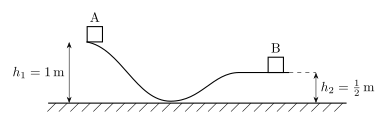
›Reveal solutionSolution
This combines energy conservation on a frictionless track with horizontal projectile motion after the particle leaves the track at B — the answer is a clean 1 m.
Concept and Intuition
On the frictionless track, only gravity does work, so mechanical energy is conserved from A to B. This gives the speed at B purely from the height drop h1−h2 (the shape of the track in between doesn't matter). Once the particle leaves the horizontal section at B, it becomes a projectile: it moves horizontally with the constant speed vB while falling freely under gravity from height h2. The horizontal range is simply (horizontal speed) × (time to fall).
Step-by-Step Solution
- Energy conservation, A to B (starting from rest at A): 21vB2=g(h1−h2), so vB2=2g(h1−h2)=2(10)(1−0.5)=10 m2/s2, giving vB=10 ms−1.
- At B, the track is horizontal, so the particle leaves with velocity vB purely horizontal, at height h2=0.5 m above the ground. …
- AP EAPCET 2026Set ap-2026-05-20-FN1 markMCQQ.The percentage decrease in range of a projectile projected at 30° when compared to maximum range is (A) 13.4 % (B) 25 % (C) 50 % (D) 75 %
›Reveal solutionSolution
Compare the range at 30∘ to the maximum range (at 45∘); the percentage decrease works out to 13.4%.
Concept and Intuition
For a projectile launched with speed u at angle θ, the horizontal range is R=gu2sin2θ. This is maximum when sin2θ=1, i.e. θ=45∘, giving Rmax=u2/g.
Step-by-Step Solution
- Rmax=gu2 (at θ=45∘).
- R30=gu2sin60∘=gu2(3/2)=23Rmax.
- 23≈0.8660. …
- AP EAPCET 2026Set ap-2026-05-20-AN1 markMCQQ.A bomber plane moves horizontally with a speed of 500 m s−1 and a bomb released from it strikes the ground in 10 sec. Angle with which it strikes the ground will be (g = 10 m s−2) (A) tan−1(51) (B) tan−1(21) (C) tan−12 (D) tan−15
›Reveal solutionSolution
Classic horizontal-projectile problem: the impact angle is found from the ratio of vertical to horizontal velocity components at landing. Answer: (A).
Concept and Intuition
A bomb released from a horizontally-moving plane undergoes projectile motion: the horizontal component of velocity never changes (no horizontal force acts, air resistance ignored), while the vertical component grows linearly under gravity from zero. The angle the resultant velocity makes with the horizontal (i.e., with the ground) at any instant is simply tan−1(vy/vx).
Step-by-Step Solution
- Horizontal velocity at impact: vx=u=500 ms−1 (unchanged).
- Vertical velocity at impact: vy=gt=10×10=100 ms−1.
- Angle with the ground: tanθ=vy/vx=100/500=1/5. …
- AP EAPCET 2025Set eng-2025-05-21-FN1 markMCQQ.If bullets are fired in all possible directions from same point with equal velocity of 10 ms−1 and with an angle of projection 45∘, then the area covered by the bullets on the ground is nearly (Acceleration due to gravity 10 ms−2) (A) 628 m2 (B) 314 m2 (C) 157 m2 (D) 79 m2
›Reveal solutionSolution
This tests recognizing that bullets fired at a fixed 45° elevation in all horizontal directions all land at the maximum range, tracing out a circle; the answer is (B).
Concept and Intuition
For projectile motion, range R=gu2sin2θ depends only on the elevation angle θ, not the azimuthal (compass) direction. If bullets are fired at θ=45∘ in every horizontal direction from the same point, each one travels the same range R (the maximum possible range, since sin90∘=1), so all the landing points trace out a full circle of radius R. The interior of this circle (all points reachable) is the region "covered," and geometrically its boundary here is exactly the locus of landing points at this fixed angle.
Step-by-Step Solution
- Range formula: R=gu2sin2θ.
- With θ=45∘: sin90∘=1, so R=gu2.
- Substitute u=10 m/s, g=10 m/s2: R=10100=10 m. …
- AP EAPCET 2025Set eng-2025-05-21-FN1 markMCQQ.A ball is projected from a point with a speed V0 at certain angle with the horizontal. From the same point and at the same instant, a person starts running with a constant speed 0.5V0 to catch the ball. If the person catches the ball after some time, then the angle of projection of the ball is (A) 60∘ (B) 30∘ (C) 45∘ (D) 53∘
›Reveal solutionSolution
This tests matching horizontal velocity components so a constant-speed runner can catch a projectile; the answer is (A).
Concept and Intuition
A person running at constant speed can only catch the ball if the ball's horizontal velocity component (which is constant throughout projectile motion, since there's no horizontal acceleration) exactly equals the runner's speed. If it didn't match, the horizontal gap between them would keep changing and could never close to zero except momentarily at the start.
Step-by-Step Solution
- The ball is projected with speed V0 at angle θ. Its horizontal velocity component is V0cosθ, and (crucially) this stays constant throughout the flight since there is no horizontal force.
- The person runs with constant speed 0.5V0 starting at the same instant and same point. …
🎓Unlock everything free for 14 days
- ✓Full step-by-step solutions
- ✓Concept-first explanations
- ✓Methods, shortcuts & mistakes
- ✓PYQ mapping + timed mock tests
Full access for 14 days. No credit card required.