Q.Three vectors A, B and C add up to zero. Find which is false.
🔒You're viewing a preview — the full solution, concept, methods & PYQ mapping are locked.
🔒 Start your 14-day free trial to unlock the full solution →Concept understanding — Triangle Inequality
Triangle Inequality (Bounding the Resultant of Two Vectors)
When you combine two displacements, two velocities, or two forces in "Motion in a Plane," you add them as vectors using the triangle law: place the tail of the second vector at the head of the first, and the resultant runs from the start to the finish. The triangle inequality is simply the statement that this resultant can never be longer than the two vectors laid end to end, and can never be shorter than their difference.
The Intuition
Suppose you walk 3 m in one direction, then 4 m in some other direction. Could you end up 8 m from where you started? No — the farthest you can possibly get is 3+4=7 m, and that only happens if both walks point the same way, so there's no bend at all (a "flat" triangle). The moment the second walk points in a different direction, a real corner appears, and cutting across that corner (the direct path) is always shorter than going via the corner. That's the geometric heart of every triangle: any one side is shorter than the sum of the other two, unless the triangle collapses onto a straight line.
The Precise Statement
For two vectors A and B added by the triangle law, the magnitude of the resultant R=A+B is bounded on both sides:
∣A∣−∣B∣≤∣A+B∣≤∣A∣+∣B∣
- The upper bound ∣A+B∣≤∣A∣+∣B∣ is reached only when A and B point in exactly the same direction (the angle between them is 0∘) — the triangle flattens out.
- The lower bound ∣A+B∣≥∣A∣−∣B∣ is reached only when A and B point in exactly opposite directions (the angle is 180∘).
- For any angle in between, the resultant magnitude lies strictly between these two limits.
This is the vector form of the ordinary triangle inequality ∣x+y∣≤∣x∣+∣y∣ you may already know for numbers: here x and y become vectors, and "the sides of a triangle" become "a vector, another vector, and their sum."
Why It Matters in Kinematics
This bound is genuinely useful when combining physical quantities in the plane:
- Relative velocity: if a boat has speed 5 m/s relative to water and the river flows at 3 m/s, the boat's speed relative to the ground must lie between ∣5−3∣=2 m/s and 5+3=8 m/s, depending on the angle the boat is steered — it can never be less than 2 or more than 8.
- Combining forces or displacements: if you know only the magnitudes of two vectors, not the angle between them, this inequality instantly tells you the range of possible resultant magnitudes without doing any trigonometry. …
Concept: Vector triple products and the constraint A+B+C=0.
Since A+B+C=0, we have C=−(A+B). The three vectors form a closed triangle (or are collinear).
Check each option:
(A) (A×B)×C lies in the plane of A and B by the BAC-CAB rule. It is zero only when A×B=0 (i.e., A∥B) or when C is parallel to A×B (i.e., C is perpendicular to the plane of A, B). The condition "B, C parallel" is neither necessary nor sufficient. False.
(B) (A×B)⋅C is the scalar triple product, which equals zero if and only if the three vectors are coplanar. Since they sum to zero, they always lie in a plane (the triangle they form). Thus (A×B)⋅C=0 always, regardless of whether B∥C. False.
(C) As noted, (A×B)×C lies in the plane of A and B, which is the same plane containing all three vectors. True. …
Since A+B+C=0 the three vectors are coplanar, so the scalar triple product (A×B)⋅C is identically zero. Statement (B) claims it is non-zero (unless B∥C), which is wrong. (B) is the false statement.
The key consequence of A+B+C=0
Three vectors summing to zero form a closed triangle, so they lie in one plane - they are coplanar. Also C=−(A+B).
Statement (B) - the false one
(A×B)⋅C is the scalar triple product, the volume of the parallelepiped on A,B,C. For coplanar vectors this volume is zero. Directly:
(A×B)⋅C=(A×B)⋅[−(A+B)]=−(A×B)⋅A−(A×B)⋅B=0,
because A×B is perpendicular to both A and B. It is always zero, not "non-zero unless B,C are parallel." Hence (B) is false.
Why the others are true
(A) By the triple-product identity (A×B)×C=B(A⋅C)−A(B⋅C). Its magnitude equals ∣A×B∣∣C∣ (as A×B⊥C), which vanishes only when A∥B; but with A+B+C=0 that forces all three collinear, i.e. B∥C as well. So the statement holds - (A) is true. …
Concept: Settle the Triple Products with One Concrete Coplanar Triangle
Method: Explicit Coordinate Construction (Pick Real Numbers for A,B,C), Not Symbolic BAC-CAB Expansion
Rather than expanding (A×B)×C symbolically via the BAC-CAB identity, this method picks one concrete, easy-to-visualize triple of vectors satisfying A+B+C=0 and computes every quantity in all four options directly as numbers -- turning an abstract vector-identity question into ordinary arithmetic.
Step 1 -- Build an explicit example
Since any three vectors summing to zero form a closed triangle, take a simple right triangle in the xy-plane:
A=3i^,B=3j^,C=−3i^−3j^
Check: A+B+C=(3−3)i^+(3−3)j^=0. Good -- this is a legitimate instance of the problem's hypothesis, and the three vectors are visibly coplanar (all lie in the xy-plane, with k^-component zero).
Step 2 -- Compute (A×B) once, reuse it in every option
A×B=(3i^)×(3j^)=9(i^×j^)=9k^
Step 3 -- Test option (B): (A×B)⋅C
9k^⋅(−3i^−3j^)=9(0)=0
The claim in (B) is that this is non-zero unless B,C are parallel -- but here B=3j^ and C=−3i^−3j^ are clearly not parallel (different directions), and yet the scalar triple product is exactly 0. This single computed number directly contradicts (B). (B) is false -- confirmed by direct arithmetic, no identity needed.
Step 4 -- Test option (A): (A×B)×C
9k^×(−3i^−3j^)=−27(k^×i^)−27(k^×j^)=−27j^−27(−i^)=27i^−27j^
This is manifestly non-zero, and B=3j^, C=−3i^−3j^ are not parallel in this example -- consistent with (A)'s claim.
Step 5 -- Test option (C): does (A×B)×C=27i^−27j^ lie in the plane of A,B,C?
All three original vectors lie in the xy-plane (zero k^-component); the computed result 27i^−27j^ also has zero k^-component. It lies in the same plane, consistent with (C)'s claim.
Step 6 -- Test option (D) …
- AP EAPCET 2025Set eng-2025-05-22-FN1 markMCQQ.The magnitudes of two vectors are A and B (A>B). If the maximum resultant magnitude of the two vectors is 'n' times their minimum resultant magnitude, then BA= (A) n−1n (B) nn+1 (C) n−1n2+1 (D) n−1n+1
›Reveal solutionSolution
Using max/min resultant =A±B and the given ratio n, algebra gives A/B=(n+1)/(n−1).
Concept and Intuition
Two vectors' resultant magnitude is largest when they point in the same direction (A+B) and smallest when they point in opposite directions (A−B, assuming A>B). Setting up the given ratio as an equation in A and B and solving for A/B is then pure algebra.
Step-by-Step Solution
- Maximum resultant: Rmax=A+B. Minimum resultant: Rmin=A−B.
- Given Rmax=nRmin: A+B=n(A−B).
- Expand: A+B=nA−nB.
- Collect A terms on one side, B terms on the other: B+nB=nA−A⇒B(n+1)=A(n−1). …
- AP EAPCET 2025Set ap-2025-05-19-AN1 markMCQQ.The magnitudes of two vectors A and B are A and B respectively, the magnitude of their resultant vector R is R. If θ is the angle between the vectors A and B, the angle made by the vector R with the vector A is α, then (A) R=sinθBsinα (B) R=sinθAsinα (C) R=sinαBsinθ (D) R=sinαAsinθ
›Reveal solutionSolution
This tests the vector-triangle (sine rule) relation for resolving a resultant vector's magnitude in terms of the angle it makes with one of its components. The answer is (C) R=sinαBsinθ.
Concept and Intuition
When two vectors are added tip-to-tail, they form a triangle whose third side is the resultant. The interior angles of this triangle relate directly to the angle between the original vectors (θ) and the angle the resultant makes with one of them (α). The sine rule for a triangle (side/sin(opposite angle) = constant for all three sides) then connects the magnitudes A, B, R to these angles.
Step-by-Step Solution
- Draw vector A from the origin, then vector B from the tip of A; the resultant R runs from the origin to the tip of B.
- In this triangle, the angle between A's direction (extended) and B is θ, so the interior angle at the vertex where B starts is (180∘−θ).
- The angle at the origin between A and R is α. …
- AP EAPCET 2023Set eng-2023-05-16-AN1 markMCQQ.The sum of the magnitudes of two vectors acting at a point is 18 and the magnitude of their resultant is 12. If the resultant is at 90∘ with the vector of smaller magnitude, then the magnitudes of the vectors are (A) 5, 13 (B) 2, 16 (C) 6, 12 (D) 8, 10
›Reveal solutionSolution
Using vector addition with the geometric condition "resultant ⟂ smaller vector" gives B2−A2=R2, which combined with A+B=18 yields the magnitudes 5 and 13.
Concept and Intuition
When a resultant of two vectors is perpendicular to one of them, that means the other vector's component along the first one's direction fully accounts for the sum — a neat right-triangle-like relation emerges: R2=B2−A2 (where A is the vector the resultant is perpendicular to).
Step-by-Step Solution
- Let A = magnitude of smaller vector, B = magnitude of larger vector. Given A+B=18.
- Resultant R=A+B is perpendicular to A (the smaller vector), so A⋅R=0.
- Using ∣R∣2=A2+B2+2ABcosθ (where θ is the angle between A,B), and the perpendicularity condition A+Bcosθ=0⇒cosθ=−A/B.
- Substituting: R2=A2+B2−2A2=B2−A2. …
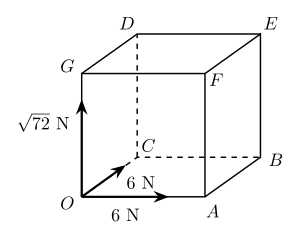
- AP EAPCET 2021Set ap-2021-09-06-AN1 markMCQQ.Three forces of magnitude 6 N, 6N and 72 N act at a corner of a cube along three edges of a cube, as shown in the figure. The resultant of the three forces is ____ [FIGURE] (a cube with bottom face O, A, B, C and top face F, G, D, E; three arrows drawn from corner O: 6N along edge OA, 6N along edge OC, and 72N along the vertical edge OG) (A) 12 N along OB (B) 18 N along OA (C) 18 N along OC (D) 12 N along OE
›Reveal solutionSolution
Taking the three mutually perpendicular edges as axes, the resultant is 62+62+(72)2=144=12 N, directed along the space diagonal OE. Option (D).
Set up axes along the edges. Let OA^, OC^ and OG^ (the vertical edge) be three mutually perpendicular unit vectors. The forces are
F=6OA^+6OC^+72OG^,72=62.
Magnitude. Since the components are along perpendicular directions:
∣F∣=62+62+(62)2=36+36+72=144=12 N. …
🎓Unlock everything free for 14 days
- ✓Full step-by-step solutions
- ✓Concept-first explanations
- ✓Methods, shortcuts & mistakes
- ✓PYQ mapping + timed mock tests
Full access for 14 days. No credit card required.