Q.Torques of equal magnitude are applied to a hollow cylinder and a solid sphere, both having the same mass and radius. The cylinder is free to rotate about its standard axis of symmetry, and the sphere is free to rotate about an axis passing through its centre. Which of the two will acquire a greater angular speed after a given time?
🔒You're viewing a preview — the full solution, concept, methods & PYQ mapping are locked.
🔒 Start your 14-day free trial to unlock the full solution →Concept understanding — Rotational Inertia Comparison
Rotational Inertia Comparison: From Intuition to Precision
Imagine pushing a shopping cart that's nearly empty, then pushing the same cart loaded with bricks. The loaded cart is harder to get moving — it resists changes to its motion more. That resistance is inertia, and it depends only on how much mass is there.
Now imagine spinning a bicycle wheel. If you hold the axle and try to tilt the spinning wheel, it fights you. But here's the twist: a lightweight wheel that's large in diameter can be harder to spin or stop than a heavy wheel that's small in diameter, even if the heavy wheel has more mass. Why? Because rotational inertia depends not just on how much mass, but on where that mass is placed relative to the axis of rotation.
Rotational inertia (also called moment of inertia) is the rotational equivalent of mass. It measures how difficult it is to change an object's rotational motion — to start it spinning, stop it, or change its spin speed.
The Core Idea: Mass × Distance²
The precise statement is this:
I=∑miri2
For a collection of point masses, rotational inertia I is the sum of each mass mi multiplied by the square of its perpendicular distance ri from the axis of rotation.
That square is crucial. Doubling the distance from the axis quadruples the rotational inertia. A mass far from the axis contributes much more to rotational inertia than the same mass close to the axis.
Why Comparison Matters
When you compare two objects, you're asking: Which is harder to spin? The answer depends on both mass and shape.
Example 1: A ring vs. a disk of the same mass and radius
- A ring has all its mass at the outer edge (r=R for all mass). Its rotational inertia is Iring=MR2.
- A solid disk has mass spread evenly from center to edge. Its rotational inertia is Idisk=21MR2.
The ring has twice the rotational inertia of the disk. Same mass, same radius — but the ring is harder to spin because its mass is concentrated farther from the axis.
Example 2: A long rod vs. a short rod of the same mass
- A rod spun about its center: I=121ML2.
- A rod spun about one end: I=31ML2.
The same rod, same mass — but spinning it about the end is four times harder than spinning it about the center. The mass is, on average, farther from the axis.
A common mistake is to think that rotational inertia depends only on mass. It does not. Two objects with the same mass can have wildly different rotational inertias depending on how their mass is distributed.
The Intuition Behind the Square
Why distance squared? Think of a spinning object. A mass far from the axis has to travel a longer path in the same time — it has a higher linear speed for the same angular speed. To change that speed (to accelerate or decelerate the rotation), you need to apply a force over that longer distance. The square comes from the geometry: the work required scales with distance, and the lever-arm effect also scales with distance. The two factors multiply.
A Quick Comparison Table
| Object | Axis location | Rotational inertia I | Relative difficulty to spin |
|---|---|---|---|
| Point mass m at distance R | Through point | mR2 | Baseline |
The key idea is that for the same torque, angular acceleration is inversely proportional to moment of inertia (τ=Iα). The object with the smaller moment of inertia will gain a larger angular speed in the same time.
Step 1: Write the moment of inertia formulas.
For a hollow cylinder about its symmetry axis: Icyl=MR2.
For a solid sphere about its centre: Isph=52MR2.
Step 2: Compare the two. Since 52<1, the sphere has a smaller moment of inertia. …
For the same torque and time, the object with the smaller moment of inertia gains a larger angular acceleration and therefore a larger angular speed. The solid sphere has a smaller moment of inertia than the hollow cylinder, so the sphere acquires the greater angular speed.
The key here is to connect torque, moment of inertia, and angular acceleration — the rotational analogue of Newton’s second law. When equal torques act on two objects, the one with the smaller moment of inertia experiences a larger angular acceleration. Over the same time interval, that larger acceleration leads to a larger final angular speed (assuming both start from rest).
Let’s work through it step by step.
- Recall the rotational form of Newton’s second law. For rotation about a fixed axis,
τ=Iα
where τ is the net torque, I is the moment of inertia about the axis, and α is the angular acceleration.
This is the direct analogue of F=ma in linear motion.
- Identify the moments of inertia for the two objects.
Both have the same mass M and radius R, but different mass distributions.
- For a hollow cylinder rotating about its central axis (the standard axis of symmetry), all the mass is at the same distance R from the axis. Its moment of inertia is
Icylinder=MR2
- For a solid sphere rotating about an axis through its centre, the mass is distributed from the centre out to R. Its moment of inertia is
Isphere=52MR2
Icylinder=MR2,Isphere=52MR2
- Compare the two moments of inertia. Since 52=0.4, we have
Isphere=0.4MR2andIcylinder=1.0MR2
So Isphere<Icylinder. The sphere is “easier” to spin — it has less rotational inertia.
- Find the angular acceleration for each. The same torque τ is applied to both. Using τ=Iα: …
Concept: Rotational Analogue of Newton's Second Law (τ=Iα)
Same torque, different moments of inertia — the object with the smaller I gets the larger angular acceleration, hence the larger angular speed after a given time.
Step 1: Moments of inertia
Hollow cylinder about its axis: Icyl=MR2.
Solid sphere about its centre: Isph=52MR2.
Step 2: Compare
Since 52<1, Isph<Icyl.
Step 3: Angular acceleration
From τ=Iα⇒α=τ/I. The same τ gives a larger α for the smaller I: …
Showing the 12 most recent of 56 on this concept.
- AP EAPCET 2026Set eng-2026-05-12-AN1 markMCQQ.A torque 'T' produces angular acceleration α in a circular disc. If radius of disc is doubled keeping the mass constant, angular acceleration becomes (A) α (B) α/2 (C) α/4 (D) 4α
›Reveal solutionSolution
Doubling a disc's radius (mass fixed) quadruples its moment of inertia, so for the same applied torque the angular acceleration drops to a quarter. The answer is α/4.
Concept and Intuition
Torque and angular acceleration are related by T=Iα, the rotational analogue of F=ma. For a solid disc, I=21MR2 depends on R2, so any change in radius has an amplified (squared) effect on the moment of inertia — and hence an inverse-squared effect on α for a fixed torque.
Step-by-Step Solution
- Original disc: I=21MR2, and T=Iα⇒α=IT=MR22T.
- New disc: radius doubled (R′=2R), mass unchanged (M). New moment of inertia: I′=21M(2R)2=21M(4R2)=4(21MR2)=4I. …
- AP EAPCET 2026Set eng-2026-05-13-FN1 markMCQQ.The acceleration of a uniform disc rolling down an inclined plane of length 1.75 m is 1/3 times the acceleration due to gravity. If a solid sphere is rolling down from the top of the same inclined plane, then the velocity with which it reaches the bottom of the plane is (A) 2.5 ms−1 (B) 5 ms−1 (C) 3.5 ms−1 (D) 7 ms−1
›Reveal solutionSolution
Tests rolling-body dynamics on an incline — first find the incline angle from the disc's given acceleration, then apply the same incline to a sphere. Answer: 3.5 ms−1.
Concept and Intuition
A body rolling without slipping down an incline shares gravitational PE between translational and rotational KE. Its acceleration is reduced from gsinθ by the factor 1+k2/R2, where k2/R2 depends only on the shape (mass distribution), not on mass or radius. A disc (k2/R2=1/2) and a sphere (k2/R2=2/5) rolling down the same incline therefore have different accelerations, but both depend on the same sinθ — so the disc's data lets us extract θ, which we then reuse for the sphere.
Step-by-Step Solution
- Uniform disc: I=21MR2⇒k2/R2=21. Acceleration down the incline: a=1+21gsinθ=32gsinθ.
- Given adisc=31g: 32gsinθ=31g⇒sinθ=21 (i.e. θ=30∘). …
- AP EAPCET 2026Set eng-2026-05-14-FN1 markMCQQ.A thin wire of length L and uniform linear mass density 'ρ' is bent into a circular loop with centre at 'O' as shown (diagram: a circle with an axis XX1 drawn as a straight horizontal line tangent to the top of the circle; a dashed vertical radius runs from the centre O up to the point of tangency, meeting axis XX1 at a right angle (90°) marked at that point). The moment of inertia of the loop about the axis XX1 is (A) 8π2ρL3 (B) 16π2ρL3 (C) 16π25ρL3 (D) 8π23ρL3
›Reveal solutionSolution
This tests the moment of inertia of a ring about an in-plane tangent axis, combining the standard diameter-axis result with the parallel axis theorem. The answer is 8π23ρL3.
Concept and Intuition
The figure shows axis XX1 as a straight line tangent to the circle at its topmost point, lying in the same plane as the ring (the dashed radius meeting it at 90° confirms it's a tangent, not an axis perpendicular to the plane). For a ring, the moment of inertia about any diameter (an axis through the centre, in the plane of the ring) is Id=21mr2 — half of the perpendicular-axis value mr2, by the perpendicular axis theorem applied to the two equal in-plane diameters. The tangent axis is parallel to a diameter but shifted by a distance r (the radius) from the centre, so the parallel axis theorem applies directly.
Step-by-Step Solution
- Circumference relation: L=2πr⇒r=2πL.
- Mass of the wire (loop): m=ρL (linear density times total length).
- Moment of inertia about a diameter (in-plane axis through centre): Id=21mr2. …
- AP EAPCET 2026Set eng-2026-05-13-AN1 markMCQQ.The moment of Inertia of a uniform circular disc is maximum about an axis perpendicular to the disc and passing through which of the following points? [FIGURE: a circle with center A; point B on the circumference at the left end of the horizontal diameter; point D between A and the right edge; point C near the top on the vertical diameter] (A) B (B) C (C) D (D) A
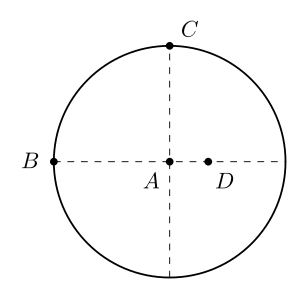
›Reveal solutionSolution
Moment of inertia about a perpendicular axis grows as Md2 with the distance d of the axis from the centre of mass, so it is maximum about the rim point B — option (A).
Concept and Intuition
Moment of inertia measures how the mass is spread out from the axis: I=∑miri2. Move the axis away from the centre of mass and every mass element (on average) sits farther from it, so I must increase. The parallel-axis theorem makes this exact:
I=Icm+Md2,
where d is the distance between the new axis and the parallel axis through the centre of mass. Note two consequences worth remembering:
- I is minimum about the axis through the centre of mass (d=0) — that is point A here.
- I increases monotonically with d, so among candidate points you simply pick the one farthest from the centre.
Step-by-Step Solution
- For a uniform disc of mass M, radius R, about the perpendicular axis through its centre: Icm=21MR2.
- About a parallel perpendicular axis through a point at distance d: I(d)=21MR2+Md2.
- Read the distances from the figure:
- A: the centre, d=0 → I=21MR2 (the minimum).
- D: a point inside the disc, a short distance right of the centre, 0<d<R.
- C: on the vertical line above the centre, d<R (or at most R). …
- AP EAPCET 2026Set eng-2026-05-15-FN1 markMCQQ.I1 represents moment of inertia of a thin, uniform rod about an axis perpendicular to its length and passing through its centre of mass. The same rod is bent into the shape of a ring. If I2 is moment of inertia of ring about an axis that is tangent to the ring and perpendicular to its plane, then I2I1= (A) 6π2 (B) 6π (C) 6π2 (D) 6π
›Reveal solutionSolution
Convert the rod's length into the ring's radius via L=2πR, then compare the rod's central MI to the ring's tangential MI (found via the parallel axis theorem). The ratio simplifies to π2/6.
Concept and Intuition
Bending a rod into a ring conserves its mass and its length (the length becomes the ring's circumference), but completely changes how that mass is distributed relative to various axes. To compare the two moments of inertia fairly, we must first express both in terms of a common variable — here, the rod's original length L, related to the ring's radius by L=2πR. We also need the parallel axis theorem to shift the ring's MI from its centre to a tangent line.
Step-by-Step Solution
- Rod's MI about the centre, perpendicular to its length: I1=12ML2.
- When bent into a ring, the rod's length becomes the ring's circumference: L=2πR⇒R=2πL.
- Ring's MI about its own centre (perpendicular to plane): Icm=MR2.
- By the parallel axis theorem, MI about a tangent axis (perpendicular to the plane, distance R from the centre): I2=Icm+MR2=MR2+MR2=2MR2. …
- AP EAPCET 2026Set eng-2026-05-18-FN1 markMCQQ.A solid cylinder rolls down an incline without slipping. Its acceleration depends on: (A) Only the mass of the cylinder (B) Only gravitational acceleration (C) Both the mass of the cylinder and the angle of inclination (D) Both the angle of incline and gravitational acceleration
›Reveal solutionSolution
For rolling without slipping, the acceleration down an incline is a=1+k2/R2gsinθ — mass cancels out entirely, leaving dependence only on g and the incline angle θ.
Concept and Intuition
For any rigid body rolling without slipping down an incline, applying Newton's second law (translational) and the torque equation (rotational) about the contact point, the mass m appears in every term and cancels. What survives is the geometric factor k2/R2 (radius of gyration ratio, which depends only on the body's shape, not its mass or size), g, and sinθ.
Step-by-Step Solution
- Newton's second law along the incline: mgsinθ−f=ma (where f is friction).
- Torque about the center of mass: fR=Iα=mk2⋅Ra (using rolling constraint a=Rα), so f=R2mk2a.
- Substituting into the first equation: mgsinθ−R2mk2a=ma⇒gsinθ=a(1+R2k2).
- So a=1+k2/R2gsinθ — note m has cancelled completely from both sides. …
- AP EAPCET 2026Set eng-2026-05-18-FN1 markMCQQ.The moment of inertia of a rod about an axis passing through its centre and perpendicular to its length is 121ML2, where M is the mass and L is the length of the rod. The rod is bent in the middle, so that the two halves make an angle of 600. The moment of inertia of the bent rod about the same axis would be (A) 121ML2 (B) 831ML2 (C) 241ML2 (D) 481ML2
›Reveal solutionSolution
Bending a rod at its center does not change its moment of inertia about the perpendicular axis through that center point — it stays 121ML2, regardless of the bend angle.
Concept and Intuition
The axis in question is perpendicular to the plane containing the rod, and it passes through the exact point where the rod is bent (the original center). For moment of inertia about such an axis, all that matters for each mass element is its straight-line distance from that fixed pivot point. Bending the rod simply rotates each half about this very pivot — like swinging a needle about a pin — which does NOT change any point's distance from the pin. So the distance distribution of mass from the axis is completely unaffected by the bend, and hence so is the moment of inertia.
Step-by-Step Solution
- Before bending: the whole rod (mass M, length L) has I=121ML2 about the perpendicular axis through its center.
- After bending at the center, split the rod into two halves, each of mass M/2 and length L/2, both hinged at the same central point (the axis location), just making an angle of 60° between them instead of being collinear.
- For an axis perpendicular to the plane and passing through one end of a rod of mass m, length l: Iend=31ml2 — this formula only depends on distances from that end along the rod, and is unaffected by any rotation of the rod about that end (in the plane perpendicular to the axis). …
- AP EAPCET 2026Set ap-2026-05-19-FN1 markMCQQ.A solid sphere and a thin circular ring of same mass and same radii are in rotational motion with same angular speeds about their diameters. Find the ratio of works done to stop them, WringWsphere (A) 5:2 (B) 2:5 (C) 4:5 (D) 5:4
›Reveal solutionSolution
Comparing rotational kinetic energies of a solid sphere and a ring (both
spinning about a diameter) with equal mass, radius and angular speed gives
the ratio of "work to stop" as their moment-of-inertia ratio, 4:5. Answer: (C).
Concept and Intuition
The work required to bring a rotating object to rest equals the rotational
kinetic energy it currently has: W=21Iω2. With M, R
and ω identical for both bodies, the ratio of the required work is
exactly the ratio of their moments of inertia about the given axis (a
diameter, in this case).
Step-by-Step Solution
- Moment of inertia of a solid sphere about a diameter: Isphere=52MR2.
- Moment of inertia of a thin circular ring about a diameter (NOT the central/perpendicular axis): using the perpendicular-axis theorem, a ring's moment of inertia about its central axis (perpendicular to its plane) is MR2; about any diameter (a "planar" axis, and by symmetry two perpendicular diameters share the load equally) it is half that: Iring, diameter=21MR2. …
- AP EAPCET 2026Set eng-2026-05-18-AN1 markMCQQ.If the moment of inertia of solid sphere of mass 2 kg and radius 10 cm about its tangent is I, then the moment of inertia of a uniform disc of mass 3.5 kg and radius 20 cm about its diameter is (A) 3.75 I (B) 2.25 I (C) 1.25 I (D) 1.75 I
›Reveal solutionSolution
This tests the parallel-axis theorem applied to a sphere (about its tangent) and the standard MOI formula for a disc about its diameter — the ratio comes out to a clean 1.25.
Concept and Intuition
The moment of inertia of a solid sphere about an axis through its centre is 52MR2. To find its MOI about a tangent line (which is parallel to a diameter, displaced by a distance R, the radius), we use the parallel-axis theorem: Itangent=Icentre+MR2=52MR2+MR2=57MR2. Separately, a uniform disc's MOI about a diameter (an axis in its own plane through the centre) is the standard result 41mr2 (half of the perpendicular-axis value 21mr2, by the perpendicular axis theorem applied to two diameters). We just compute both numerically and take the ratio.
Step-by-Step Solution
- Sphere: M=2 kg, R=10 cm=0.1 m. Icentre=52(2)(0.1)2=0.4×0.02=0.008 kgm2.
- By parallel axis theorem, I=Icentre+MR2=0.008+2(0.01)=0.008+0.02=0.028 kgm2 (equivalently I=57MR2=1.4×2×0.01=0.028). …
- AP EAPCET 2026Set ap-2026-05-20-AN1 markMCQQ.The ratio of moment of inertia with respect to their diameters of a circular disc and a solid sphere having same radii and same masses is (A) 4 : 5 (B) 5 : 4 (C) 8 : 5 (D) 5 : 8
›Reveal solutionSolution
Comparing the standard diametral moment-of-inertia formulas for a disc (MR2/4) and a solid sphere (2MR2/5) of equal mass and radius gives the ratio 5:8. Answer: (D).
Concept and Intuition
Moment of inertia about an axis depends on how mass is distributed relative to that axis. A thin disc's mass lies in a flat plane, so about a diameter (an axis in that plane) it has a smaller moment of inertia than about its own central perpendicular axis. A solid sphere's mass is distributed in three dimensions symmetrically, giving a fixed known coefficient about any diameter. Knowing these two standard formulas by heart lets you answer such ratio questions instantly.
Step-by-Step Solution
- Standard result: moment of inertia of a uniform disc about a diameter =41MR2 (half of its axial value 21MR2, by the perpendicular axis theorem).
- Standard result: moment of inertia of a uniform solid sphere about a diameter =52MR2. …
- AP EAPCET 2025Set eng-2025-05-21-FN1 markMCQQ.If the radius of gyration of a thin circular ring about an axis passing through its centre and perpendicular to its plane is 102 cm, then its radius of gyration about its diameter is (A) 10 cm (B) 20 cm (C) 102 cm (D) 202 cm
›Reveal solutionSolution
Uses radius of gyration for a ring about its central perpendicular axis vs. its diameter, linked by the perpendicular axis theorem; the diameter value is 10 cm.
Concept and Intuition
For a thin ring, all the mass lies at distance R from the centre, so the moment of inertia about the axis through the centre perpendicular to its plane is simply Iz=MR2 (every mass element is at the same distance from that axis). The perpendicular axis theorem relates this to the two diameters (which are identical by symmetry): Iz=Ix+Iy=2Idiameter, so Idiameter=21MR2.
Step-by-Step Solution
- About the central perpendicular axis: Iz=MR2=Mk12⇒k1=R.
- Given k1=102 cm, so R=102 cm. …
- AP EAPCET 2025Set eng-2025-05-22-FN1 markMCQQ.Three thin uniform rods each of mass M and length L are placed along the three axes of a cartesian coordinate system with one end of all the rods at origin. The moment of inertia of the system of the rods about z-axis is (A) 3ML2 (B) 32ML2 (C) 2ML2 (D) ML2
›Reveal solutionSolution
Only the rods perpendicular to the z-axis (along x and y) contribute; each gives 31ML2, so the total is 32ML2.
Concept and Intuition
Moment of inertia about an axis depends only on the perpendicular distance of each mass element from that axis. A rod lying exactly ON the axis of rotation (here, the rod along z, being rotated about the z-axis) has zero perpendicular distance everywhere, so it contributes nothing. The other two rods, lying along x and y, have points whose distance from the z-axis equals their own coordinate value — making their moment of inertia about z identical to the standard "rod about a perpendicular axis through one end" result.
Step-by-Step Solution
- Rod along the z-axis: every point is (0,0,z), whose perpendicular distance from the z-axis is 0. So its MI about z-axis =0.
- Rod along the x-axis: points are (x,0,0), perpendicular distance from z-axis is x. Its MI about the z-axis is the same as a rod's MI about a perpendicular axis through one end: Ix=∫0Lx2(LMdx)=LM⋅3L3=3ML2. …
🎓Unlock everything free for 14 days
- ✓Full step-by-step solutions
- ✓Concept-first explanations
- ✓Methods, shortcuts & mistakes
- ✓PYQ mapping + timed mock tests
Full access for 14 days. No credit card required.