Q.(a) A child stands at the centre of a turntable with his two arms outstretched. The turntable is set rotating with an angular speed of 40 rev/min. How much is the angular speed of the child if he folds his hands back and thereby reduces his moment of inertia to 2/5 times the initial value? Assume that the turntable rotates without friction.
🔒You're viewing a preview — the full solution, concept, methods & PYQ mapping are locked.
🔒 Start your 14-day free trial to unlock the full solution →Concept understanding — Conservation of Angular Momentum
Conservation of Angular Momentum
The Intuition First
Imagine you're sitting on a spinning office chair with your arms stretched out. Someone gives you a gentle push, and you start rotating slowly. Now pull your arms in tight against your chest. What happens? You spin faster. Push your arms back out — you slow down again.
Nothing external pushed you to go faster or slower. The change came from inside — from how you arranged your mass relative to the axis of rotation.
That's the core idea: Angular momentum is a quantity that stays constant for a rotating system unless an external torque acts on it. When you pulled your arms in, you didn't change your angular momentum — you changed your distribution of mass, and your rotation speed had to adjust to keep the total constant.
The Precise Statement
L=constantifτext=0
Where:
- L is the angular momentum of the system
- τext is the net external torque acting on the system
In words: The total angular momentum of an isolated system (no external torque) remains constant in both magnitude and direction.
What Is Angular Momentum?
For a point mass m moving with velocity v at position r from a reference point:
L=r×mv
For a rigid body rotating about a fixed axis:
L=Iω
Where:
- I = moment of inertia (how mass is distributed relative to the axis)
- ω = angular velocity (how fast it spins)
Moment of inertia I depends on where the mass is, not just how much. Mass far from the axis gives larger I; mass close to the axis gives smaller I.
Why It Works: The Physics
Newton's second law for rotation says:
τext=dtdL
If τext=0, then dtdL=0, so L is constant.
Since L=Iω, if I changes (you pull arms in), ω must change in the opposite way to keep L the same:
I1ω1=I2ω2
Smaller I → larger ω (spin faster). Larger I → smaller ω (spin slower).
Real-World Examples
| Situation | What happens | Why |
|---|---|---|
| Ice skater pulling arms in | Spins faster | I decreases, ω increases to keep L constant |
| Diver tucking into a ball | Rotates faster in midair | Same principle — no external torque during flight |
| Cat falling upside-down | Twists body to land on feet | Changes I of different body parts to rotate without external torque |
| Planet orbiting the Sun | Speeds up when closer, slows down when farther | Gravitational force is central (torque = 0), so L is constant |
Angular momentum is a vector. Its direction matters too. If no external torque acts, the axis of rotation stays fixed in space. This is why a spinning gyroscope or a bicycle wheel resists being tilted.
Common Mistake to Avoid …
Concept: Rotational Dynamics — conservation of angular momentum in the absence of external torque.
(a) No external torque acts on the child–turntable system, so angular momentum L=Iω is conserved.
Let initial moment of inertia be I and initial angular speed ω1=40 rev/min.
Final moment of inertia I2=52I.
From Iω1=I2ω2: …
Using conservation of angular momentum (Iω=constant) because no external torque acts on the system, the new angular speed becomes 100 rev/min. The kinetic energy increases because the child does internal muscular work while folding his arms.
Why conservation of angular momentum works here
The child and turntable together form a system that rotates without friction. When the child folds his arms, no external torque acts on the system — the only forces are internal (the child's muscles). For any system with zero net external torque, angular momentum is conserved:
L=Iω=constant
This is the rotational analogue of conservation of linear momentum. The moment of inertia I changes because the child redistributes mass closer to the axis; angular speed ω must adjust to keep L unchanged.
(a) Finding the new angular speed
1. Let the initial moment of inertia be I1 and the initial angular speed be ω1=40 rev/min.
2. When the child folds his arms, the moment of inertia becomes:
I2=52I1
3. Conservation of angular momentum gives:
I1ω1=I2ω2
Substitute I2:
I1×40=52I1×ω2
4. Cancel I1 (non-zero) and solve:
40=52ω2⇒ω2=40×25=100 rev/min
A common mistake is to forget that ω must be in consistent units. Here both speeds are in rev/min, so the ratio is valid. If you convert to rad/s, the ratio remains the same — the factor 25 is dimensionless.
Notice that reducing I to 52 multiplies ω by 25. This inverse proportionality is the hallmark of angular momentum conservation: smaller I means faster spin.
(b) Comparing kinetic energies
1. Rotational kinetic energy is:
K=21Iω2
Initial kinetic energy:
K1=21I1ω12
Final kinetic energy:
K2=21I2ω22=21(52I1)(100)2
2. Express K2 in terms of K1:
K2=21⋅52I1⋅1002=21I1⋅52⋅10000
But K1=21I1⋅402=21I1⋅1600. So:
K1K2=160052⋅10000=16004000=2.5
Thus K2=2.5K1 — the kinetic energy increases by a factor of 2.5. …
Concept: Conservation of Angular Momentum (L=Iω= constant)
No external torque acts on the child–turntable system (frictionless), so L is conserved even though the child's own moment of inertia changes.
Step 1: Set up part (a)
Let initial I1, ω1=40 rev/min; final I2=52I1.
Step 2: Apply I1ω1=I2ω2
I1(40)=52I1ω2⇒ω2=40×25=100 rev/min
Step 3: Compare kinetic energies for part (b)
K=21Iω2=2IL2 (since L is fixed)
K1K2=I2I1=25=2.5⇒K2=2.5K1>K1
Step 4: Physical explanation …
- AP EAPCET 2026Set eng-2026-05-15-AN1 markMCQQ.A planet revolves around the sun in an elliptical orbit. The areal velocity of the planet is 4×10¹⁶ m2s−1. If the maximum distance between the planet and the sun is 4×10¹² m, then the minimum speed of the planet is (A) 2 kms−1 (B) 8 kms−1 (C) 20 kms−1 (D) 24 kms−1
›Reveal solutionSolution
Tests Kepler's second law (constant areal velocity) and the fact that speed is minimum at the farthest point (aphelion). Answer: 20 km/s.
Concept and Intuition
For a planet orbiting under a central (gravitational) force, angular momentum about the sun is conserved, which is equivalent to saying the line joining planet and sun sweeps out equal areas in equal times — Kepler's Second Law. Mathematically, dtdA=2mL, a constant for the whole orbit.
At the two special points of the elliptical orbit — perihelion (closest) and aphelion (farthest) — the planet's velocity vector is exactly perpendicular to the radius vector (the radial component of velocity is momentarily zero there, since r is at a turning point). At these two points only, the instantaneous rate of area sweep simplifies exactly to dtdA=21rv, with no need for a general dot-product treatment. Since r and v are inversely related (rv=const at the apsides, from angular momentum conservation), the minimum speed occurs at the maximum distance (aphelion) — a very intuitive coupling of "far means slow, near means fast."
Step-by-Step Solution
- Areal velocity is constant: dtdA=4×10¹⁶ m2s−1. …
- AP EAPCET 2026Set ap-2026-05-19-AN1 markMCQQ.A particle of mass 3 kg with position vector (i^+2j^) m has velocity 2i^+j^+2k^ ms−1. Its angular momentum about z-axis in kgm2s−1 is (A) zero (B) 9 (C) -4 (D) -9
›Reveal solutionSolution
Computing L=r×p and reading off the z-component gives Lz=−9 kgm2s−1.
Concept and Intuition
Angular momentum about the origin is L=r×p, where p=mv. We only need the z-component of the resulting cross product, which (using the standard determinant expansion) comes only from the x- and y- components of r and p (the z-components of r and p do not affect Lz).
Step-by-Step Solution
- Momentum: p=mv=3(2i^+j^+2k^)=6i^+3j^+6k^, i.e. (px,py,pz)=(6,3,6).
- Position vector: r=i^+2j^, i.e. (rx,ry,rz)=(1,2,0).
- Compute L=r×p via the determinant:
L=i^16j^23k^06=i^(2⋅6−0⋅3)−j^(1⋅6−0⋅6)+k^(1⋅3−2⋅6)
=i^(12)−j^(6)+k^(3−12)=12i^−6j^−9k^ …
- AP EAPCET 2026Set ap-2026-05-20-FN1 markMCQQ.The figure shows the revolution of the planet (P) around the sun (S) in elliptical orbit. Which of the following statements is true? [FIGURE] (an ellipse with the sun S at a point left of centre; the ellipse is divided by two perpendicular diameters into quadrant points B at top, D at bottom, A at left end, C at right end; the planet P is shown between D and C moving anticlockwise toward C) (A) Time taken by the planet to travel BAD is less than that for DCB (B) Time taken by the planet to travel BAD is greater than that for DCB (C) Time taken by the planet to travel ADC is less than that for CBA (D) Time taken by the planet to travel ADC is greater than that for CBA
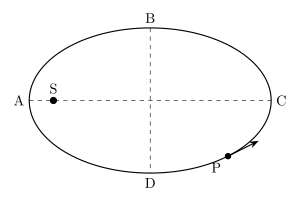
›Reveal solutionSolution
Because the sun sits at a focus offset toward A, the area swept by the sun–planet line over arc BAD is less than over arc DCB; by Kepler's equal-area law this means BAD takes less time than DCB.
Concept and Intuition
Kepler's second law says the line joining the sun to the planet sweeps out equal areas in equal times — this is a direct consequence of angular momentum conservation about the focus. The chord BD (the minor axis) passes through the geometric centre O of the ellipse, so it splits the ellipse into two geometrically equal halves. But the area swept from the focus S is not the same as the geometric half-ellipse area, because S is not at O — it's offset toward A.
Step-by-Step Solution
- Set up coordinates: ellipse centred at O, major axis along A–C, minor axis along B–D (through O). Focus S lies on the major axis, between O and A (closer to A, consistent with A being the near/perihelion point).
- The chord BD divides the ellipse into two geometrically equal halves (each area =21πab), since any line through the centre bisects an ellipse's area.
- However, the area swept by the radius vector from S as the planet moves along arc B→A→D is bounded not by the chord BD but by the two segments SB and SD. Since S lies inside the A-side half (between O and A, i.e. on the same side as A relative to chord BD), the swept region is the half-ellipse area minus the triangle DSB: Areaswept(BAD)=21πab−T, where T=area(△DSB)>0. …
- AP EAPCET 2023Set eng-2023-05-15-FN1 markMCQQ.A force of (2i^+3j^+4k^) N acts on a particle whose position vector with respect to the origin of the coordinate system is (6i^+bj^+12k^) m. If the angular momentum of the body is constant, the value of 'b' is (A) 6 (B) 9 (C) 12 (D) 3
›Reveal solutionSolution
Constant angular momentum ⇒ zero torque ⇒ r×F=0; solving component-wise gives b=9.
Concept and Intuition
Angular momentum L=r×p changes according to dtdL=τ=r×F. If L is constant, the torque about the origin due to the applied force must be zero. This happens precisely when r and F are parallel (or anti-parallel), i.e. the force line passes through the origin (a central force situation).
Step-by-Step Solution
- Given F=2i^+3j^+4k^ and r=6i^+bj^+12k^.
- Torque τ=r×F=i^62j^b3k^124.
- i^ component: b(4)−12(3)=4b−36.
- j^ component: −(6(4)−12(2))=−(24−24)=0 — automatically zero.
- k^ component: 6(3)−b(2)=18−2b. …
- AP EAPCET 2022Set ap-2022-07-11-AN1 markMCQQ.A rod of mass M and length 2L lies horizontally. A particle of mass m, moving with a velocity v, travelling in the vertical plane, hits the end of the rod B and sticks to it as shown in the figure. [FIGURE] (rod AB of length 2L lying horizontally with its midpoint marked x=0; a particle of mass m falls vertically downward with velocity v and strikes end B) Then the velocity of point B just after collision is (A) (M+mm)v (B) (M+mm){1+(M+m)1+31M}v (C) (M+mm)⎩⎨⎧1+(M+m)(31+(M+m)2m2)M⎭⎬⎫v (D) (M+mm)⎩⎨⎧1+(M+m)(21+(M+m)2m2)M⎭⎬⎫v
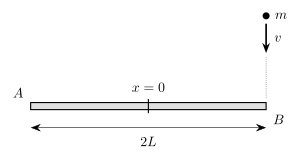
›Reveal solutionSolution
This is a combined linear + angular momentum conservation problem for a free rod struck at one end by a sticking particle; solving for the centre-of-mass velocity and the rotation about the new centre of mass, and adding their contributions at point B, gives option (C).
Concept and Intuition
When an object is struck by another object and they stick together (perfectly inelastic collision) with no external force acting during the (very short) collision, two conservation laws apply for the combined system:
- Linear momentum is conserved — this fixes the velocity of the new centre of mass.
- Angular momentum about any fixed point in space is conserved — this fixes the angular velocity of the combined body about its own (new) centre of mass.
The velocity of any point on the rigid body afterward is then the vector sum of the centre-of-mass translational velocity and the rotational velocity (ω×r) of that point relative to the new centre of mass.
Step-by-Step Solution
- Centre of mass velocity. Before collision only the particle has momentum mv (rod at rest). So
Vcm=M+mmv
- Location of the new centre of mass. Taking the rod's own centre O (x=0) and end B at x=L: the particle (mass m) sticks at B, so
d=M+mmL(distance of new CM from O, towards B)
The distance from the new CM to B is then L−d=M+mML.
- Moment of inertia about the new CM. The rod's own moment of inertia about O is 31ML2 (rod of length 2L about its centre). Using the parallel-axis theorem for the rod's shift, plus the particle's contribution at its own distance from the new CM:
Icm=31ML2+Md2+m(L−d)2=ML2(31+M+mm)
(the last two terms combine to the standard two-body reduced-mass form M+mMmL2).
- Angular momentum conservation. Taking angular momentum about the fixed point O (the rod's original centre, an inertial point unaffected by the collision):
Linitial=mvL(particle’s angular momentum about O)
Equating this to the final angular momentum (rotation about new CM + orbital contribution of the CM's motion about O) and solving gives the angular speed:
ω=L(M+m)(31+M+mm)mv …
- AP EAPCET 2022Set eng-2022-07-07-FN1 markMCQQ.If the earth suddenly shrinks to 641 of its original volume, while keeping the same mass, then the duration of the day will be [Assume earth is a perfect sphere] (A) 24 hours (B) 1.5 hours (C) 16 hours (D) 48 hours
›Reveal solutionSolution
Conservation of angular momentum with R→R/4 (so I→I/16) speeds up rotation 16×, cutting the day from 24 h to 1.5 h.
Concept and Intuition
This is exactly like a figure skater pulling in their arms: shrinking the radius reduces the moment of inertia, and with no external torque acting, angular momentum L=Iω stays constant, so ω must increase to compensate.
Step-by-Step Solution
- Volume V=34πR3. If Vnew=Vold/64, then Rnew3=Rold3/64⇒Rnew=Rold/4.
- Moment of inertia of a uniform sphere: I=52MR2. Mass is unchanged, so Inew/Iold=(Rnew/Rold)2=(1/4)2=1/16. …
- AP EAPCET 2022Set eng-2022-07-07-FN1 markMCQQ.A wheel is rotating freely at some angular speed. A second wheel initially at rest and with thrice the rotational inertia of the first, is suddenly coupled to the first wheel. The fraction of the original rotational kinetic energy lost is (A) 0.50 (B) 0.25 (C) 0.66 (D) 0.75
›Reveal solutionSolution
Coupling conserves angular momentum but not KE; working through it, 3/4 of the original rotational KE is lost.
Concept and Intuition
When two rotating bodies are suddenly coupled (like an inelastic collision but rotational), angular momentum is conserved because the coupling forces are internal, but kinetic energy is not conserved — some is dissipated as heat/sound in the coupling process, just like inelastic linear collisions.
Step-by-Step Solution
- Let first wheel: inertia I1=I, initial angular speed ω. Second wheel: inertia I2=3I, at rest.
- Conservation of angular momentum: Iω+3I(0)=(I+3I)ω′⇒ω′=4IIω=4ω.
- Initial KE: KEi=21Iω2.
- Final KE: KEf=21(4I)(4ω)2=21(4I)16ω2=8Iω2. …
- AP EAPCET 2021Set eng-2021-08-23-FN1 markMCQQ.Assertion (A): Angular speed, linear speed as Kinetic energy change with time but angular momentum remains constant for a planet orbiting the sun. Reason (R): Angular momentum is constant as no torque acts on the planet. (A) Both A and R are true and R is a correct explanation for A (B) Both A and R are true but R is not a correct explanation for A (C) A is true, R is false (D) A is false, R is false
›Reveal solutionSolution
A central force exerts no torque about the force centre, so angular momentum is conserved even as speed and KE vary — both statements are true and R explains A.
Concept and Intuition
Gravitational force on a planet is always directed toward the Sun (a central force). Torque τ=r×F vanishes whenever F is parallel (or anti-parallel) to r, which is exactly the case here. Since τ=dL/dt, zero torque means angular momentum L is strictly constant — this is precisely why planets sweep equal areas in equal times (Kepler's 2nd law), speeding up near perihelion and slowing down near aphelion, so their linear/angular speed and KE do change even though L doesn't.
Step-by-Step Solution
- Assertion states: angular speed, linear speed, KE change with time, but angular momentum is constant. This is a correct description of planetary motion (true, due to varying orbital radius in an ellipse).
- Reason states: angular momentum is constant because no torque acts on the planet. This is the correct physical cause (true). …
- AP EAPCET 2021Set eng-2021-08-24-AN1 markMCQQ.If 'A' is the areal velocity of a planet of mass 'M', its angular momentum is: (A) AM (B) 2MA (C) A2M (D) AM2
›Reveal solutionSolution
Areal velocity of a planet is directly related to its angular momentum by A=L/(2M) — this relation is Kepler's second law written in terms of angular momentum.
Concept and Intuition
Kepler's second law says a planet sweeps out equal areas in equal times. This is really a statement about conservation of angular momentum: for a particle at position r moving with momentum p=mv, the infinitesimal area swept in time dt is dA=21∣r×v∣dt, and ∣r×mv∣=L is exactly the angular momentum. So the constant areal velocity is nothing but angular momentum divided by twice the mass.
Step-by-Step Solution
- Areal velocity: A=dtdAswept=21∣r×v∣.
- Angular momentum: L=∣r×p∣=M∣r×v∣ (mass of the planet is M).
- Comparing the two: ∣r×v∣=ML, so …
🎓Unlock everything free for 14 days
- ✓Full step-by-step solutions
- ✓Concept-first explanations
- ✓Methods, shortcuts & mistakes
- ✓PYQ mapping + timed mock tests
Full access for 14 days. No credit card required.