Q.To maintain a rotor at a uniform angular speed of 200 rad s−1, an engine needs to transmit a torque of 180 N m. What is the power required by the engine? (Note: uniform angular velocity in the absence of friction implies zero torque. In practice, applied torque is needed to counter frictional torque). Assume that the engine is 100% efficient.
🔒You're viewing a preview — the full solution, concept, methods & PYQ mapping are locked.
🔒 Start your 14-day free trial to unlock the full solution →Concept understanding — Rotational Dynamics
Rotational Dynamics: The Physics of Spinning Things
Imagine you're trying to open a heavy door. You push near the hinge — it barely moves. Push near the handle — it swings open easily. Same force, different result. That's the first clue: rotation isn't just about how much you push, but where and in what direction.
Now think about a spinning bicycle wheel. Why is it so hard to tilt it sideways when it's spinning fast? And why does a figure skater spin faster when she pulls her arms in? These are the questions rotational dynamics answers.
The Core Idea
Rotational dynamics is the study of why things rotate and how their rotation changes. It's the spinning-world equivalent of Newton's laws for straight-line motion.
In linear motion, you have:
- Force (F) causes acceleration (a)
- Mass (m) resists acceleration
In rotational motion, you have:
- Torque (τ) causes angular acceleration (α)
- Moment of inertia (I) resists angular acceleration
The master equation is:
τnet=Iα
This is the rotational version of F=ma. Every term has a direct parallel.
Breaking It Down
Torque — The Rotational "Push"
Torque isn't just force — it's force multiplied by the distance from the pivot point (the lever arm). That's why the door handle works better than the hinge.
τ=rFsinθ
Where r is the distance from the axis, F is the force, and θ is the angle between them. Maximum torque happens when you push perpendicular to the lever arm (θ=90∘).
Think of torque as "twisting effectiveness." A wrench works because the handle gives you a long lever arm. A short wrench needs more force to do the same job.
Moment of Inertia — The Rotational "Mass"
Mass resists linear acceleration. Moment of inertia resists angular acceleration. But unlike mass, moment of inertia depends on how the mass is distributed relative to the axis of rotation.
For a point mass m at distance r from the axis:
I=mr2
For extended objects, you sum (or integrate) over all mass elements:
I=∑miri2
| Object | Axis | Moment of Inertia |
|--------|------|-------------------|
| Thin hoop | Through center, perpendicular to plane | MR2 |
| Solid disk | Through center, perpendicular to plane | 21MR2 |
| Solid sphere | Through center | 52MR2 |
| Thin rod | Through center, perpendicular to rod | 121ML2 |
Notice: a hoop has more moment of inertia than a disk of the same mass and radius because its mass is farther from the axis. That's why a hoop is harder to start spinning.
Angular Acceleration — How Fast Rotation Changes
Just as acceleration is the rate of change of velocity, angular acceleration α is the rate of change of angular velocity ω:
α=dtdω
And angular velocity is the rate of change of angular displacement θ:
ω=dtdθ
The Complete Picture: Rotational Analogues
| Linear Quantity | Rotational Analogue |
|---|---|
| Displacement x | Angular displacement θ |
| Velocity v | Angular velocity ω |
| Acceleration a | Angular acceleration α |
| Mass m | Moment of inertia I |
| Force F | Torque τ |
| Newton's 2nd law: F=ma | τ=Iα |
| Kinetic energy: 21mv2 | 21Iω2 |
| Momentum: p=mv | Angular momentum: L=Iω |
The Key Insight: Conservation of Angular Momentum
This is where rotational dynamics gets beautiful. Just as linear momentum is conserved when no external force acts, angular momentum is conserved when no external torque acts:
L=Iω=constant …
The key idea here is Power in Rotational Motion. Power is the rate at which work is done, and in rotational dynamics, it is the product of the applied torque and the angular speed.
The power P required to maintain rotational motion is given by:
P=τω
where τ is the torque and ω is the angular speed. …
The power required by an engine to maintain a uniform angular speed against a given torque is the product of the torque and the angular speed. The required power is 36000 W.
When an engine maintains a rotor at a uniform angular speed, it means there is no angular acceleration. In an ideal scenario without friction, no torque would be needed once the desired speed is reached. However, in practice, there's always some frictional torque opposing the motion. The engine must apply an equal and opposite torque to precisely counteract this frictional torque, thereby keeping the net torque zero and the angular speed constant. The power required by the engine is the rate at which it does work to overcome this frictional resistance.
This concept is directly analogous to linear motion: if you push a block at a constant velocity across a rough surface, you need to apply a force equal to the frictional force. The power you expend is the product of this force and the velocity (P=Fv). In rotational motion, force is replaced by torque (τ), and linear velocity is replaced by angular speed (ω).
-
Identify the given quantities:
We are given the uniform angular speed of the rotor and the torque the engine needs to transmit.
- Angular speed, ω=200 rad s−1
- Torque, τ=180 N m
-
Recall the formula for power in rotational motion:
The power (P) delivered by a rotating object or an engine applying torque is the product of the torque (τ) and the angular speed (ω).
P=τω …
Concept: Power in Rotational Motion (P=τω)
Power delivered against a (frictional) torque at uniform angular speed is the rotational analogue of P=Fv.
Step 1: Identify given values
τ=180 N m, ω=200 rad/s. …
Showing the 12 most recent of 60 on this concept.
- AP EAPCET 2026Set eng-2026-05-12-FN1 markMCQQ.A ring of mass 1.5 kg and radius 35 cm is rolling without slipping on a horizontal floor. If the translational kinetic energy of the ring is 100 J, then its rotational kinetic energy is (A) 150 J (B) 50 J (C) 100 J (D) 200 J
›Reveal solutionSolution
A rolling ring always splits its kinetic energy 50:50 between translation and rotation, because its moment of inertia I=MR2 makes the two energy expressions identical in form. Answer: (C) 100 J.
Concept and Intuition
For any object rolling without slipping, translational and rotational kinetic energies are linked through the no-slip condition v=ωR. Whether the two energies are equal, or one dominates, depends entirely on the shape factor k2 in I=Mk2 (where k is the radius of gyration). A ring/hoop has all its mass at radius R, so I=MR2 exactly — this is the special case where the rotational KE expression becomes numerically identical to the translational KE expression once v=ωR is substituted. (Contrast: a solid disc has I=21MR2, so its rotational KE is only half its translational KE; a solid sphere has I=52MR2, giving an even smaller ratio.)
Step-by-Step Solution
- Moment of inertia of a ring about its central axis: I=MR2.
- Rolling without slipping condition: v=ωR, i.e. ω=v/R.
- Rotational KE:
KErot=21Iω2=21(MR2)(Rv)2=21Mv2.
- Compare to translational KE: KEtrans=21Mv2 — identical expression! …
- AP EAPCET 2026Set eng-2026-05-12-AN1 markMCQQ.Hollow sphere rolls on an inclined plane of height h without slipping. If it starts from rest, its speed at the bottom is (A) 2gh (B) 710gh (C) 56gh (D) 34gh
›Reveal solutionSolution
Rolling without slipping converts gravitational PE into both translational and rotational KE; using the hollow sphere's moment of inertia I=32mr2 gives v=6gh/5.
Concept and Intuition
When an object rolls without slipping down an incline, its total kinetic energy at the bottom is split between translational motion of the centre of mass and rotation about that centre. The fraction going into rotation depends on the object's moment-of-inertia factor (k2 in I=mk2) — a hollow sphere (k2=32r2) ends up slower at the bottom than a solid sphere (k2=52r2) because more of its mass (and hence energy) is invested in rotation.
Step-by-Step Solution
- Energy conservation (starting from rest, height h): mgh=21mv2+21Iω2.
- For a hollow (thin-walled) sphere: I=32mr2.
- Rolling without slipping: ω=v/r, so 21Iω2=21(32mr2)(r2v2)=31mv2. …
- AP EAPCET 2026Set eng-2026-05-14-AN1 markMCQQ.The rotational kinetic energy of a solid sphere of mass 3 kg and radius 0.2 m rolling down an inclined plane of height 7m is (nearer to) (A) 80 J (B) 36 J (C) 40 J (D) 60 J
›Reveal solutionSolution
A solid sphere rolling down an incline splits its total kinetic energy in a fixed ratio between translation and rotation; for a solid sphere the rotational share is 2/7 of the total, giving 60 J here.
Concept and Intuition
For rolling without slipping, v=ωR, so translational and rotational kinetic energies are always in a fixed ratio determined by the moment of inertia factor. For a solid sphere, I=52MR2, and this ratio comes out to rotational KE being 2/7 of the total KE — independent of speed, mass, or radius (radius and mass are given here mostly as distractors, though mass does scale the total energy).
Step-by-Step Solution
- Total mechanical energy converted from height (energy conservation, rolling without slipping, no energy loss to friction since it's rolling not sliding): Etotal=Mgh=3×10×7=210 J.
- Total KE at the bottom = translational KE + rotational KE =21Mv2+21Iω2.
- For a solid sphere, I=52MR2 and rolling condition v=ωR: …
- AP EAPCET 2026Set eng-2026-05-15-AN1 markMCQQ.A particle executes uniform circular motion with an angular momentum L. Its kinetic energy is doubled and the angular frequency is halved, then its angular momentum becomes (A) 2 L (B) 4 L (C) L/2 (D) L/4
›Reveal solutionSolution
This tests the relation between kinetic energy, angular frequency, and angular momentum in circular motion, KE=21Lω. The answer is (B), 4L.
Concept and Intuition
For a particle in circular motion, angular momentum L=mr2ω and kinetic energy KE=21mr2ω2. Notice that KE=21(mr2ω)ω=21Lω — this links L, KE, and ω directly without needing m or r individually, which is exactly what's needed here since only KE and ω are said to change.
Step-by-Step Solution
- Start from L=mr2ω and KE=21mr2ω2.
- Notice KE=21(mr2ω)⋅ω=21Lω, so L=ω2KE.
- Originally, L=ω2KE.
- After the change: KE′=2KE and ω′=2ω.
- New angular momentum: L′=ω′2KE′=ω/22(2KE)=ω4KE×2=ω8KE. …
- AP EAPCET 2026Set eng-2026-05-15-FN1 markMCQQ.A particle is moving in a circular path with constant angular velocity. Its initial angular momentum is L. If the radius of the circle is tripled by keeping angular velocity same, the new angular momentum is (A) 3L (B) 6L (C) 9L (D) 3L
›Reveal solutionSolution
A point particle's angular momentum about the circle's centre is L=mr2ω — it scales with the square of the radius, not linearly. Tripling r while keeping ω fixed multiplies L by 32=9.
Concept and Intuition
It's tempting to think angular momentum scales the same way as linear momentum with radius, but for circular motion L=Iω, and the moment of inertia of a point mass is I=mr2 — quadratic in r. So even though ω is unchanged, tripling the radius has an amplified effect on L because the particle is both farther from the axis (bigger lever arm) and moving faster in absolute terms (since v=rω also increases with r).
Step-by-Step Solution
- Angular momentum of a particle in circular motion: L=Iω=(mr2)ω.
- Given: initial radius r, initial angular momentum L=mr2ω. …
- AP EAPCET 2026Set ap-2026-05-19-AN1 markMCQQ.A uniform rod of mass m, length l falls with speed v as shown in the figure. Suddenly one of its ends gets stuck to a frictionless hook. Angular velocity of rod just after its end gets stuck is: [FIGURE] (a horizontal rod of mass m and length l falling vertically with speed v; one end of the rod is approaching a fixed frictionless hook mounted on a wall to its right) (A) 2l3v (B) lv (C) l2v (D) 4l3v
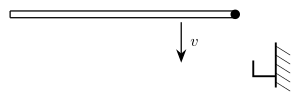
›Reveal solutionSolution
The rod’s end suddenly sticks to a frictionless hook, so angular momentum about the hook is conserved during the collision. The initial angular momentum comes from the rod’s linear motion, and the final angular momentum is that of the rod rotating about the hook. Solving gives ω=2l3v, which corresponds to option (A).
Concept and Intuition
When the rod’s end snags on the frictionless hook, the hook exerts an impulsive force on that end. Because the hook is frictionless, this force passes through the hook point — it has no torque about the hook itself. Therefore, angular momentum of the rod about the hook is conserved during the very brief collision. The rod initially has no rotation, only downward translation. After the catch, it rotates about the hook as a rigid body. We equate the angular momentum just before and just after the catch.
Watch outA common mistake is to try to use conservation of linear momentum or energy. The hook exerts an external force, so linear momentum is not conserved. Energy is also not conserved because the collision is inelastic (the end sticks). Only angular momentum about the hook is conserved.
Step-by-step solution
-
Set up the coordinate system and initial conditions
The rod is horizontal, length l, mass m, falling straight down with speed v. Its center of mass (CM) is at the midpoint. Just before the catch, the right end is about to touch the hook. The rod has no rotation — it’s purely translating downward.
-
Angular momentum about the hook just before the catch
The hook is at the right end of the rod. For a point mass dm at a horizontal distance x from the hook (measured leftward along the rod), its velocity is v downward. The angular momentum of that mass element about the hook is
dL=(x)(v)dm
because the perpendicular distance from the hook to the velocity vector is x, and the direction (into the page) is the same for all elements.
Integrate over the rod: dm=lmdx, with x from 0 (at the hook) to l (at the left end).
Linitial=∫0lxvlmdx=lmv∫0lxdx=lmv⋅2l2=21mvl.
TipThis is the same as the angular momentum of a point mass m at the rod’s center of mass, because the CM is at distance l/2 from the hook: L=(l/2)(mv)=21mvl. That’s a quick check. …
-
- AP EAPCET 2026Set ap-2026-05-20-FN1 markMCQQ.A uniform rod of mass 20 kg and length 1.6 m is pivoted at its one end and can swing freely in the vertical plane. The angular acceleration of the rod just after the rod is released from rest in the horizontal position is (g – acceleration due to gravity) (A) 1615g (B) 1617g (C) 1516g (D) 169g
›Reveal solutionSolution
Use τ=Iα for a rod pivoted at one end and released from horizontal; α=2L3g=1615g for L=1.6m.
Concept and Intuition
When a uniform rod pivoted at one end is released from horizontal, gravity acting at its centre of mass produces a torque about the pivot. Newton's second law for rotation, τ=Iα, with I the moment of inertia of the rod about the pivoted end, gives the initial angular acceleration.
Step-by-Step Solution
- Moment of inertia of a uniform rod about one end: I=3mL2.
- Weight mg acts at the centre, a distance L/2 from the pivot; when horizontal, this is the full perpendicular lever arm, so torque τ=mg⋅2L.
- Newton's second law for rotation: τ=Iα⇒mg2L=3mL2α. …
- AP EAPCET 2026Set ap-2026-05-20-AN1 markMCQQ.A uniform solid cylinder of mass m and radius R is pulled along a horizontal smooth road by a horizontal force F applied at its center of mass. If the cylinder rolls without slipping, the angular acceleration α of the cylinder is: (A) 2mRF (B) 2mR3F (C) 3mR2F (D) 3mRF
›Reveal solutionSolution
Combining Newton's second law, the torque equation about the centre, and the rolling constraint for a cylinder pulled by a horizontal force at its centre gives α=2F/3mR. Answer: (C).
Concept and Intuition
A force applied exactly through the centre of mass produces zero torque about that centre by itself — so on its own it cannot make the cylinder spin. It is friction at the contact point that supplies the torque needed to keep the cylinder rolling without slipping as it's dragged forward. The trick is to write both the translational equation (net force = ma) and the rotational equation (net torque about the centre = Iα) and tie them together with the no-slip condition a=αR.
Step-by-Step Solution
- Translational: F−f=ma (friction f opposes the forward pull as it acts backward at the contact point to prevent slipping).
- Rotational about the centre: fR=Iα=21mR2α (moment of inertia of a solid cylinder about its axis is 21mR2).
- Rolling constraint: a=αR⇒α=a/R.
- From step 2: f=21mRα=21ma. …
- AP EAPCET 2025Set eng-2025-05-22-AN1 markMCQQ.A solid sphere of mass 4 kg and radius 28 cm is on an inclined plane. If the acceleration of the sphere when it rolls down without sliding is 3.5 ms−2, then the acceleration of the sphere when it slides down without rolling is (A) 2.5 ms−2 (B) 3.5 ms−2 (C) 1.7 ms−2 (D) 4.9 ms−2
›Reveal solutionSolution
Rolling acceleration is reduced from the sliding value by the sphere's moment-of-inertia factor; back-solving the given rolling acceleration recovers gsinθ, which is exactly the sliding (frictionless) acceleration — 4.9 m/s².
Concept and Intuition
For an object rolling without slipping down an incline, part of the gravitational potential energy goes into rotational kinetic energy, so its linear (translational) acceleration is less than gsinθ: aroll=1+I/(mr2)gsinθ. For a solid sphere, I=52mr2, so aroll=1+2/5gsinθ=75gsinθ. If instead it slides down without rolling (frictionless, no rotation), all the energy goes into translational KE, giving simply aslide=gsinθ — independent of mass, radius, or moment of inertia.
Step-by-Step Solution
- Rolling acceleration: aroll=75gsinθ=3.5 m/s2.
- Solve for gsinθ: gsinθ=57×3.5=4.9 m/s2. …
- AP EAPCET 2025Set eng-2025-05-22-FN1 markMCQQ.A thin uniform circular disc rolls with a constant velocity without slipping on a horizontal surface. Its total kinetic energy is (A) three times its rotational kinetic energy (B) three times its translational kinetic energy (C) one and half times its rotational kinetic energy (D) twice its translational kinetic energy
›Reveal solutionSolution
For a rolling disc, total KE splits as 43Mv2 (total), 41Mv2 (rotational), 21Mv2 (translational) — total is 3× the rotational part.
Concept and Intuition
Rolling without slipping links the disc's rotational and translational motion via v=ωR. A disc's moment of inertia (I=21MR2) is smaller than, say, a ring's (MR2), which means for a disc the translational KE dominates over the rotational KE — the exact ratio is what this question checks.
Step-by-Step Solution
- Moment of inertia of a disc about its central axis: I=21MR2.
- Rolling without slipping: v=ωR⇒ω=Rv.
- Rotational KE: KErot=21Iω2=21⋅21MR2⋅R2v2=41Mv2.
- Translational KE: KEtrans=21Mv2.
- Total KE: KEtotal=KEtrans+KErot=21Mv2+41Mv2=43Mv2.
- Ratio total to rotational: KErotKEtotal=1/43/4=3. So total KE is three times the rotational KE. …
- AP EAPCET 2025Set eng-2025-05-23-FN1 markMCQQ.A thin circular ring and a circular disc of equal mass are rolling without sliding. If their linear velocities are equal and the total kinetic energy of the disc is 6 J, then the total kinetic energy of the ring is (A) 6 J (B) 3 J (C) 8 J (D) 4 J
›Reveal solutionSolution
This tests total kinetic energy (translational + rotational) for rolling bodies with different moments of inertia but equal mass and linear speed. Answer: (C).
Concept and Intuition
For any body rolling without slipping, total KE =21mv2(1+mr2I), where mr2I is a shape-dependent factor (a pure number): 21 for a disc, 1 for a ring. So bodies with the same mass and linear speed will still have different total KE purely because of this shape factor.
Step-by-Step Solution
- Total KE of a rolling body: KE=21mv2+21Iω2, and for rolling without slipping ω=v/r.
- For the disc, Idisc=21mr2:
KEdisc=21mv2+21(21mr2)(rv)2=21mv2+41mv2=43mv2.
Given KEdisc=6 J, so 43mv2=6⟹mv2=8.
3. For the ring, Iring=mr2:
KEring=21mv2+21(mr2)(rv)2=21mv2+21mv2=mv2. …
- AP EAPCET 2025Set ap-2025-05-19-AN1 markMCQQ.If a solid sphere of mass 50 g and diameter 20 cm rolls without slipping with a velocity 5 cm s−1 on a surface, then its total kinetic energy is (A) 6.25×10⁻⁷ J (B) 2.50×10⁻⁷ J (C) 8.75×10⁻⁵ J (D) 3.75×10⁻⁵ J
›Reveal solutionSolution
Tests total (translational + rotational) kinetic energy of a rolling solid sphere; the diameter given is a distractor (not needed, since v is given directly).
Concept and Intuition
For any body rolling without slipping, the point of contact is instantaneously at rest, so the body's motion is a pure translation of the center of mass plus a pure rotation about that center — both energies add. Writing ω=v/R, the rotational KE becomes 21Iω2=21(R2k2)mv2, so total KE is 21mv2(1+R2k2). For a solid sphere, I=52MR2, i.e. k2/R2=2/5.
Step-by-Step Solution
- m=50 g=0.05 kg, v=5 cm/s=0.05 m/s.
- For a solid sphere, R2k2=52, so total KE factor =1+52=57.
- Total KE =21mv2×57=21(0.05)(0.0025)×1.4. …
🎓Unlock everything free for 14 days
- ✓Full step-by-step solutions
- ✓Concept-first explanations
- ✓Methods, shortcuts & mistakes
- ✓PYQ mapping + timed mock tests
Full access for 14 days. No credit card required.