Q.Explain reversible and irreversible processes. Describe the working of Carnot engine. Obtain an expression for the efficiency.
You're viewing a preview — the full solution, concept, methods & PYQ mapping are locked.
Start your 14-day free trial to unlock the full solution →Reversible processes are ideal and retraceable; irreversible processes are real and cannot be exactly reversed. A Carnot engine runs on two isothermal + two adiabatic steps and has maximum efficiency = 1 - T2/T1.
PART 1 — Reversible and irreversible processes:
Reversible process: A process that is carried out infinitely slowly, so that the system passes through a continuous series of equilibrium states, and which can be reversed exactly by an infinitesimal change of conditions, leaving no net change in either the system or the surroundings. It is an ideal process (no friction, no sudden changes). Example (idealised): very slow isothermal expansion of a gas.
Irreversible process: A process that cannot be retraced along the same path to restore both the system and surroundings to their original states. All natural/real processes are irreversible because of friction, viscosity, sudden (finite) changes, and heat loss. Examples: free expansion of a gas, heat flow from a hot body to a cold body, a moving object stopping due to friction.
PART 2 — Working of a Carnot engine:
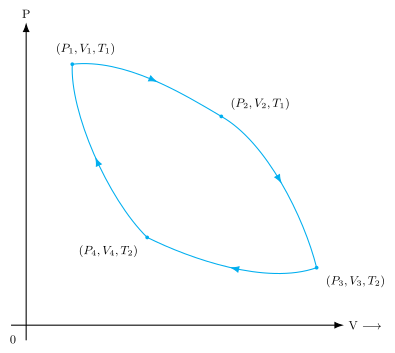
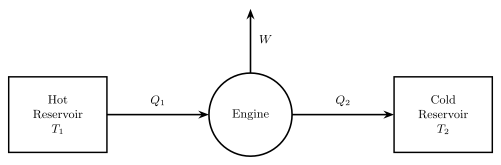
A Carnot engine is an ideal heat engine that operates between a hot reservoir (source) at temperature T1 and a cold reservoir (sink) at temperature T2 (T1 greater than T2). Its working substance (an ideal gas) is taken through a reversible cycle of four steps:
- Isothermal expansion (at T1): The gas absorbs heat Q1 from the source and expands isothermally, doing work. Temperature stays constant at T1.
- Adiabatic expansion: The gas is thermally insulated and expands, doing work; its temperature falls from T1 to T2 (no heat exchange).
- Isothermal compression (at T2): The gas is compressed at constant temperature T2 and rejects heat Q2 to the sink.
- Adiabatic compression: The gas is insulated and compressed; its temperature rises from T2 back to T1, returning it to the initial state and completing the cycle.
PART 3 — Efficiency: …
Unlock everything free for 14 days
- Full step-by-step solutions
- Concept-first explanations
- Methods, shortcuts & mistakes
- PYQ mapping + timed mock tests
Full access for 14 days. No credit card required.