Question of 35
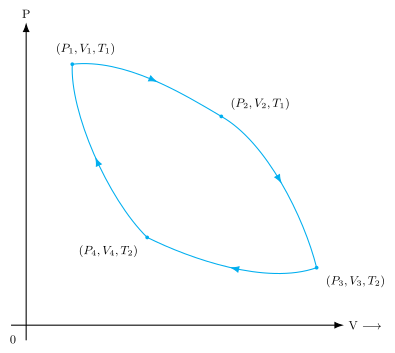
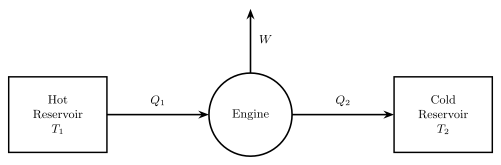
Q.Explain the Carnot cycle. Also prove that the efficiency of a Carnot engine is η = 1 - T2/T1. [3+2=5] OR Establish the formula for the work done in isothermal and adiabatic processes.
Rajasthan RbseRajasthan Board Senior Secondary Part-I Examination 2024Subjective· 5mImportance★★★★★
0% · 0/35 Questions
You're viewing a preview — the full solution, concept, methods & PYQ mapping are locked.
Start your 14-day free trial to unlock the full solution →The Carnot cycle is a 4-step reversible cycle (isothermal expansion, adiabatic expansion, isothermal compression, adiabatic compression) between two temperatures T1 (hot) and T2 (cold); working through the heat exchanged in each step gives efficiency η = 1 − T2/T1.
The Carnot cycle (four reversible steps), for 1 mole of ideal gas:
- Isothermal expansion (A→B) at temperature T1: gas absorbs heat Q1 from the hot reservoir while expanding from V1 to V2; since ΔU = 0 for an isothermal process of an ideal gas, all absorbed heat is converted to work: Q1 = W1 = RT1 ln(V2/V1)
- Adiabatic expansion (B→C): gas expands from V2 to V3, cooling from T1 to T2, with no heat exchange (Q=0); work is done at the expense of internal energy.
- Isothermal compression (C→D) at temperature T2: gas is compressed from V3 to V4, rejecting heat Q2 to the cold reservoir: Q2 = RT2 ln(V3/V4)
- Adiabatic compression (D→A): gas is compressed back to its initial state, from V4 to V1, temperature rising from T2 back to T1, again with no heat exchange.
Efficiency:
Efficiency is defined as (net work done)/(heat absorbed from the source):
η = W/Q1 = (Q1 − Q2)/Q1 = 1 − Q2/Q1
…
Unlock everything free for 14 days
- Full step-by-step solutions
- Concept-first explanations
- Methods, shortcuts & mistakes
- PYQ mapping + timed mock tests
Full access for 14 days. No credit card required.