Q.Describe the working of Carnot engine. Obtain an expression for the efficiency. A refrigerator is to maintain eatables kept inside at 9°C. If room temperature is 36°C, calculate the coefficient of performance.
You're viewing a preview — the full solution, concept, methods & PYQ mapping are locked.
Start your 14-day free trial to unlock the full solution →A Carnot engine is an idealized reversible heat engine operating between a hot reservoir (source, T₁) and a cold reservoir (sink, T₂) in a 4-step cycle, with efficiency η = 1 − T₂/T₁. Treating the refrigerator as running the reverse Carnot cycle between T₂ = 282 K and T₁ = 309 K gives a coefficient of performance of about 10.44.
Part 1 — Working of the Carnot engine.
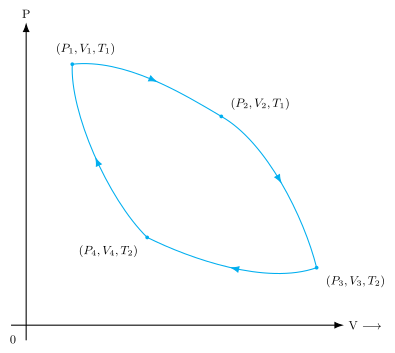
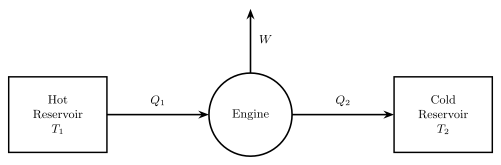
A Carnot engine is an ideal, reversible heat engine that absorbs heat from a source (hot reservoir) at a fixed high temperature T₁, converts part of it into work, and rejects the rest to a sink (cold reservoir) at a fixed low temperature T₂. It operates in a closed cycle of four reversible steps, using an ideal gas as the working substance in a cylinder with a frictionless piston:
- Isothermal expansion (A→B): The gas, in contact with the source at temperature T₁, absorbs heat Q₁ from the source and expands isothermally (temperature stays at T₁), doing work on the surroundings, with its internal energy unchanged (since ΔU = 0 for an isothermal process of an ideal gas).
- Adiabatic expansion (B→C): The gas is thermally isolated (no heat exchange) and allowed to expand further, doing additional work at the expense of its own internal energy, so its temperature falls from T₁ to T₂.
- Isothermal compression (C→D): The gas, now in contact with the sink at temperature T₂, is compressed isothermally; work is done on the gas, and it rejects heat Q₂ to the sink (temperature remains T₂).
- Adiabatic compression (D→A): The gas is thermally isolated again and compressed adiabatically back to its initial state A, its temperature rising from T₂ back to T₁, completing the cycle.
Part 2 — Efficiency of the Carnot engine.
The net work done by the engine per cycle is W = Q₁ − Q₂ (heat absorbed minus heat rejected), and the efficiency is defined as the fraction of absorbed heat converted to useful work:
η = W / Q₁ = (Q₁ − Q₂) / Q₁ = 1 − Q₂/Q₁
For a Carnot cycle, it can be shown (from the properties of the isothermal and adiabatic steps) that Q₂/Q₁ = T₂/T₁, so:
η = 1 − T₂/T₁
…
Unlock everything free for 14 days
- Full step-by-step solutions
- Concept-first explanations
- Methods, shortcuts & mistakes
- PYQ mapping + timed mock tests
Full access for 14 days. No credit card required.