Q.Explain reversible and irreversible processes. Describe the working of Carnot engine. Obtain an expression for the efficiency.
You're viewing a preview — the full solution, concept, methods & PYQ mapping are locked.
Start your 14-day free trial to unlock the full solution →Reversible processes are idealised and exactly undoable; irreversible processes are real and cannot be perfectly undone. The Carnot engine is the ideal reversible heat engine, with efficiency η = 1 − T₂/T₁ — the theoretical maximum for any engine working between those two temperatures.
Reversible process: A process is reversible if it can be carried out in such a way that, at the end, both the system and its surroundings can be restored exactly to their original states, with no trace left behind. A reversible process must proceed through a continuous succession of equilibrium states (quasi-static), infinitely slowly, with no dissipative effects such as friction, viscosity, or unrestrained expansion. Reversible processes are an idealisation — no real process is perfectly reversible, but some (like a very slow, frictionless, ideal-gas compression) can closely approximate one.
Irreversible process: A process is irreversible if it cannot be exactly reversed — that is, the system and surroundings cannot both be brought back to their original states without some external intervention leaving a permanent change somewhere. All real, naturally-occurring processes are irreversible, because they involve friction, viscosity, finite temperature/pressure differences, or free (unrestrained) expansion. Examples: heat flowing from a hot body to a cold one, gas expanding freely into a vacuum, a pendulum slowing down due to air resistance.
The Carnot engine:
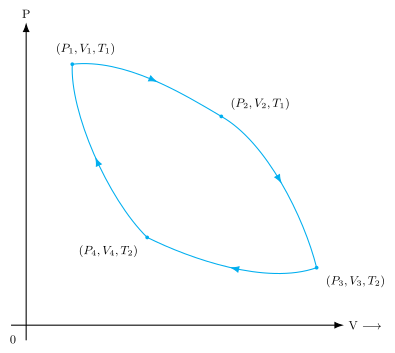
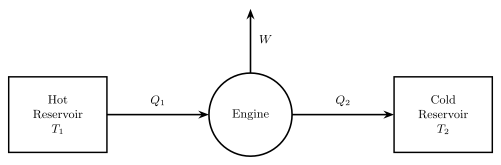
The Carnot engine is an idealised heat engine that operates in a cycle between two heat reservoirs — a hot source at temperature and a cold sink at temperature () — using only reversible processes, making it the most efficient engine theoretically possible between those two temperatures. Its working substance (usually taken as an ideal gas) undergoes a cycle of four reversible steps:
- Isothermal expansion at : the gas absorbs heat from the hot reservoir and expands, doing work, while staying at constant temperature .
- Adiabatic expansion: the gas expands further with no heat exchange, so its temperature drops from to .
- Isothermal compression at : the gas is compressed while releasing heat to the cold reservoir, staying at constant temperature . …
Unlock everything free for 14 days
- Full step-by-step solutions
- Concept-first explanations
- Methods, shortcuts & mistakes
- PYQ mapping + timed mock tests
Full access for 14 days. No credit card required.