Q.Is it possible to increase the temperature of a gas without adding heat to it? Explain.
🔒You're viewing a preview — the full solution, concept, methods & PYQ mapping are locked.
🔒 Start your 14-day free trial to unlock the full solution →Concept understanding — Adiabatic Compression Factor
Adiabatic Compression Factor: From Intuition to Precision
Imagine you pump air into a bicycle tyre. The pump gets noticeably warm. That warmth isn't coming from outside — it's generated inside the air you're compressing. Why? Because you're doing work on the gas, and since the compression happens too fast for heat to escape, all that work stays inside as internal energy, raising the temperature.
This is the core idea: adiabatic means "no heat exchange with the surroundings." When you compress a gas adiabatically, its temperature rises. The adiabatic compression factor is the ratio that tells you how much the temperature rises for a given compression.
The Intuition First
Think of a gas as a swarm of tiny, fast-moving particles. When you push a piston in, you're moving the wall toward the particles. Each time a particle bounces off the approaching wall, it rebounds with a higher speed than it had — like a tennis ball hit by a moving racket. Faster particles mean higher temperature.
If the compression is slow enough that heat can leak out (isothermal), the temperature stays constant. But if it's fast (adiabatic), the temperature climbs. The adiabatic compression factor captures exactly this: the ratio of final temperature to initial temperature when a gas is compressed without heat loss.
The Precise Statement
For an ideal gas undergoing a reversible adiabatic process, the relationship between temperature (T) and volume (V) is:
TVγ−1=constant
where γ (gamma) is the adiabatic index — the ratio of specific heats: γ=CvCp.
If you compress from volume V1 to V2 (so V2<V1), the temperature changes from T1 to T2 according to:
T2=T1(V2V1)γ−1
The factor (V2V1)γ−1 is the adiabatic compression factor for temperature. Since V1/V2>1 and γ−1>0, this factor is always greater than 1 — confirming that temperature rises.
Adiabatic compression factor (temperature)=(V2V1)γ−1
You can also express it in terms of pressure. Using PVγ=constant, you get:
T2=T1(P1P2)γγ−1
Here (P1P2)γγ−1 is the pressure-based version.
What γ Means
γ depends on the number of degrees of freedom of the gas molecule:
| Gas type | Degrees of freedom | γ | Example |
|---|---|---|---|
| Monatomic | 3 (translation only) | 5/3 ≈ 1.67 | He, Ar |
| Diatomic / linear triatomic (rigid) | 5 (3 translation + 2 rotation) | 7/5 = 1.40 | N₂, O₂; CO₂ (theoretical) |
| Non-linear triatomic | 6 (3 translation + 3 rotation) | 4/3 ≈ 1.33 | H₂O vapour |
A higher γ means the temperature rises more sharply for the same compression. Monatomic gases heat up the most — they have only translational motion to store energy, so all the work of compression goes into raising temperature. …
Concept: Adiabatic Compression
Yes, a gas can be heated without adding heat by doing work on it under adiabatic conditions.
The first law of thermodynamics states:
ΔU=Q−W
where ΔU is the change in internal energy, Q is heat added to the system, and W is work done by the system.
For an ideal gas, internal energy depends only on temperature: ΔU=nCVΔT. If we compress the gas adiabatically (Q=0), then:
ΔU=−W …
Yes—compress the gas adiabatically (no heat exchange). Work done on the gas converts directly into internal energy, raising its temperature without any heat transfer.
Why temperature can rise without heat
Temperature measures the average kinetic energy of molecules. The first law of thermodynamics tells us that the internal energy of a gas changes according to
ΔU=Q−W
where Q is heat added to the system and W is work done by the system. For an ideal gas, internal energy depends only on temperature: ΔU=nCVΔT.
Now here's the key insight: if we can change ΔU without changing Q, we change temperature without heat. The route is work.
The adiabatic compression route
An adiabatic process is one in which no heat enters or leaves the system: Q=0. This happens when the process is fast (no time for heat exchange) or when the container is perfectly insulated.
Under adiabatic conditions, the first law simplifies to
ΔU=−W
If we compress the gas—do work on it—then W (work done by the gas) is negative, so ΔU is positive. The internal energy rises, and with it the temperature.
Physical picture
-
Compression does microscopic work. When a piston moves inward, molecules bouncing off it rebound with higher speed—like a ball bouncing off an approaching bat. Each collision transfers kinetic energy to the molecules.
-
No heat leaks out. Because the process is adiabatic, this added kinetic energy stays in the gas; it isn't conducted away to the surroundings.
-
Temperature climbs. More kinetic energy per molecule means higher temperature, even though Q=0.
This is exactly how a diesel engine ignites fuel: rapid adiabatic compression heats air to the ignition temperature without a spark plug. …
Reach for a familiar mechanical example instead of the formula: pump up a bicycle tyre quickly and feel the pump barrel — it gets noticeably warm, even though no flame touched it. That warmth comes purely from mechanical work done on the trapped air, with essentially no heat exchanged through the pump walls over just a few fast strokes (approximately adiabatic). The general lesson this illustrates: temperature depends only …
Showing the 12 most recent of 26 on this concept.
- AP EAPCET 2026Set eng-2026-05-14-FN1 markMCQQ.Two gases 'A' and 'B' are initially at same pressure, volume and temperature. If 'A' is compressed isothermally and 'B' adiabatically to half of the initial volume, then the final pressure of 'A' is (A) greater than the final pressure of 'B' (B) equal to the final pressure of 'B' (C) less than the final pressure of 'B' (D) twice the final pressure of 'B'
›Reveal solutionSolution
This compares final pressures after equal-volume isothermal vs adiabatic compression, using PV=const vs PVγ=const. The answer is (C) less than the final pressure of B.
Concept and Intuition
An adiabatic curve is always steeper than an isothermal curve at any common point on a P-V diagram (since γ>1). This means for the same fractional decrease in volume, adiabatic compression raises the pressure by a larger factor than isothermal compression does. Physically, in adiabatic compression no heat escapes, so all the compression work raises the gas's internal energy (and hence temperature and pressure) further than in the isothermal case, where the gas can shed heat to keep temperature — and hence pressure rise — smaller.
Step-by-Step Solution
- Both gases start at the same P0,V0,T0.
- Gas A, isothermal to V0/2: P0V0=PA(V0/2)⇒PA=2P0.
- Gas B, adiabatic to V0/2: P0V0γ=PB(V0/2)γ⇒PB=P0⋅2γ. …
- AP EAPCET 2026Set eng-2026-05-15-FN1 markMCQQ.The pressure and density of a diatomic gas (γ=57) change adiabatically from (p, d) to (p1,d1). If dd1=32, then pp1 should be (A) 1281 (B) 32 (C) 128 (D) 321
›Reveal solutionSolution
For an adiabatic change, pressure scales with density as p∝dγ; with d′/d=32=25 and γ=7/5, the exponent works out to a clean integer power, giving p′/p=27=128.
Concept and Intuition
The adiabatic condition pVγ=constant is usually written in terms of volume, but density d=Vm is just ∝1/V for a fixed mass of gas. Substituting V∝1/d turns the law into pd−γ=constant, i.e. p∝dγ. This is a very handy restated form whenever a problem gives density ratios instead of volume ratios.
Step-by-Step Solution
- Start from pVγ=p1V′γ.
- Replace V→d1 and V′→d′1: pd−γ=p1d′−γ.
- Rearrange: pp1=(dd1)γ.
- Substitute d1/d=32 and γ=7/5: pp1=327/5. …
- AP EAPCET 2026Set eng-2026-05-18-FN1 markMCQQ.The pressure P1 and density d1 of a diatomic gas change to P2 and d2 during an adiabatic operation. Find the value of P2P1, if d1d2=32 (A) 128 (B) 641 (C) 64 (D) 1281
›Reveal solutionSolution
This tests relating pressure and density in an adiabatic process via γ for a diatomic gas. Answer: P1/P2=1/128.
Concept and Intuition
In an adiabatic process, PVγ=constant. Since density is inversely proportional to volume for a fixed mass of gas, this relation can be rewritten directly in terms of pressure and density: P∝ργ. For a diatomic gas, γ=7/5=1.4.
Step-by-Step Solution
- Adiabatic relation: P1V1γ=P2V2γ⇒P2P1=(V1V2)γ.
- Since density ρ=m/V (mass constant), V∝1/ρ, so V1V2=ρ2ρ1.
- Thus P2P1=(ρ2ρ1)γ=(d2d1)γ.
- Given d1d2=32, so d2d1=321. …
- AP EAPCET 2026Set ap-2026-05-19-FN1 markMCQQ.During an adiabatic process, if the volume of 4 moles of a monoatomic gas initially at a temperature of 127∘C increases by 7 times, then the work done by the gas is (R - universal gas constant) (A) 2400 R (B) 900 R (C) 1800 R (D) 1200 R
›Reveal solutionSolution
Tests the adiabatic relation TVγ−1=const to find the temperature drop on expansion, then converts that into work done using W=−ΔU (since Q=0).
Concept and Intuition
In an adiabatic process no heat is exchanged, so any work the gas does on its surroundings comes entirely out of its internal energy — the gas must cool as it expands. Finding the final temperature from the adiabatic volume relation is the key step; after that, W=nCv(T1−T2) follows directly since Q=0.
Step-by-Step Solution
- Initial temperature T1=127+273=400K. The volume "increases by 7 times" means the increase itself equals 7V1, so the final volume is V2=V1+7V1=8V1.
- Monoatomic gas: γ=5/3, so γ−1=2/3.
- Adiabatic relation: T1V1γ−1=T2V2γ−1⇒T2=T1(V2V1)2/3=400(81)2/3.
- (81)2/3=(2−3)2/3=2−2=41, so T2=400×41=100K. …
- AP EAPCET 2025Set eng-2025-05-21-AN1 markMCQQ.If a gas of volume 400 cc at an initial pressure P is suddenly compressed to 100 cc, then its final pressure is (The ratio of the specific heat capacities of the gas at constant pressure and constant volume is 1.5) (A) 32P (B) 8P (C) 32P (D) 16P
›Reveal solutionSolution
Sudden compression is adiabatic; applying P1V1γ=P2V2γ with γ=1.5 and a volume ratio of 4 gives the final pressure 8P.
Concept and Intuition
"Suddenly compressed" signals no time for heat exchange with the surroundings — this is an adiabatic process, governed by PVγ=constant, not Boyle's law (PV=const, which is isothermal). The extra pressure rise beyond what Boyle's law would predict comes from the gas heating up as it's compressed (since no heat escapes, the compression work raises internal energy/temperature).
Step-by-Step Solution
- Adiabatic relation: P1V1γ=P2V2γ.
- Given V1=400 cc, V2=100 cc, so V2V1=4.
- γ=Cp/Cv=1.5.
- P2=P1(V2V1)γ=P×41.5. …
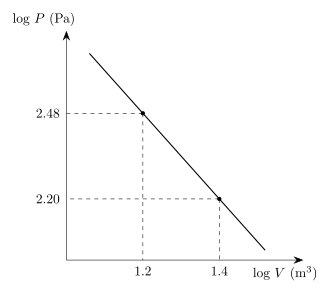
- AP EAPCET 2025Set eng-2025-05-23-FN1 markMCQQ.If the given graph shows the logarithmic values of pressure (P) and volume (V) of an ideal gas, then the ratio of the specific heat capacities of the gas is [FIGURE] (a straight line graph of log P (Pa) on the y-axis vs log V (m^3) on the x-axis, sloping downward from left to right; the line passes through the points (1.2, 2.48) and (1.4, 2.20), each marked with dashed guide lines) (A) 1.5 (B) 1.2 (C) 1.4 (D) 1.3
›Reveal solutionSolution
A straight line on a logP vs logV plot represents an adiabatic process, whose slope's magnitude directly gives γ=CP/CV. Answer: 1.4.
Concept and Intuition
For an adiabatic process of an ideal gas, PVγ=constant. Taking logarithms: logP+γlogV=constant, i.e. logP=−γlogV+constant. This is a straight line with slope −γ when plotted as logP (y-axis) versus logV (x-axis) — exactly the graph given, which decreases as V increases (consistent with a negative slope).
Step-by-Step Solution
- Slope of the line =Δ(logV)Δ(logP)=1.4−1.22.20−2.48=0.2−0.28=−1.4.
- Comparing to logP=−γlogV+const, the slope equals −γ.
- So −γ=−1.4⇒γ=1.4. …
- AP EAPCET 2025Set eng-2025-05-26-AN1 markMCQQ.If 5.6 litres of a monoatomic gas at STP is adiabatically compressed to 0.7 litres, then the work done on the gas is nearly (R - Universal gas constant) (A) 307R (B) 357R (C) 367R (D) 407R
›Reveal solutionSolution
For an adiabatic compression, no heat is exchanged, so the work done on the gas equals its rise in internal energy; computing T2 from TVγ−1=const and then ΔU gives about 307R.
Concept and Intuition
In an adiabatic process, Q=0, so the first law of thermodynamics ΔU=Q−Wby gas reduces to ΔU=−Wby gas=Won gas. That is, all the work done on the gas during adiabatic compression goes directly into raising its internal energy — there is nowhere else for the energy to go since no heat can escape.
For an adiabatic process, TVγ−1=constant, which lets us find the final temperature purely from the volume ratio and γ (here γ=5/3 for a monoatomic gas).
Step-by-Step Solution
- Find moles at STP: n=22.4 L/mol5.6 L=0.25 mol; T1=273 K.
- Volume ratio: V2V1=0.75.6=8.
- Adiabatic relation: T2=T1(V2V1)γ−1=273×82/3.
- 82/3=(23)2/3=22=4, so T2=273×4=1092 K.
- ΔT=1092−273=819 K. …
- AP EAPCET 2025Set eng-2025-05-26-FN1 markMCQQ.When an ideal diatomic gas undergoes adiabatic expansion, if the increase in its volume is 0.5%, then the change in the pressure of the gas is (A) +0.5% (B) -0.5% (C) -0.7% (D) +0.7%
›Reveal solutionSolution
Taking the logarithmic differential of the adiabatic law PVγ=const links fractional changes in pressure and volume through γ; for a diatomic gas (γ=1.4) a +0.5% volume change gives a −0.7% pressure change — option (C).
Concept and Intuition
In an adiabatic process, no heat is exchanged, and the gas obeys PVγ=constant. For small (percentage-scale) changes, it's convenient to take the logarithmic derivative of this relation rather than solving it exactly — this converts the power-law relationship into a simple linear one between the fractional (percentage) changes in P and V.
Step-by-Step Solution
- Start from PVγ=const.
- Take natural log: lnP+γlnV=const.
- Differentiate: PdP+γVdV=0 ⇒ PdP=−γVdV.
- For a diatomic ideal gas, γ=57=1.4. …
- AP EAPCET 2025Set eng-2025-05-27-FN1 markMCQQ.A monatomic gas at a pressure of 100 kPa expands adiabatically such that its final volume becomes 8 times its initial volume. If the work done during the process is 180 J, then the initial volume of the gas is (A) 1600 cm3 (B) 800 cm3 (C) 1200 cm3 (D) 2000 cm3
›Reveal solutionSolution
This tests the adiabatic work formula W=γ−1P1V1−P2V2 for a monatomic gas; the answer is (A) 1600 cm3.
Concept and Intuition
In an adiabatic process no heat is exchanged, so all the work done by the gas comes at the expense of its internal energy: W=−ΔU=γ−1P1V1−P2V2. For a monatomic gas γ=5/3. Since we're given the volume ratio (V2=8V1), we can find P2 in terms of P1 using the adiabatic relation PVγ=constant, and then everything reduces to one unknown, V1.
Step-by-Step Solution
- Given: P1=100 kPa, V2=8V1, W=180 J, monatomic so γ=5/3.
- Adiabatic relation: P1V1γ=P2V2γ⇒P2=P1(V2V1)γ=P1(81)5/3.
- Since 8=23, 85/3=25=32, so P2=32P1.
- P2V2=32P1×8V1=4P1V1. …
- AP EAPCET 2024Set ap-2024-05-16-FN1 markMCQQ.Two samples of same gas (γ=23) have equal volume. If their volumes are doubled by adiabatic and isothermal processes respectively for sample 1 and 2. Their final pressures are now equal. The ratio of initial pressures is (A) 2 (B) 21 (C) 23 (D) 2/3
›Reveal solutionSolution
This tests comparing final pressures reached by the same starting gas volume under two different doubling processes — adiabatic vs isothermal — using their respective PV relations.
Concept and Intuition
An adiabatic expansion follows PVγ=constant while an isothermal expansion follows the simpler PV=constant (Boyle's law). Both samples start with the same volume V0 (though possibly different initial pressures) and both are expanded to the same final volume 2V0. Since we're told their final pressures come out equal, we can write each process's pressure relation, solve each for the common final pressure, and equate them to find the ratio of the two initial pressures needed to make that happen.
Step-by-Step Solution
- Sample 1 undergoes adiabatic expansion: P1V0γ=Pf(2V0)γ⇒Pf=P1(2V0V0)γ=2γP1.
- Sample 2 undergoes isothermal expansion: P2V0=Pf(2V0)⇒Pf=2P2. …
- AP EAPCET 2024Set eng-2024-05-20-AN1 markMCQQ.A certain volume of a gas at 300 K expands adiabatically until its volume is doubled. The resultant fall in temperature of the gas is nearly (The ratio of the specific heats of the gas =1.5) (A) 88 K (B) 77 K (C) 67 K (D) 54 K
›Reveal solutionSolution
Using the adiabatic relation TVγ−1=const with γ=1.5 and volume doubling gives a temperature fall of about 88 K.
Concept and Intuition
In an adiabatic process no heat is exchanged, so any expansion is powered entirely by the gas's own internal energy — the gas does work on its surroundings and necessarily cools. The relation TVγ−1=constant captures exactly how much a given volume expansion cools an ideal gas, with the exponent set by γ (how many degrees of freedom store the energy).
Step-by-Step Solution
- Adiabatic condition: T1V1γ−1=T2V2γ−1.
- Rearranged: T2=T1(V2V1)γ−1=300(21)1.5−1=300(0.5)0.5.
- (0.5)0.5=0.7071, so T2=300×0.7071=212.1 K. …
- AP EAPCET 2024Set eng-2024-05-21-AN1 markMCQQ.An ideal gas is found to obey PV3/2=constant during an adiabatic process. If such a gas initially at a temperature T is adiabatically compressed to 41th of its volume, then its final temperature is (A) 3T (B) 2T (C) 2T (D) 3T
›Reveal solutionSolution
Matching PV3/2=const to the adiabatic form PVγ=const gives γ=3/2; the companion relation TVγ−1=const then gives the final temperature, 2T.
Concept and Intuition
An adiabatic process for an ideal gas obeys PVγ=const, and combining this with the ideal gas law PV=nRT gives an equivalent relation directly between temperature and volume, TVγ−1=const. Once we identify the effective γ from the given P–V relation, we can jump straight to how temperature responds to a volume change, without needing pressure at all.
Step-by-Step Solution
- Given PV3/2=const, so γ=3/2 for this (unusual) gas.
- Adiabatic T–V relation: TVγ−1=const, here γ−1=1/2. …
🎓Unlock everything free for 14 days
- ✓Full step-by-step solutions
- ✓Concept-first explanations
- ✓Methods, shortcuts & mistakes
- ✓PYQ mapping + timed mock tests
Full access for 14 days. No credit card required.