Q.A person of mass 60 kg wants to lose 5 kg by going up and down a 10 m high stairs. Assume he burns twice as much fat while going up than coming down. If 1 kg of fat is burnt on expending 7000 kilo calories, how many times must he go up and down to reduce his weight by 5 kg?
🔒You're viewing a preview — the full solution, concept, methods & PYQ mapping are locked.
🔒 Start your 14-day free trial to unlock the full solution →Concept understanding — Work Energy Principle
The Work-Energy Principle: From Intuition to Precision
Imagine pushing a heavy box across a rough floor. The harder you push and the farther it slides, the faster it moves when you let go. That connection — between the effort you put in (force × distance) and the change in the box's motion — is exactly what the Work-Energy Principle captures.
The Intuition First
Think of work as "energy transferred by a force." When you do work on an object, you're essentially pumping energy into it. That energy has to go somewhere — and in the simplest case, it shows up as a change in the object's speed. The object's kinetic energy (energy of motion) increases by exactly the amount of work you did.
This is why a car's brakes get hot: the work done by friction removes kinetic energy, turning it into thermal energy. The principle holds even when energy changes form.
The Precise Statement
Wnet=ΔK=Kf−Ki=21mvf2−21mvi2
Where:
- Wnet = net work done on the object (total work from all forces combined)
- K = kinetic energy = 21mv2
- m = mass, v = speed
The net work done on an object equals the change in its kinetic energy.
Why "Net Work" Matters
If you push a box forward while friction pulls it backward, only the net force matters. Suppose you push with 50 N and friction opposes with 30 N over 2 m:
- Work done by you: 50×2=100 J
- Work done by friction: −30×2=−60 J (negative because force opposes motion)
- Net work: 100−60=40 J
That 40 J is exactly the increase in the box's kinetic energy. The individual works don't matter — only the sum.
A Common Trap
The Work-Energy Principle applies to net work, not work done by a single force. A force can do positive work while the object slows down (if another force does even more negative work). Always find the total work from all forces.
When Does It Hold?
The principle works for:
- Any constant or varying force
- Straight-line or curved paths
- Objects that don't rotate (for now)
It fails if:
- The object deforms permanently (like crumpling a car) …
The mechanical energy spent climbing up the stairs is mgh, using g=9.8 m/s2. Since the person burns twice as much fat going up as coming down, the energy spent coming down is half that of going up.
Energy spent climbing up: Eup=mgh=60×9.8×10=5880 J. Energy spent coming down: Edown=21Eup=2940 J. Energy per round trip: Etrip=5880+2940=8820 J. …
Solution
Concept: Work-Energy Principle applied to metabolic energy expenditure.
The mechanical energy spent climbing up the stairs is mgh. Since the person burns twice as much fat going up as coming down, energy spent coming down is half that of going up.
Energy spent climbing up:
Eup=mgh=60×9.8×10=5880 J
Energy spent coming down (half of going up):
Edown=21Eup=2940 J
Energy per round trip:
Etrip=Eup+Edown=5880+2940=8820 J
Total energy needed to burn 5 kg fat:
Using 1 kcal = 4200 J: …
Proportional-reasoning shortcut. Since going up burns exactly twice the fat of coming down, one full round trip costs 1.5× the energy of a single climb — there's no need to track 'up' and 'down' energies separately. Climbing energy per trip: mgh=60×9.8×10=5880 J ≈1.4 kcal (using 1 kcal=4200 J), so one round trip costs 1.5×1.4=2.1 kcal. Number of trips needed: $n=\dfrac{5\times70 …
- AP EAPCET 2026Set eng-2026-05-12-FN1 markMCQQ.A motor of efficiency 80% lifts water from a tank and delivers it from the end of a pipe which is 3.2 m vertically above the level from which water is drawn. If the cross-sectional area of the pipe is 12 cm2 and water leaves the end of the pipe at a speed of 6 ms−1, then the power of the motor is (acceleration due to gravity =10 ms−2) (A) 450 W (B) 360 W (C) 900 W (D) 720 W
›Reveal solutionSolution
This tests the energy-rate (power) approach to fluid flow with an inefficient motor: compute the mechanical power delivered to the water (PE rate + KE rate), then scale up by the efficiency to get the electrical/input power the motor draws. Answer: (A).
Concept and Intuition
The motor does two useful things to the water every second: it lifts a certain mass through height h=3.2 m (giving it gravitational PE), and it accelerates it up to the exit speed v=6 m/s (giving it KE). The rate at which this useful energy is delivered is the motor's output power. But the motor is only 80% efficient — it must actually draw more input power than this useful output, because some of the input is wasted (as heat, friction, etc.). So input power = output power / efficiency.
Step-by-Step Solution
- Mass flow rate: water leaves the pipe of area A=12 cm2=12×10−4 m2 at speed v=6 m/s, so the volume flow rate is Av=7.2×10⁻³ m3/s, and with density ρ=1000 kg/m3,
m˙=ρAv=7.2 kg/s.
- Useful (output) power: each kilogram of water gains PE =gh=10×3.2=32 J and KE =21v2=21×36=18 J, total 50 J/kg. So
Pout=m˙×50=7.2×50=360 W.
- Motor input power: since the motor is 80% efficient, Pout=0.8Pin, so Pin=0.8360=450 W. …
- AP EAPCET 2026Set eng-2026-05-14-FN1 markMCQQ.A 5 kg block is pushed by 100 N over 10 m on a plane. If the coefficient of friction between the block and plane is 0.2, the final kinetic energy of the block is ____ (g=10 ms−2) (A) 1000 J (B) 900 J (C) 800 J (D) 700 J
›Reveal solutionSolution
This tests the work-energy theorem with friction: net work done on the block equals its gain in kinetic energy. The answer is 900 J.
Concept and Intuition
The work-energy theorem says the net work done by all forces on an object equals its change in kinetic energy. Here two horizontal forces act along the direction of motion: the applied 100 N push (doing positive work) and kinetic friction (doing negative work, since it always opposes relative sliding). The block starts from rest, so its final KE is exactly the net work done over the 10 m displacement.
Step-by-Step Solution
- Work done by the applied force over 10 m: WF=F×d=100×10=1000 J.
- Normal force on a horizontal plane equals weight: N=mg=5×10=50 N.
- Kinetic friction force: f=μN=0.2×50=10 N. …
- AP EAPCET 2026Set eng-2026-05-15-FN1 markMCQQ.An object is sliding (without rolling) from the top of the smooth inclined plane of height h from rest as shown and it just completes a vertical circle of diameter 20 cm. Then the minimum height h of smooth inclined plane is [FIGURE: a right-triangular smooth inclined plane of height h, with a small block sliding down from the top and a circular loop of diameter 20 cm at the bottom of the incline] (A) 0.25 m (B) 0.2 m (C) 0.5 m (D) 2.5 m
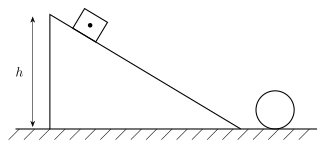
›Reveal solutionSolution
The minimum-height problem for a ball that slides down a smooth incline and then "just completes" a vertical circular loop: combine the "just completes the loop" condition (vtop2=gr) with energy conservation from the starting height to the top of the loop, giving h=2.5r.
Concept and Intuition
"Just completes" a vertical circular loop means that at the very top of the loop, gravity alone is exactly enough to supply the centripetal force — the normal force from the track drops to zero there. Any less speed and the object would leave the track before reaching the top. This gives the minimum speed condition mg=rmvtop2⇒vtop2=gr. Everything else follows from energy conservation on a frictionless (smooth) surface, since no energy is lost.
Step-by-Step Solution
- Loop diameter d=20cm=0.2m⇒ radius r=0.1m.
- Height of the top of the loop above the ground =2r=0.2m (since the loop sits on the ground and the object must reach the very top of the loop).
- Minimum speed at the top of the loop (gravity supplies all the centripetal force): vtop2=gr.
- Energy conservation from rest at height h (top of incline, ground level = reference) to the top of the loop: …
- AP EAPCET 2026Set ap-2026-05-20-AN1 markMCQQ.A force of 250 N is required to lift a mass of 75 kg through a pulley system. In order to lift this mass through 3 m, the rope has to be pulled through 12 m. The efficiency of the system is (A) 50 % (B) 75 % (C) 33% (D) 90%
›Reveal solutionSolution
Efficiency of a machine is output (useful) work over input work; here it comes out to 75%. Answer: (B).
Concept and Intuition
A pulley system trades force for distance: you pull the rope through a larger distance to lift a load through a smaller one, with the mechanical advantage set by the number of supporting rope segments. No real machine is loss-free, so the efficiency compares the useful work actually delivered (lifting the load) to the work you actually put in (pulling the rope) — the shortfall is lost to friction in the pulleys.
Step-by-Step Solution
- Useful output work =mgh=75 kg×10 ms−2×3 m=2250 J.
- Input work supplied by the pulling force =F×d=250 N×12 m=3000 J. …
- AP EAPCET 2025Set eng-2025-05-23-FN1 markMCQQ.A particle of mass 0.2 g and charge 2 C is released from rest in a uniform electric field of 20 NC−1. The kinetic energy of the particle after moving a distance of 20 cm is (A) 10 J (B) 8 J (C) 18 J (D) 12 J
›Reveal solutionSolution
Uses the work-energy theorem: the kinetic energy gained equals the work done by the electric force over the distance moved. Answer: 8 J.
Concept and Intuition
A charged particle released from rest in a uniform electric field experiences a constant force F=qE, and by the work-energy theorem, the kinetic energy it gains equals the work done by this force as it moves: KE=F×d. The mass value given is actually irrelevant to computing the kinetic energy directly via this route (it would only be needed to find velocity or acceleration separately).
Step-by-Step Solution
- Electric force on the charge: F=qE=2 C×20 N/C=40 N.
- Distance moved: d=20 cm=0.2 m.
- By the work-energy theorem, kinetic energy gained =F×d=40×0.2=8 J. …
- AP EAPCET 2025Set ap-2025-05-20-FN1 markMCQQ.The work done to take a body of mass 100 kg to the top of a building of height 20 m is (Acceleration due to gravity = 10 ms−2) (A) 14700 J (B) 15700 J (C) 20000 J (D) 30000 J
›Reveal solutionSolution
The work done against gravity to raise a mass to a height equals mgh; with g=10 ms−2 this gives 20000 J.
Concept and Intuition
Lifting a body at (essentially) constant velocity means the applied force just balances gravity, so the work done by that force equals the gain in gravitational potential energy, mgh.
Step-by-Step Solution
- Given m=100 kg, h=20 m, g=10 ms−2 (as stated in the question).
- W=mgh=100×10×20=20000 J.
Common Mistakes …
- AP EAPCET 2023Set ap-2023-05-22-AN1 markMCQQ.The work done in lifting a body of mass 2 kg from the surface of the earth to a height 10 m is (A) 98 J (B) 196 J (C) 147 J (D) 288 J
›Reveal solutionSolution
With g=9.8 ms−2, lifting a 2 kg mass by 10 m requires work W=mgh=196 J.
Concept and Intuition
For heights small compared to Earth's radius, the gravitational field can be treated as uniform, so the work done in raising a mass against gravity equals the increase in gravitational potential energy, mgh, with no need for the more general −GMm/r expression.
Step-by-Step Solution
- Recall W=mgh for lifting a mass through height h near Earth's surface.
- Substitute m=2 kg, g=9.8 ms−2, h=10 m.
- W=2×9.8×10=196 J.
- This matches option (B).
Common Mistakes …
- AP EAPCET 2023Set ap-2023-05-23-AN1 markMCQQ.The speed of a body of mass 10 kg changes from 20ms−1 to 30ms−1. The increase in the kinetic energy of the body is (A) 1250 J (B) 4500 J (C) 2500 J (D) 3000 J
›Reveal solutionSolution
Using ΔKE=21m(vf2−vi2) with m=10 kg, vi=20, vf=30 ms−1 gives an increase of 2500 J.
Concept and Intuition
Kinetic energy is KE=21mv2. When speed changes from v1 to v2, the change in kinetic energy is the difference between the final and initial kinetic energies: ΔKE=21mv22−21mv12=21m(v22−v12).
Step-by-Step Solution
- Initial KE: 21×10×202=5×400=2000 J.
- Final KE: 21×10×302=5×900=4500 J.
- Increase in KE: 4500−2000=2500 J. …
- AP EAPCET 2021Set eng-2021-10-05-FN1 markMCQQ.A body of mass 2.5 kg is thrown vertically upwards with a kinetic energy of 500 J. The height at which the kinetic energy of the body reduces to 50% of its original value is _____ (g=10 m.s−2) (A) 10 m (B) 12.5 m (C) 25 m (D) 50 m
›Reveal solutionSolution
By energy conservation, the KE lost (250 J) converts entirely to gravitational PE, giving a height of 10 m.
Concept and Intuition
As the body rises, kinetic energy converts to gravitational potential energy (mechanical energy is conserved, ignoring air resistance): KE0=KE(h)+mgh.
Step-by-Step Solution
- Initial KE =500J; at height h, KE is 50% of that =250J.
- Energy conservation: mgh=KE0−KE(h)=500−250=250J.
- h=mg250=2.5×10250=25250=10m. …
🎓Unlock everything free for 14 days
- ✓Full step-by-step solutions
- ✓Concept-first explanations
- ✓Methods, shortcuts & mistakes
- ✓PYQ mapping + timed mock tests
Full access for 14 days. No credit card required.