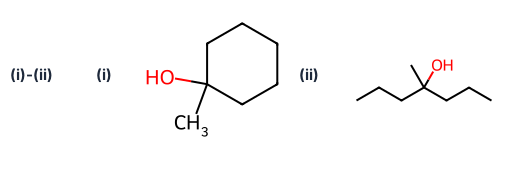
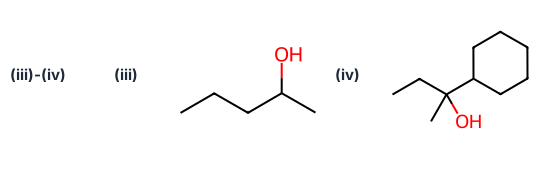
Q.Show how would you synthesise the following alcohols from appropriate alkenes?
🔒You're viewing a preview — the full solution, concept, methods & PYQ mapping are locked.
🔒 Start your 14-day free trial to unlock the full solution →Concept understanding — Electrophilic Addition Reactions
Electrophilic Aromatic Substitution – The First Meeting
Imagine you have a benzene ring — that perfect, flat hexagon of six carbons with alternating double bonds. It's stable, almost stubbornly so. You want to attach something new to it, say a bromine atom or a nitro group. But benzene doesn't react like an alkene. It doesn't just add across a double bond. Instead, it does something more elegant: it kicks out a hydrogen and keeps its aromatic ring intact.
That's the heart of Electrophilic Aromatic Substitution (EAS).
The Intuition: Why "Substitution" and Not "Addition"?
Benzene's stability comes from its delocalised π electrons — a cloud above and below the ring. This cloud is electron-rich, so it attracts electrophiles (electron-loving species). But if an electrophile simply added to a double bond, the ring would break its aromaticity, losing that huge stabilisation. That would be energetically costly.
So benzene does something smarter: it lets the electrophile attack, temporarily breaks aromaticity to form a high-energy intermediate (the arenium ion), and then loses a proton to restore the aromatic ring. The net result? A hydrogen is replaced by the electrophile. The ring is back to its stable, aromatic self.
The key trade-off: temporary loss of aromaticity is acceptable because the final product regains it. Addition reactions would permanently destroy aromaticity — benzene avoids that.
The Precise Statement
Electrophilic Aromatic Substitution is a reaction in which an electrophile (E+) replaces a hydrogen atom on an aromatic ring, proceeding through a sigma complex (arenium ion) intermediate, and restoring aromaticity after deprotonation.
The general equation:
Ar−H+EX+Ar−E+HX+
where Ar represents an aromatic ring.
The Mechanism in Three Steps
-
Generation of the electrophile – Many EAS reactions need a catalyst to create a strong enough E+. For example, bromination uses FeBrX3 to polarise BrX2 into BrX+.
-
Attack by the aromatic ring – The π electrons of benzene attack the electrophile, forming a sigma complex (also called the arenium ion or Wheland intermediate). This intermediate is non-aromatic — it has four π electrons delocalised over five carbons, and one sp3 carbon bearing the electrophile and a hydrogen.
Benzene+E+⟶Sigma complex (non-aromatic)
- Deprotonation – A base (often the counterion of the catalyst, like FeBrX4X−) removes the proton from the sp3 carbon. The pair of electrons from the C–H bond flows back into the ring, restoring the aromatic sextet.
Sigma complex+Base⟶Product+HX+
The sigma complex is not aromatic. It's a high-energy intermediate. Students often mistakenly think it's still aromatic — it isn't. That's why the step is fast and the complex is short-lived.
Why This Matters for Exams
EAS is the gateway to understanding how to put groups onto benzene rings. The rate-determining step is usually the formation of the sigma complex (step 2). The regiochemistry (where the electrophile goes) depends on whether the ring already has a substituent — that's the topic of activating/deactivating groups and ortho/para vs. meta directors. …
Why this formula?
Electrophilic Addition Reactions: Why the Mechanism Works
Electrophilic addition is a cornerstone of alkene and alkyne chemistry. Instead of memorising the "arrow pushing," let's understand why the reaction proceeds the way it does — driven by electron density, stability, and charge.
1. The Core Idea: Why Alkenes React This Way
Alkenes have a π-bond — a cloud of electrons above and below the plane of the σ-bond. This π-electron cloud is:
- Electron-rich (nucleophilic)
- Exposed (not shielded by σ-bonds like in alkanes)
An electrophile (electron-lover) is attracted to this high electron density. The reaction is electrophilic addition because the electrophile attacks first.
Key principle: The π-bond acts as a Lewis base (electron donor). The electrophile is a Lewis acid (electron acceptor).
2. The General Mechanism (Two-Step)
Step 1: Formation of a Carbocation (or Bridged Intermediate)
The electrophile (E⁺) attacks the π-bond. The π-electrons form a new σ-bond to E⁺, leaving the other carbon with a positive charge — a carbocation.
C=C+EX+⟶CX+−C−E
Why does this happen?
The π-bond is weaker than a σ-bond (~260 kJ/mol vs ~350 kJ/mol). Breaking the π-bond to form a σ-bond is energetically favourable because the new σ-bond is stronger. The carbocation is a high-energy intermediate, but it's stabilised by:
- Hyperconjugation (alkyl groups donate electron density)
- Inductive effect (alkyl groups push electrons toward the positive carbon)
Step 2: Nucleophilic Attack
A nucleophile (Nu⁻) attacks the carbocation, forming a second σ-bond.
CX+−C−E+NuX−⟶C−Nu−C−E
Why does this happen?
The carbocation is electron-deficient (positive charge). The nucleophile is electron-rich. Opposite charges attract — this is electrostatic and orbital overlap driven.
3. The Key "Formula" — Markovnikov's Rule
Statement: In the addition of HX to an unsymmetrical alkene, the hydrogen attaches to the carbon with more hydrogens already, and the X attaches to the carbon with fewer hydrogens.
Why does this rule hold? (The reasoning)
Consider propene: CHX3−CH=CHX2 + HBr.
- Possible carbocations:
- Primary carbocation: CHX3−CHX+−CHX2Br (less stable)
- Secondary carbocation: CHX3−CHBr−CHX2X+ (more stable)
The more substituted carbocation (secondary > primary) is more stable due to:
- Hyperconjugation: More alkyl groups = more C–H σ-bonds that can donate electron density into the empty p-orbital of the carbocation.
- Inductive effect: Alkyl groups are electron-donating, stabilising the positive charge.
Result: The reaction proceeds via the more stable carbocation, leading to Markovnikov addition.
Markovnikov's rule is not a law — it's a consequence of carbocation stability.
4. The "Anti-Markovnikov" Exception (Why It Happens)
With HBr in the presence of peroxides (ROOR), the addition is anti-Markovnikov — Br goes to the less substituted carbon.
Why? The mechanism changes from ionic to free-radical.
- Peroxide decomposes to radicals: ROOR2RO⋅
- RO• abstracts H from HBr: RO⋅+HBrROH+Br⋅
- Br• adds to the alkene — at the less substituted carbon (because the radical formed is more stable — tertiary > secondary > primary).
- The new radical abstracts H from another HBr, regenerating Br•. …
Each target is the Markovnikov alcohol of an alkene, so make it by acid-catalysed hydration (H2O, dilute H2SO4). Hydroboration-oxidation would give the anti-Markovnikov isomer and is not suitable here. …
Acid-catalysed hydration adds water across a C=C double bond so that -OH goes to the more substituted carbon (Markovnikov's rule). Choosing the alkene whose double bond sits at the carbon that must bear the -OH gives each alcohol directly.
Concept
In acid hydration the alkene is protonated to give the more stable carbocation; water then attacks that carbon, so -OH lands on the more substituted carbon. Three of these targets are tertiary alcohols and one is secondary - exactly the Markovnikov products - so acid hydration is the right method (hydroboration-oxidation would place -OH on the less substituted carbon).
Step-by-step
- 1-Methylcyclohex-1-ene: protonation gives the tertiary carbocation at the methyl-bearing ring carbon; water adds there, giving 1-methylcyclohexan-1-ol.
- 4-Methylhept-3-ene, CH3CH2CH2-C(CH3)=CH-CH2CH3: the more substituted carbon is the methyl-bearing C-4; Markovnikov addition of water puts -OH there, giving 4-methylheptan-4-ol.
- Pent-1-ene, CH2=CH-CH2CH2CH3: protonation gives the secondary cation at C-2; water adds to C-2, giving pentan-2-ol. …
Method: Retrosynthetic Markovnikov-Hydration Method for Alcohols from Alkenes
Core Concept
Any tertiary or secondary alcohol whose -OH sits on the MORE substituted carbon of what would be a C-C double bond can be made by acid-catalysed (Markovnikov) hydration of the corresponding alkene: protonation of the alkene gives the more stable carbocation, and water then adds to that same carbon.
Steps
- Locate the carbinol carbon (the one bearing -OH) in the target alcohol and identify the two carbons flanking it in the original chain/ring.
- Mentally remove H2O from across the carbinol carbon and an adjacent carbon to "regenerate" the alkene double bond at that position — this is the alkene precursor.
- Check that the carbinol carbon is the MORE substituted of the two alkene carbons (this confirms Markovnikov addition will correctly place -OH there; if it were the less-substituted carbon, hydroboration-oxidation — not acid hydration — would be needed instead).
- Write the synthesis as: alkene + H2O, dilute H2SO4 (or H3PO4) --> Markovnikov alcohol, mentioning that H+ generates the more stable carbocation which water then attacks.
- Repeat for each target alcohol.
Applying this: (i) 1-methylcyclohexan-1-ol comes from 1-methylcyclohex-1-ene (the tertiary ring carbon is the more-substituted alkene carbon).
(ii) 4-methylheptan-4-ol comes from 4-methylhept-3-ene (protonation gives the tertiary cation at C-4). …
- AP EAPCET 2023Set ap-2023-05-22-FN1 markMCQQ.What is the major product formed in the reaction given below? CH2=CH−CH3Br2/CCl4 major product (A) 1-Bromopropane (B) 2-Bromopropane (C) 1, 2-Dibromopropane (D) 1, 3-Dibromopropane
›Reveal solutionSolution
The reaction of propene with bromine in carbon tetrachloride is an electrophilic addition that yields the vicinal dibromide. The major product is 1,2-dibromopropane.
The key concept here is electrophilic addition of bromine to an alkene. Bromine (Br₂) is nonpolar, but when it approaches the electron-rich double bond, the bond becomes polarized. The π electrons act as a nucleophile, attacking one bromine atom and displacing the other as a bromide ion (Br⁻). This forms a cyclic bromonium ion intermediate. The bromide ion then attacks the more substituted carbon of the three-membered ring (since that carbon can better stabilize partial positive charge), leading to anti addition of the two bromine atoms across the double bond.
Let’s walk through the steps:
-
Identify the alkene: Propene (CH₂=CH–CH₃) is an unsymmetrical alkene with a terminal double bond.
-
Formation of the bromonium ion: The π electrons attack one bromine molecule. As the Br–Br bond breaks, the bromine that gains a positive charge bridges the two carbons of the double bond, forming a cyclic bromonium ion. The other bromine becomes a free bromide ion (Br⁻) in solution.
-
Nucleophilic attack by bromide: The bromide ion attacks the bromonium ion. Because the bromonium ion is a three-membered ring, the attack occurs from the opposite side (anti addition). The question is: which carbon gets attacked? The bromide prefers the more substituted carbon (the one with the methyl group) because that carbon can better accommodate partial positive charge in the transition state. So the Br⁻ attacks the middle carbon (C-2) rather than the terminal carbon (C-1). …
-
- AP EAPCET 2021Set eng-2021-08-25-FN1 markMCQQ.Which reaction of ethanol will decolorize bromine water? (A) C2H5OH+HBr⟶C2H5Br+H2O (B) 2C2H5OHH+413KC2H5−O−C2H5+H2O (C) C2H5OH+Na⟶C2H5ONa+21H2O (D) C2H5OHH+443KC2H4+H2O
›Reveal solutionSolution
Only ethanol's acid-catalysed dehydration to ethylene creates a C=C bond, which is what actually decolourises bromine water via addition. Answer: (D).
Concept and Intuition
Bromine water is a standard qualitative test for unsaturation (C=C or C≡C bonds): Br2 adds across the double bond (electrophilic addition, forming a vicinal dibromide), consuming the orange/red bromine colour. Any reaction of ethanol that does not produce an alkene or alkyne therefore cannot decolourise bromine water, no matter what other chemistry it involves.
Step-by-Step Solution
- (A) C2H5OH+HBr→C2H5Br+H2O: a substitution product, no double bond formed — no reaction with Br2 water.
- (B) 2C2H5OHH+413KC2H5−O−C2H5+H2O: intermolecular dehydration to diethyl ether — no double bond, no reaction.
- (C) C2H5OH+Na→C2H5ONa+21H2: simple deprotonation/redox with sodium — no double bond, no reaction.
- (D) C2H5OHH+443KC2H4+H2O: intramolecular (unimolecular) dehydration at the higher temperature gives ethylene, C2H4, which has a C=C bond. …
🎓Unlock everything free for 14 days
- ✓Full step-by-step solutions
- ✓Concept-first explanations
- ✓Methods, shortcuts & mistakes
- ✓PYQ mapping + timed mock tests
Full access for 14 days. No credit card required.