Q.Match the acids given in Column I with their correct IUPAC names given in Column II.
Column I:
Column II:
🔒You're viewing a preview — the full solution, concept, methods & PYQ mapping are locked.
🔒 Start your 14-day free trial to unlock the full solution →Concept understanding — IUPAC Nomenclature
IUPAC Nomenclature (Organic Compounds)
IUPAC nomenclature is a systematic way to name a compound so that its name alone tells you its exact structure, with no ambiguity. Every organic name follows the same underlying recipe, whatever the functional group.
The Recipe
-
Identify the principal characteristic group. If the molecule has a functional group senior enough to be named as a suffix (carboxylic acid > ester > amide > nitrile > aldehyde > ketone > alcohol > amine, and so on down the seniority order), that group decides the suffix and must be included in the parent chain. A halogen is never senior enough to be a suffix — it is always named as a prefix ("halo-"), whatever else is present.
-
Choose the parent chain. The parent is the longest continuous carbon chain that contains the principal characteristic group (if there is one). Among chains of the same length, the one with the most substituents wins.
-
Number the chain. Number from whichever end gives the LOWEST LOCANT to the principal characteristic group first. If there is no principal group (e.g. a simple haloalkane, or an alkene with a halogen substituent), lowest locant goes to the site of unsaturation (double/triple bond) first, then to substituents as a set.
Watch outWhen two numbering directions give the SAME locant for the principal group/unsaturation (a genuine tie), the tie-break is the lowest locant SET for the substituents as a group — compare the two sets at their first point of difference. Only if the sets are themselves tied does the alphabetically-first substituent get the lower number.
-
Name and cite the substituents as prefixes, in alphabetical order (ignoring multiplying prefixes like di-/tri- but not ignoring structural prefixes like iso-/cyclo-), each with its own locant.
-
Assemble the name: locants + substituent prefixes (alphabetical) + parent chain name + suffix (if any).
Worked Example
CH3−CH(Cl)−CH(CH3)−CH2−CH3: the longest chain is 5 carbons (pentane), no principal characteristic group (just a halogen substituent), so number for the lowest locant set. From the left: Cl at C2, methyl at C3 → set {2,3}. From the right: methyl at C3, Cl at C4 → set {3,4}. {2,3} is lower, so numbering from the left wins: 2-chloro-3-methylpentane. …
Why this formula?
IUPAC Nomenclature: Why the Rules Work the Way They Do
IUPAC nomenclature is not a single formula, but a system of rules designed to give every organic compound a unique, unambiguous name. The "why" behind these rules lies in clarity, consistency, and communication — ensuring that a chemist in Tokyo and one in Toronto draw the same structure from the same name.
1. The Core Principle: The Longest Carbon Chain
Rule: Identify the longest continuous chain of carbon atoms. This becomes the parent chain (e.g., pentane, hexane).
Why?
- The longest chain represents the backbone of the molecule.
- It gives the most stable, fundamental name — shorter chains would be branches, not the main structure.
- Example: In a molecule with 5 carbons in a row and a 2-carbon branch, calling it "pentane" (not "ethane") tells you the core skeleton is 5 carbons long.
Key idea: The parent chain is the maximum continuous path — not necessarily the one that looks "straight" on paper.
2. Numbering: Lowest Locants (The "First Point of Difference" Rule)
Rule: Number the parent chain so that substituents get the smallest possible numbers. When there's a tie, compare the first point of difference.
Why?
- This ensures reproducibility — two chemists will always number the same way.
- It avoids ambiguity: "2-methylpentane" is unambiguous; "3-methylpentane" would be a different compound.
- The first point of difference rule: If you have substituents at positions 2,4 and 3,5, choose 2,4 because 2 < 3 (the first number is smaller).
Example:
- For a methyl group on carbon 2 vs. carbon 4 of a 5-carbon chain:
- 2-methylpentane (correct)
- 4-methylpentane (wrong — higher number)
3. Alphabetical Order of Substituents
Rule: List substituents in alphabetical order (ignoring prefixes like di-, tri-, sec-, tert- but not iso-).
Why?
- Alphabetical order is a universal sorting convention — no need to remember priority based on size or complexity.
- It makes names searchable and predictable.
- Example: "3-ethyl-2-methylpentane" (e before m) — not "2-methyl-3-ethylpentane".
Exception: Prefixes like iso- and neo- are considered part of the name (e.g., isopropyl comes before methyl because "i" < "m").
4. Multiple Bonds: The "Lowest Locant" Rule for Alkenes/Alkynes
Rule: Number the chain so that the double or triple bond gets the lowest possible number, even if it means giving a substituent a higher number.
Why?
- The functional group (alkene/alkyne) is more important than alkyl substituents.
- The bond position defines the compound's reactivity and geometry.
- Example: In pent-2-ene (not pent-3-ene), the double bond is between carbons 2 and 3 — the lower number (2) is used.
Priority order:
- Principal functional group (e.g., -OH, -COOH, C=C)
- Multiple bonds
- Substituents (alkyl, halo, etc.)
5. The "Suffix" and "Prefix" System …
Concept: IUPAC Nomenclature of dicarboxylic acids — the parent chain is the longest carbon chain containing both carboxyl groups, numbered from one carboxyl carbon to the other.
Reasoning:
- Phthalic acid has a benzene ring with two carboxyl groups at positions 1 and 2 → Benzene-1,2-dicarboxylic acid.
- Oxalic acid has two carboxyl groups directly bonded (2 carbons total) → Ethane-1,2-dioic acid. …
This matching problem connects common (trivial) names of dicarboxylic acids to their systematic IUPAC names. The key is to count the total carbon atoms in the parent chain (including both carboxyl carbons) and note the benzene ring in phthalic acid. The correct matches are: (i)→(b), (ii)→(e), (iii)→(d), (iv)→(a), (v)→(c).
Why IUPAC Nomenclature for Dicarboxylic Acids Works This Way
The IUPAC system names a dicarboxylic acid by identifying the longest continuous carbon chain that contains both carboxyl (−COOH) groups. The suffix "-dioic acid" replaces the "-e" of the parent alkane name. The two carboxyl carbons are always carbon 1 and the last carbon of the chain — so numbering is fixed, and locants (1,6- etc.) are mandatory to show the positions.
The common names you see in Column I are historical: they come from the source where each acid was first isolated (oxalic from wood sorrel, succinic from amber, etc.). But the IUPAC name tells you exactly how many carbons are in the backbone.
A quick memory aid: the common names for straight-chain dicarboxylic acids follow the Greek prefix for the number of carbons in the parent chain including both carboxyl carbons:
- Oxalic = 2 carbons (ethanedioic)
- Malonic = 3 (propanedioic)
- Succinic = 4 (butanedioic)
- Glutaric = 5 (pentanedioic)
- Adipic = 6 (hexanedioic)
The pattern breaks at phthalic because it's aromatic.
Step-by-Step Matching
1. Phthalic acid (i)
Phthalic acid has two carboxyl groups attached to a benzene ring at positions 1 and 2. The parent structure is benzene, and the functional groups are named as substituents. The IUPAC name is benzene-1,2-dicarboxylic acid. This matches Column II entry (b).
A common mistake is to try to force phthalic acid into the alkane chain pattern. It is not a straight-chain dicarboxylic acid — the benzene ring is the parent, not a carbon chain. Never count ring carbons as part of an alkane chain.
2. Oxalic acid (ii)
Oxalic acid is the simplest dicarboxylic acid: two carboxyl groups directly bonded to each other. The parent chain has only 2 carbon atoms (the two carboxyl carbons). The IUPAC name is ethane-1,2-dioic acid. This matches Column II entry (e).
3. Succinic acid (iii)
Succinic acid has a four-carbon chain with a carboxyl group at each end. The parent alkane is butane (4 carbons). The IUPAC name is butane-1,4-dioic acid. This matches Column II entry (d).
4. Adipic acid (iv) …
Concept: IUPAC Nomenclature of Dicarboxylic Acids
The systematic name for a dicarboxylic acid follows the pattern:
alkane chain length – positions of –COOH groups – dioic acid
The carbon atoms of both carboxyl groups are included in the parent chain.
Method: Chain-Length Matching Method
Steps
-
Identify the carbon skeleton of each common acid (excluding the –COOH carbons, then add them back).
-
Count total carbons in the parent chain (including both carboxyl carbons).
-
Write the IUPAC name as:
alkane (with that total carbon count) – positions of –COOH groups – dioic acid -
Match with Column II.
Applying the method
| Common name | Carbon skeleton (excluding –COOH) | Total carbons in chain | IUPAC name |
|---|---|---|---|
| Phthalic acid | Benzene ring with –COOH at positions 1 and 2 | Benzene-1,2-dicarboxylic acid | (b) |
| Oxalic acid | Ethane (2 carbons) | 2 carbons → Ethane-1,2-dioic acid | (e) |
| Succinic acid | Butane (4 carbons) | 4 carbons → Butane-1,4-dioic acid | (d) |
| Adipic acid | Hexane (6 carbons) | 6 carbons → Hexane-1,6-dioic acid | (a) |
Here are the most common mistakes students make when matching these dicarboxylic acids with their IUPAC names, along with the reasoning to avoid them.
Mistake 1: Confusing the Common Name with the Carbon Chain Length
The Mistake:
Students often misjudge the number of carbon atoms in the parent chain. For example, they might think "Succinic acid" has 3 carbons (because it sounds like "succinct") or "Glutaric acid" has 4 carbons (because it sounds like "gluten" or "glutamate" which has 4 carbons in its backbone).
Why it happens:
The common names (phthalic, oxalic, succinic, etc.) are historical and don't directly tell you the carbon count. Relying on sound-alike words or memorization without understanding the structure leads to errors.
How to Avoid:
Memorize the carbon skeleton for each common name. The easiest way is to learn the systematic pattern:
- Oxalic → 2 carbons (Ox- = sharp, like oxalic acid is the simplest)
- Malonic → 3 carbons (not in this list, but good to know)
- Succinic → 4 carbons (Succ- = juice of amber, 4 carbons)
- Glutaric → 5 carbons (Glut- = related to glutamic acid, 5 carbons)
- Adipic → 6 carbons (Adip- = fat, 6 carbons)
Quick Trick: Write the common name and immediately write the number of carbons next to it:
- Oxalic → 2
- Succinic → 4
- Glutaric → 5
- Adipic → 6
Mistake 2: Forgetting that the Carboxyl Groups Count as Carbons
The Mistake:
When counting the carbon chain for the IUPAC name (e.g., "Hexane-1,6-dioic acid"), students sometimes count only the carbons between the two -COOH groups, forgetting that the carboxyl carbon itself is part of the chain.
Example of the error:
For Adipic acid, a student might think the chain between the two -COOH groups has 4 carbons (HOOC-CH₂-CH₂-CH₂-CH₂-COOH) and incorrectly match it with "Butane-1,4-dioic acid" (which has 4 carbons total). But the correct chain includes both carboxyl carbons, giving 6 carbons total → Hexane-1,6-dioic acid.
How to Avoid:
Always draw the full structure or count the total carbons in the parent chain including the -COOH groups.
- For a dicarboxylic acid, the IUPAC name tells you the total number of carbons in the longest continuous chain that includes both carboxyl groups.
- Formula: Total carbons = carbons between the two -COOH groups + 2 (the two carboxyl carbons).
Example:
- Oxalic acid: HOOC-COOH → 2 carbons total → Ethane-1,2-dioic acid (not "Methane").
- Succinic acid: HOOC-CH₂-CH₂-COOH → 4 carbons total → Butane-1,4-dioic acid.
Mistake 3: Mixing Up the Position of the Carboxyl Groups (1,2 vs 1,4 etc.)
The Mistake:
Students correctly identify the carbon count but then match the wrong positional isomer. For example, they might match Phthalic acid (benzene ring with two -COOH groups) with "Benzene-1,4-dicarboxylic acid" (which is terephthalic acid) instead of the correct Benzene-1,2-dicarboxylic acid.
Why it happens:
They remember "phthalic" is related to benzene but forget the specific position (ortho, meta, para).
How to Avoid:
Learn the positional relationship for common aromatic dicarboxylic acids:
- Phthalic acid → 1,2 (ortho) → Benzene-1,2-dicarboxylic acid
- Isophthalic acid → 1,3 (meta) → Benzene-1,3-dicarboxylic acid …
Showing the 12 most recent of 35 on this concept.
- AP EAPCET 2026Set eng-2026-05-12-FN1 markMCQQ.The IUPAC name of the following structure is CH3−CO−C(CH3)=C(CH3)−COOH (a ketone CH3−C(=O)− joined to a carbon bearing a methyl branch, double bonded to a second carbon also bearing a methyl branch, which is joined to a −COOH group) (A) 2-Carboxy-3-methylpent-2-en-3-one (B) 4-Carboxy-3-methylpent-3-en-2-one (C) 4-oxo-2,3-dimethylpent-2-enoic acid (D) 2,3-Dimethyl-4-oxopent-2-enoic acid
›Reveal solutionSolution
Carboxylic acid outranks ketone in IUPAC seniority, so −COOH must be C1 and the ketone is named as a substituent prefix "oxo-". Answer: 2,3-dimethyl-4-oxopent-2-enoic acid.
Concept and Intuition
IUPAC nomenclature ranks functional groups by seniority for choosing the "parent" suffix: carboxylic acids outrank ketones. So whenever both a −COOH and a C=O (ketone) are present in the same chain, the compound is named as a "...oic acid" with the ketone expressed as an "oxo-" prefix, and numbering must start from the end nearest the −COOH group (giving it locant 1) regardless of where the ketone or double bond fall.
Step-by-Step Solution
- Identify the five-carbon backbone: COOH−C(CH3)=C(CH3)−CO−CH3.
- Since −COOH has higher seniority than the ketone, it is named as the suffix "-oic acid" and must be numbered C1.
- Number from the COOH end: C1 = COOH; C2 = =C(CH3)− (attached to COOH); C3 = C(CH3)=; C4 = C(=O)−; C5 = CH3.
- The double bond lies between C2 and C3: so the parent name is "pent-2-enoic acid".
- There is a methyl substituent on both C2 and C3: "2,3-dimethyl-".
- The ketone oxygen sits on C4, expressed as the prefix "4-oxo-" (since the acid already claims the suffix). …
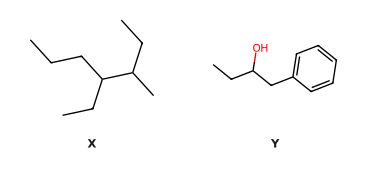
- AP EAPCET 2026Set eng-2026-05-14-FN1 markMCQQ.The correct IUPAC names of the compounds X and Y given below are respectively [FIGURE: X is a branched heptane-type skeletal structure with an ethyl and a methyl substituent; Y is a phenyl group attached via CH2 to a CH(OH) carbon which continues to an ethyl group (i.e. a phenyl-substituted butan-2-ol)] (A) 3-Methyl-4-ethylheptane ; 1-Phenylbutan-2-ol (B) 4-Ethyl-3-Methylheptane ; 1-Phenylbutan-2-ol (C) 3-(sec-butyl)-hexane ; 2-Hydroxy-1-phenylbutane (D) 3-Methyl-4-Ethylheptane ; 2-Hydroxybutylbenzene
›Reveal solutionSolution
Naming heptane with adjacent methyl/ethyl branches must alphabetise the substituent names (ethyl before methyl) even though the locants (3,4) are the same either way; the second structure is simply 1-phenylbutan-2-ol. Only option (B) gets both names right.
Concept and Intuition
IUPAC substitutive nomenclature has two separate rules that both matter here:
- Lowest locants — number the main chain from whichever end gives the substituents the lowest possible position numbers. For two adjacent substituents on a 7-carbon chain, one numbering gives {3,4} and the other gives {4,5}; since 3<4 at the first point of difference, {3,4} is chosen — this fixes which carbon is 3 and which is 4, but not yet how they're written in the name.
- Alphabetical citation — once locants are fixed, the substituents must be listed in the name in alphabetical order of their names, regardless of which locant number each one carries. Since "ethyl" (e) precedes "methyl" (m) alphabetically, the name must read "...-ethyl-...-methyl-heptane", i.e. 4-ethyl-3-methylheptane — even though methyl sits at the numerically smaller position 3.
Options (A) and (D) both list "3-Methyl-4-ethyl..." — citing methyl before ethyl — which violates the alphabetisation rule, even though the locants are numerically correct. Option (B) lists "4-Ethyl-3-Methyl...", correctly alphabetised.
For structure Y: ring–CH2–CH(OH)–CH2–CH3 is a four-carbon chain (butane) bearing OH on the second carbon (numbering from the phenyl-bearing end so the alcohol gets the lowest locant, and phenyl sits on C1): this is exactly 1-phenylbutan-2-ol. "2-Hydroxy-1-phenylbutane" and "2-Hydroxybutylbenzene" (options C, D) are both non-standard — the hydroxyl group, being the principal characteristic group here, must be expressed as the suffix "-ol", not as a "hydroxy-" prefix.
Step-by-Step Solution …
- AP EAPCET 2026Set eng-2026-05-15-AN1 markMCQQ.The IUPAC name of the given compound is [Structure: a hex-5-ene chain bearing a hydroxyl, methyl and ethyl group on the same carbon — CH2=CH−CH2−CH2−C(OH)(CH3)(C2H5)] (A) 5-Ethylhex-1-en-5-ol (B) 2-Ethylhex-5-en-2-ol (C) 5-Methylhept-1-en-5-ol (D) 3-Methylhept-6-en-3-ol
›Reveal solutionSolution
This tests IUPAC chain-selection (longest chain through the principal group) and numbering priority (lowest locant to the suffix -ol over the double bond). The answer is 3-methylhept-6-en-3-ol.
Concept and Intuition
When naming a polyfunctional/branched molecule, two rules matter here: (1) choose the longest continuous carbon chain that contains the principal characteristic group (here, the carbon bearing –OH); if there's a choice among chains of different lengths through that carbon, pick the longest one, even if it means treating a substituent as part of chain vs branch differently. (2) Once the chain is fixed, number it so the principal characteristic group (the one cited as suffix, i.e. -ol) gets the lowest locant — this takes priority over giving the double bond the lowest locant.
Step-by-Step Solution
- Draw the structure: CH2=CH−CH2−CH2−C(OH)(CH3)(CH2CH3). The central carbon bearing OH is attached to: (a) a 4-carbon chain ending in the double bond (CH2=CH−CH2−CH2−), (b) a methyl group, (c) an ethyl group.
- To maximize chain length while keeping the OH-bearing carbon in the chain, extend through the ethyl group rather than the methyl: this chain is CH2=CH−CH2−CH2−C(OH)(CH3)−CH2−CH3 — count the carbons: 1,2,3,4,5,6,7 → seven carbons, i.e. a heptene skeleton, with a methyl branch left over at C5 (numbering from the vinyl end) or C3 (numbering from the ethyl end).
- Now decide the numbering direction. IUPAC numbering priority: lowest locant to the principal characteristic group (suffix, here "-ol") beats lowest locant to unsaturation ("-ene"). …
- AP EAPCET 2026Set eng-2026-05-15-AN1 markMCQQ.Match the following List I (Compound) and List II (Common name): A. C6H5OH ... I. Quinol B. [Structure: 2,4,6-trinitrophenol — a benzene ring with OH and NO2 groups at the 2, 4 and 6 positions, C6H2(OH)(NO2)3] ... II. Carbolic acid C. [Structure: 1,4-dihydroxybenzene (hydroquinone) — a benzene ring with OH groups para to each other, C6H4(OH)2] ... III. p-Cresol D. [Structure: 4-methylphenol (p-cresol) — a benzene ring with OH and CH3 groups para to each other, CH3−C6H4−OH] ... IV. Picric acid Correct answer is (A) A-IV, B-II, C-I, D-III (B) A-II, B-IV, C-I, D-III (C) A-II, B-IV, C-III, D-I (D) A-IV, B-I, C-III, D-II
›Reveal solutionSolution
Matching each phenolic compound to its trivial/common name: phenol = carbolic acid, 2,4,6-trinitrophenol = picric acid, hydroquinone = quinol, p-cresol = p-cresol.
Concept and Intuition
Many simple phenolic compounds carry historic trivial names that are still in common industrial/medical use, independent of their IUPAC names. Recognising the structure (substitution pattern and functional groups) is the key to recalling the correct trivial name.
Step-by-Step Solution
- A. C6H5OH (phenol) — historically used as a disinfectant, its common name is Carbolic acid ⇒ A–II.
- B. 2,4,6-trinitrophenol — this compound's trivial name is literally Picric acid (used as an explosive/dye) ⇒ B–IV.
- C. 1,4-dihydroxybenzene (hydroquinone) — commonly called Quinol (used in photographic developers) ⇒ C–I.
- D. 4-methylphenol — this is literally p-Cresol ⇒ D–III. …
- AP EAPCET 2026Set eng-2026-05-15-FN1 markMCQQ.The IUPAC name of the following hydrocarbon is CH3−CH(CH3)−CH2−CH2−CH(CH3)−CH(CH3)−CH2−CH3 (A) 2, 5, 6 – Trimethyloctane (B) 2 – Ethyl – 3, 6 – dimethylheptane (C) 3, 4, 7 – Trimethyloctane (D) 2 – Ethyl – 2, 6 – dimethylheptane
›Reveal solutionSolution
The longest chain is an 8-carbon octane bearing three methyl branches; numbering to give the lowest locant set yields 2,5,6-trimethyloctane.
Concept and Intuition
IUPAC naming requires (1) finding the longest continuous carbon chain, (2) identifying substituents, and (3) numbering the chain from whichever end gives the lowest set of locants to the substituents (compared term-by-term at the first point of difference).
Step-by-Step Solution
- Write out the structure and number the main chain left to right: CH3(1)−CH(CH3)(2)−CH2(3)−CH2(4)−CH(CH3)(5)−CH(CH3)(6)−CH2(7)−CH3(8).
- This is an 8-carbon chain (octane) — check it's the longest: all branches are single methyl groups, so none of them can extend the main chain further; 8 carbons is indeed the longest possible chain.
- Methyl substituents sit at carbons 2, 5, and 6 when numbered from the left end.
- Now number from the right end instead: original C8→1, C7→2, C6→3, C5→4, C4→5, C3→6, C2→7, C1→8. The methyls (originally at C2, C5, C6) now sit at positions 7, 4, 3 — locant set {3,4,7}.
- Compare the two locant sets at the first point of difference: {2,5,6} vs {3,4,7} → 2 < 3, so the left-to-right numbering ({2,5,6}) is preferred (lower locants rule). …
- AP EAPCET 2026Set ap-2026-05-19-FN1 markMCQQ.What is the IUPAC name of the compound formed when m-cresol is subjected to dinitration? (A) 3-methyl-4,6-dinitrophenol (B) 5-methyl-2,4-dinitrophenol (C) 2-methyl-4,6-dinitrophenol (D) 4-methyl-2,6-dinitrophenol
›Reveal solutionSolution
Nitration of m-cresol is directed by both –OH and –CH3 to the two positions that avoid steric crowding; correctly renumbering for lowest locants gives 5-methyl-2,4-dinitrophenol.
Concept and Intuition
In m-cresol (–OH at C1, –CH3 at C3), both substituents are activating, ortho/para-directing groups. The ring position between them (C2) is doubly activated but sterically hindered, so electrophilic nitration preferentially occurs at the two positions that are activated by both groups without steric clash: C4 (para to OH, ortho to CH3) and C6 (ortho to OH, para to CH3). Once the substitution pattern is fixed on the ring, IUPAC numbering (with OH's carbon fixed at C1, since it carries the principal -ol suffix) is chosen in whichever direction gives the lowest set of locants to all substituents.
Step-by-Step Solution
- Place OH at C1, CH3 at C3 (m-cresol).
- Directing effects favour nitration at C4 and C6, avoiding sterically hindered C2 and electronically unfavoured C5.
- Numbering one way (OH=1→C2→C3(CH3)→C4(NO2)→C5→C6(NO2)) gives substituent locants {3,4,6}.
- Numbering the other way around the ring (OH=1→C2(NO2, was old C6)→C3→C4(NO2, was old C4)→C5(CH3, was old C3)→C6) gives locants {2,4,5}. …
- AP EAPCET 2026Set eng-2026-05-18-AN1 markMCQQ.Which of the following represents the structure of 'Terpineol'? (A) [FIGURE] (a cyclohexene ring with a CH3 group on the double-bond carbon at the top, and a −C(CH3)2OH group attached at the bottom ring carbon) (B) [FIGURE] (a cyclohexene ring with CH3 on the double-bond carbon at the top, and an isopropyl group plus an −OH on two adjacent lower ring carbons) (C) [FIGURE] (a benzene ring with an −OH at one position, two CH3 groups, and a Cl substituent — a chlorocresol-type aromatic structure) (D) [FIGURE] (a cyclohexadiene ring with CH3 at the top, and −OH plus an isopropyl group on lower ring carbons) 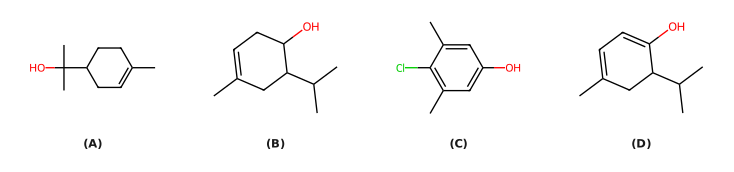
›Reveal solutionSolution
Terpineol is p-menth-1-en-8-ol: a cyclohexene ring with a ring methyl on the double bond and a tertiary alcohol side-chain −C(CH3)2OH hanging off the ring — matching structure (A), not the ring-bound-OH or aromatic alternatives.
Concept and Intuition
Terpineol is a monoterpenoid, biosynthetically related to the menthane (p-menthane) skeleton — a cyclohexane/cyclohexene ring with a methyl group at C1 and an isopropyl-derived group at C4. In α-terpineol specifically, the isopropyl-derived group has been oxidised to a tertiary alcohol, giving the side chain −C(CH3)2OH instead of a simple isopropyl. The −OH is on the side-chain carbon, NOT directly on the ring.
Step-by-Step Solution
- Recall the terpineol skeleton: it is derived from limonene-type monoterpenes, i.e. a cyclohexene ring with a methyl group on the ring at the double bond, and (at the para-like ring position) a three-carbon side chain.
- In α-terpineol, that three-carbon side chain is oxidised at its central carbon to a tertiary alcohol: −C(CH3)2−OH, attached to the ring by a single bond (not part of the ring itself).
- This matches structure (A): cyclohexene ring, CH3 on the double-bond carbon (top), and the −C(CH3)2OH group on the ring carbon on the other side (bottom) — a side-chain alcohol, not a ring-bound one.
- Structure (B) instead places the −OH directly ON the ring with an adjacent isopropyl group — that describes a different terpene alcohol (a cyclic/ring alcohol), not terpineol. …
- AP EAPCET 2026Set ap-2026-05-20-AN1 markMCQQ.Identify the correct option in which the compound is not named as per IUPAC (A) 1-Ethyl-3, 3-dimethyl cyclohexane (structure: cyclohexane ring bearing an ethyl substituent and a gem-dimethyl substituent) (B) Cyclohex-2-en-1-ol (structure: cyclohexene ring with OH at C1 and the double bond between C2-C3) (C) 2-Chloro-1-methyl-4-nitrobenzene (structure: benzene ring with CH3, Cl adjacent to it, and NO2 para to CH3) (D) 4-Ethyl-1-fluoro-2-nitrobenzene (structure: benzene ring with F, NO2 adjacent to it, and C2H5 substituent)
›Reveal solutionSolution
Option (A)'s name violates the lowest-locants rule — the correct IUPAC name is 3-ethyl-1,1-dimethylcyclohexane, not 1-ethyl-3,3-dimethylcyclohexane.
Concept and Intuition
When a ring or chain carries several substituents, IUPAC numbering is fixed by comparing the entire set of locants term-by-term at the first point of difference, and choosing whichever numbering gives the lowest set overall — this comes before any alphabetical tie-breaking (which only applies when two numbering choices give identical locant sets).
Step-by-Step Solution
- The ring carries an ethyl group and a gem-dimethyl carbon, two positions apart around the ring.
- Numbering with the ethyl carbon as C1 gives dimethyl at C3,C3 → locant set {1,3,3}.
- Numbering with the gem-dimethyl carbon as C1 instead gives ethyl at C3 → locant set {1,1,3}.
- Compare term-by-term: both start with 1; at the second position, 1<3, so {1,1,3} is the lower (preferred) set.
- Therefore the correct name is 3-Ethyl-1,1-dimethylcyclohexane, and the given name '1-Ethyl-3,3-dimethylcyclohexane' (option A) is NOT correctly IUPAC-named. …
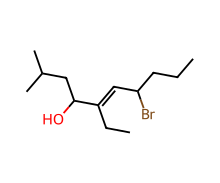
- AP EAPCET 2025Set eng-2025-05-21-FN1 markMCQQ.The IUPAC name of the following compound is [FIGURE] (a branched skeletal structure: an ethyl group (CH3-CH2-) attached to a carbon that carries a C=C double bond going down to a CH which connects to a CH-Br carbon, which continues as a propyl chain -CH2-CH2-CH3; the same double-bond-bearing carbon also connects on the other side to a CH-OH carbon, then a CH2, then a CH bearing a methyl branch and terminating in a CH3 -- i.e. a line structure of 7-bromo-5-ethyl-2-methyldec-5-en-4-ol) (A) 6-Ethyl-9-methyl-4-bromodec-5-en-7-ol (B) 7-Bromo-2-methyl-5-ethyldec-5-en-4-ol (C) 7-Bromo-5-ethyl-2-methyldec-5-en-4-ol (D) 4-Bromo-6-ethyl-9-methyldec-5-en-7-ol
›Reveal solutionSolution
This tests IUPAC numbering priority: the principal characteristic group (here, −OH, suffixed as −ol) must receive the lowest possible locant, which fixes the numbering direction of the parent chain over the alternative that would look inverted.
Concept and Intuition
When naming a polyfunctional compound, IUPAC rules require choosing the numbering direction that gives the lowest locant to the principal characteristic group expressed as a suffix (here −ol), ahead of unsaturation (ene) and substituents (bromo, ethyl, methyl), which are only used as tie-breakers if the principal group's locant is the same either way.
Step-by-Step Solution
- Identify the parent chain: a straight 10-carbon chain (dec-) containing one C=C double bond, one −OH, and three substituents (Br, ethyl, methyl).
- Number from the end nearer the −OH group so that it gets the lower possible locant (Rule: principal characteristic group gets priority for lowest locant).
- Numbering from that end: methyl at C2, −OH at C4, double bond C5=C6 ("5-ene"), ethyl at C5, bromo at C7.
- Numbering the other way would push −OH to C7 instead of C4 — a higher locant for the principal group — so it is rejected.
- Arrange substituent prefixes alphabetically: bromo, ethyl, methyl → "7-Bromo-5-ethyl-2-methyldec-5-en-4-ol". …
- AP EAPCET 2025Set eng-2025-05-22-FN1 markMCQQ.The correct decreasing order of priority for the functional group of organic compounds in the IUPAC method of nomenclature is (A) −CHO>−OH>−CONH2>−COCl (B) −CONH2>−CHO>−COCl>−OH (C) −COCl>−CONH2>−CHO>−OH (D) −CHO>−CONH2>−COCl>−OH
›Reveal solutionSolution
This tests the IUPAC seniority (priority) order of functional groups for choosing the principal characteristic group in nomenclature. Among acid halide, amide, aldehyde and alcohol, the correct decreasing priority is −COCl>−CONH2>−CHO>−OH.
Concept and Intuition
IUPAC nomenclature ranks characteristic groups by a fixed seniority order (roughly following decreasing oxidation state/reactivity of the carbon-based functional groups): cations > carboxylic acids > sulfonic acids > anhydrides > esters > acid halides > amides > nitriles > aldehydes > ketones > alcohols > amines > ethers. The group highest in this order is chosen as the principal characteristic group (suffix), and all others are cited as prefixes.
Step-by-Step Solution
- Identify the four groups in the question: acid chloride (-COCl), amide (-CONH2), aldehyde (-CHO), and alcohol (-OH).
- Apply the known IUPAC seniority list: acid halides rank above amides, amides rank above aldehydes, and aldehydes rank above alcohols. …
- AP EAPCET 2025Set eng-2025-05-23-FN1 markMCQQ.IUPAC names of mesityl oxide and oxalic acid are respectively (A) 4-Methylpent-3-en-2-one; Ethanedioic acid (B) 4-Methylpent-3-en-2-one; Propanedioic acid (C) 3-Methylpent-3-en-2-one; Propanedioic acid (D) 3-Methylpent-3-en-2-one; Ethanedioic acid
›Reveal solutionSolution
This tests IUPAC naming of two common named compounds: mesityl oxide is 4-methylpent-3-en-2-one, and oxalic acid (the two-carbon diacid) is ethanedioic acid.
Concept and Intuition
IUPAC naming of a ketone requires finding the longest carbon chain that includes the carbonyl carbon, numbering from the end that gives the carbonyl the lowest possible locant, and citing all substituents/unsaturations with their locants. For a simple dicarboxylic acid, the name is built directly off the number of carbons in the chain (including both -COOH carbons), using the suffix '-dioic acid'.
Step-by-Step Solution
- Mesityl oxide: structure (CH3)2C=CH−CO−CH3. The longest chain through the carbonyl carbon is 5 carbons: CH3−CO−CH=C(CH3)−CH3. Numbering from the carbonyl end (to give it the lowest locant, position 2): C1(CH3)−C2(=O)−C3(H)=C4(CH3)−C5(H3), i.e. a methyl branch sits on C4. This gives 4-methylpent-3-en-2-one. …
- AP EAPCET 2025Set ap-2025-05-20-FN1 markMCQQ.Match the following List-I (compound) — List-II (common name) A) HO−C6H4−OH (benzene ring with OH substituents at para positions, 1,4-dihydroxybenzene) — I) Catechol B) C6H5−O−CH2−CH3 (benzene ring with an O−CH2−CH3 substituent) — II) Cumene C) benzene ring with OH substituents at two adjacent (ortho) carbons, 1,2-dihydroxybenzene — III) Phenetole D) C6H5−CH(CH3)2 (benzene ring with a CH(CH3)2 substituent) — IV) Quinol The correct answer is (A) A-IV, B-III, C-I, D-II (B) A-IV, B-I, C-II, D-III (C) A-III, B-I, C-IV, D-II (D) A-II, B-III, C-IV, D-I
›Reveal solutionSolution
Matching common (trivial) names of aromatic compounds: 1,4-dihydroxybenzene = Quinol, phenetole = ethyl phenyl ether, catechol = 1,2-dihydroxybenzene, cumene = isopropylbenzene.
Concept and Intuition
Many simple aromatic compounds carry historical trivial names that are still in common industrial/chemical usage, and these names are frequently tested for recall in organic chemistry.
Step-by-Step Solution
- A) HO-C6H4-OH at the para (1,4) position is the classic photographic developer Quinol (also called hydroquinone) → matches IV.
- B) C6H5-O-CH2-CH3 is ethyl phenyl ether, whose trivial name is Phenetole → matches III.
- C) The 1,2- (ortho) dihydroxybenzene isomer is Catechol → matches I.
- D) C6H5-CH(CH3)2 (isopropylbenzene) is Cumene, the industrial precursor to phenol via the cumene process → matches II. …
🎓Unlock everything free for 14 days
- ✓Full step-by-step solutions
- ✓Concept-first explanations
- ✓Methods, shortcuts & mistakes
- ✓PYQ mapping + timed mock tests
Full access for 14 days. No credit card required.