Q.The reagent which does not react with both acetone and benzaldehyde is __________.
🔒You're viewing a preview — the full solution, concept, methods & PYQ mapping are locked.
🔒 Start your 14-day free trial to unlock the full solution →Concept understanding — Clemmensen Reduction Cannizzaro Reaction
Clemmensen Reduction & Cannizzaro Reaction: Two Completely Different Reactions
These two reactions are often grouped together in textbooks because they both involve carbonyl compounds (C=O), but they do entirely different things. Let's take them one at a time.
Clemmensen Reduction
Intuition first. Imagine you have a ketone or aldehyde — a molecule with a C=O group. You want to remove that oxygen entirely and replace the C=O with two hydrogen atoms, turning it into a simple hydrocarbon chain. That's a reduction (adding hydrogen, removing oxygen). The Clemmensen reduction is a brute-force way to do this using a strongly acidic, reducing environment.
The precise reaction:
A ketone or aldehyde is heated with zinc amalgam (Zn-Hg) and concentrated hydrochloric acid (HCl). The C=O group is reduced to a CH₂ group.
R−C(=O)−RX′+4[H]Zn(Hg),HCl,heatR−CHX2−RX′+HX2O
Aldehyde or KetoneZn(Hg), conc. HCl, ΔHydrocarbon
Key points for exams:
- Works only for ketones and aldehydes that are stable in strong acid.
- Does not work for compounds that get destroyed by conc. HCl (e.g., acid-sensitive groups like esters, nitriles).
- The mechanism is complex and not usually tested in detail — just know it's a reductive removal of C=O.
- The product is always a saturated hydrocarbon (alkane).
Clemmensen reduction cannot reduce carboxylic acids, esters, or amides. Only aldehydes and ketones.
Example:
Acetophenone (CX6HX5−CO−CHX3) → Ethylbenzene (CX6HX5−CHX2−CHX3)
Cannizzaro Reaction
Intuition first. This is a disproportionation reaction — one molecule of aldehyde gets oxidised (to a carboxylic acid) while another gets reduced (to an alcohol). It happens only with aldehydes that have no alpha-hydrogen atoms (i.e., the carbon next to the C=O has no H). Why? Because if there were alpha-hydrogens, the aldehyde would undergo aldol condensation instead.
The precise reaction:
An aldehyde without α-hydrogen is treated with concentrated aqueous or alcoholic base (NaOH/KOH). Two molecules of aldehyde react: one becomes a carboxylate salt, the other becomes a primary alcohol.
2R−CHO+OHX−R−COOX−+R−CHX2OH
After acidification, the carboxylate salt gives the carboxylic acid.
2HCHOconc. NaOHHCOONa+CH3OH
(Formaldehyde → sodium formate + methanol)
Key points for exams:
- Only works for aldehydes with no α-hydrogen: formaldehyde, benzaldehyde, trimethylacetaldehyde, etc.
- The base must be concentrated (dilute base won't work).
- Formaldehyde is the most common example — it gives formic acid (as formate) and methanol.
- Crossed Cannizzaro: When formaldehyde is mixed with another aldehyde (like benzaldehyde), formaldehyde is always the one that gets oxidised (to formate), and the other aldehyde gets reduced (to alcohol). This is because formaldehyde is the strongest reducing agent among aldehydes.
In a crossed Cannizzaro, formaldehyde always becomes the carboxylate. The other aldehyde becomes the alcohol. This is a common exam question.
Example: …
Why this formula?
Okay, let's break down these two very different reactions. They are often studied together because they both involve carbonyl compounds (C=O), but their mechanisms and purposes are completely opposite.
The Core Idea: Two Paths from a Carbonyl
Think of a carbonyl group (C=O) as a reactive hub. The carbon is electrophilic (electron-loving) because the oxygen pulls electron density away. The reactions it undergoes depend entirely on the conditions (acidic, basic, reducing) and the structure of the molecule (does it have an α-hydrogen?).
- Clemmensen Reduction is about removing the oxygen entirely.
- Cannizzaro Reaction is about disproportionating the molecule (one gets reduced, one gets oxidized).
1. Clemmensen Reduction: Why it Removes Oxygen
What it does: Converts a carbonyl group (C=O) in an aldehyde or ketone into a methylene group (CHX2).
RX2C=OZn(Hg)/HCl,heatRX2CHX2
Why this formula holds (The Mechanism):
The key is the reducing power of zinc amalgam in a strongly acidic environment.
- Protonation: The carbonyl oxygen is basic. In the strong HCl, it gets protonated first.
RX2C=O+HX+RX2C=OHX+
This makes the carbon *even more* electrophilic.
2. Electron Transfer from Zinc: Zinc metal (Zn) is a good reducing agent. It donates electrons to the electron-deficient carbon. This is a single electron transfer (SET) process, not a simple hydride transfer.
- The zinc inserts itself, forming an organozinc intermediate (a carbenoid species).
- This intermediate is highly reactive.
- Protonation and Elimination: The acidic medium provides plenty of HX+ ions. The intermediate gets protonated, and the oxygen (now as HX2O) is eliminated. The zinc is oxidized to ZnX2+.
The "Why" in a nutshell: The strong acid activates the carbonyl, and the zinc metal provides the electrons needed to break the C=O bond and replace it with two C−H bonds. The reaction does not work under basic conditions because you need the acid to protonate the oxygen first.
2. Cannizzaro Reaction: Why it Disproportionates
What it does: An aldehyde without an α-hydrogen (like formaldehyde HCHO or benzaldehyde CX6HX5CHO) reacts with a strong base to give a carboxylic acid and an alcohol.
2HCHOconc⋅NaOHHCOONa+CHX3OH
Why this formula holds (The Mechanism):
The key is the absence of α-hydrogens. If there were an α-hydrogen, the base would deprotonate that instead, leading to an aldol reaction. Here, the base has no choice but to attack the carbonyl itself.
- Nucleophilic Attack: The strong base (OHX−) attacks the electrophilic carbonyl carbon.
RCHO+OHX−R−CH(OH)OX−
This forms a **tetrahedral intermediate** (an alkoxide).
2. The Crucial Hydride Transfer: This is the unique step. The tetrahedral intermediate is unstable. It can't lose OHX− (that would just give back the aldehyde). Instead, it acts as a hydride donor (HX−).
- The carbon bearing the negative charge (from the OHX− attack) is very electron-rich. It kicks out a hydride ion (HX−) to a second molecule of aldehyde.
- This is a hydride shift.
R−CH(OH)OX−+RCHORCOOH+RCHX2OX− …
The key idea is that Fehling's solution oxidises only aliphatic aldehydes — it does not react with ketones (like acetone) or aromatic aldehydes (like benzaldehyde).
Step 1: Acetone is a ketone; benzaldehyde is an aromatic aldehyde.
Step 2: Sodium hydrogen sulphite adds to the carbonyl group of both aldehydes and ketones. Phenyl hydrazine forms hydrazones with both. Grignard reagents add to both carbonyls. …
The key is to check which reagent reacts with both a ketone (acetone) and an aldehyde (benzaldehyde). Fehling's solution only oxidises aliphatic aldehydes — it reacts with neither acetone (a ketone) nor benzaldehyde (an aromatic aldehyde). The correct answer is (iii) Fehling's solution.
Concept & Intuition
This question tests your understanding of the reactivity of carbonyl compounds — specifically, how aldehydes and ketones differ in their reactions with common reagents.
Acetone is a ketone (CHX3COCHX3), while benzaldehyde is an aromatic aldehyde (CX6HX5CHO). Both have a carbonyl group (C=O), but the key difference lies in the hydrogen atom attached to the carbonyl carbon: aldehydes have at least one H (making them easier to oxidise), while ketones have two carbon groups attached.
Many reagents attack the electrophilic carbonyl carbon via nucleophilic addition. Others are specific to the oxidisability of the aldehyde group. The reagent that fails to react with both must be one that works only on aldehydes (or only on ketones), or on neither.
Let’s examine each option.
Step-by-Step Analysis
1. Sodium hydrogen sulphite (NaHSOX3)
This reagent adds across the C=O bond via nucleophilic addition. The bisulphite ion (HSOX3X−) attacks the electrophilic carbonyl carbon, forming a crystalline bisulphite addition product.
- Acetone: Reacts readily — gives a white crystalline solid.
- Benzaldehyde: Also reacts — though more slowly due to steric hindrance from the phenyl ring, it still forms the addition product.
This reaction is reversible and works with both aldehydes and ketones (especially aliphatic ones). So NaHSOX3 is not the answer.
2. Phenyl hydrazine (CX6HX5NHNHX2)
Phenyl hydrazine is a derivative of hydrazine that reacts with carbonyl compounds to form phenylhydrazones (C=N−NHCX6HX5). This is a classic condensation reaction (nucleophilic addition–elimination).
- Acetone: Forms acetone phenylhydrazone.
- Benzaldehyde: Forms benzaldehyde phenylhydrazone.
This reaction works for all aldehydes and ketones. It’s the basis for identifying carbonyl compounds (e.g., Brady’s test uses 2,4-dinitrophenylhydrazine). So phenyl hydrazine reacts with both.
3. Fehling’s solution
Fehling’s solution is an oxidising agent — it contains CuX2+ ions complexed with tartrate in alkaline medium. It specifically oxidises aliphatic aldehydes to carboxylate salts, while the CuX2+ is reduced to CuX+, giving a red precipitate of CuX2O. …
Concept: Nucleophilic Addition to the Carbonyl Group
Both acetone (a ketone) and benzaldehyde (an aldehyde) contain a polar C=O bond. This makes them susceptible to nucleophilic addition reactions. The reagent that will not react with either must lack the ability to act as a nucleophile toward the carbonyl carbon under normal conditions.
Method: Reagent Functionality Analysis
Step 1: Identify the reactive site in each reagent
- Sodium hydrogen sulphite (NaHSOX3): The bisulphite ion (HSOX3X−) is a nucleophile. It adds to the carbonyl carbon of both aldehydes and ketones to form a crystalline bisulphite addition product.
- Phenyl hydrazine (CX6HX5NHNHX2): The terminal −NHX2 group is a strong nucleophile. It reacts with both aldehydes and ketones to form phenylhydrazones.
- Fehling's solution: Contains CuX2+ ions in alkaline tartrate. It is an oxidising agent, not a nucleophile. It oxidises only aldehydes (not ketones) to carboxylic acids, reducing CuX2+ to CuX2O (red precipitate).
- Grignard reagent (RMgX): The carbon attached to Mg is strongly nucleophilic (carbanion character). It adds to the carbonyl carbon of both aldehydes and ketones.
Step 2: Find the reagent that does not react with both
- Sodium hydrogen sulphite — adds to both acetone and benzaldehyde (bisulphite addition product).
- Phenyl hydrazine — reacts with both (forms phenylhydrazones).
- Grignard reagent — adds to both carbonyls.
- Fehling's solution — an oxidising agent, not a nucleophile. It oxidises only aldehydes (benzaldehyde → gives red CuX2O) and does not react with ketones (acetone). So it does not react with both — it is selective for the aldehyde only. …
Here is a breakdown of the common mistakes students make on this question, along with the correct reasoning to avoid them.
The Core Concept: Reactivity of the Carbonyl Group
Both acetone (a ketone) and benzaldehyde (an aldehyde) contain a carbonyl group (C=O). However, they differ in reactivity due to the groups attached to that carbonyl.
- Benzaldehyde has a phenyl ring, which stabilizes the carbonyl carbon via resonance, making it less reactive towards nucleophilic addition than a typical aldehyde.
- Acetone has two electron-donating methyl groups, which make it less reactive than formaldehyde, but it still undergoes typical ketone reactions.
The key is to know which reagents react with both types of carbonyl compounds, and which react with only one (or neither).
Mistake #1: Assuming Fehling's Solution reacts with both
The Mistake: Students often remember that Fehling's solution is a test for aldehydes and assume it will react with benzaldehyde (an aldehyde) and also with acetone (a ketone) because both have a carbonyl group.
Why it's wrong: Fehling's solution (containing CuX2+ in a basic tartrate complex) is an oxidizing agent. It only oxidizes aliphatic aldehydes. It does not oxidize ketones (like acetone) or aromatic aldehydes (like benzaldehyde). Benzaldehyde is an aromatic aldehyde and is not oxidized by Fehling's solution.
How to avoid: Memorize the specific limitations of common tests.
- Fehling's test: Positive for aliphatic aldehydes only. Negative for ketones and aromatic aldehydes.
- Tollens' test: Positive for all aldehydes (aliphatic and aromatic). Negative for ketones.
Since Fehling's solution reacts with neither acetone nor benzaldehyde, it is the correct answer to the question.
Mistake #2: Forgetting that Phenylhydrazine reacts with both
The Mistake: Students might think phenylhydrazine is too bulky to react with a hindered ketone like acetone, or that it only reacts with aldehydes.
Why it's wrong: Phenylhydrazine (CX6HX5NHNHX2) is a nucleophile that attacks the electrophilic carbonyl carbon. It undergoes a condensation reaction (forming a hydrazone) with both aldehydes and ketones. Acetone and benzaldehyde both react readily with it.
How to avoid: Remember that hydrazine derivatives (phenylhydrazine, 2,4-dinitrophenylhydrazine) are general reagents for all carbonyl compounds. They are used to test for the presence of any aldehyde or ketone.
Mistake #3: Confusing Sodium Hydrogen Sulphite's reactivity
The Mistake: Students might think sodium hydrogen sulphite (NaHSOX3) only reacts with aldehydes, or that it doesn't react with aromatic aldehydes.
Why it's wrong: Sodium hydrogen sulphite adds to the carbonyl group of both aldehydes and many ketones (including acetone) to form a crystalline bisulphite addition product. Benzaldehyde also reacts, though the equilibrium is less favorable than with aliphatic aldehydes. The reaction is still observable. …
Showing the 12 most recent of 20 on this concept.
- AP EAPCET 2026Set eng-2026-05-13-FN1 markMCQQ.Consider the following reaction Cumene (i) O2(ii) H3O+ A + B A is acidic in nature and forms salt with aq. NaOH. A and B are converted to corresponding hydrocarbons with reagents X and Y respectively. What are X and Y? (A) X=Sn,Δ ; Y=NaBH4 (B) X=NaBH4 ; Y=Sn,Δ (C) X=Zn,Δ ; Y=Zn∣Hg,HCl (D) X=Zn∣Hg,HCl ; Y=Zn,Δ
›Reveal solutionSolution
The cumene process gives phenol (A) and acetone (B). Phenol → benzene needs zinc-dust distillation; acetone → propane needs Clemmensen reduction (Zn-Hg/HCl). So X = Zn,Δ and Y = Zn|Hg,HCl.
Concept and Intuition
The cumene process is the industrial route to phenol: cumene (isopropylbenzene) is air-oxidised to cumene hydroperoxide, which is then cleaved by dilute acid (H3O+) via the Hock rearrangement to give phenol (A) and acetone (B) simultaneously. Since A (phenol) is acidic (reacts with NaOH to form sodium phenoxide, confirming it's phenol) — this fixes A = phenol, B = acetone.
To convert each oxygen-containing product back to its parent hydrocarbon:
- Phenol → benzene: distillation with zinc dust removes the −OH group (reduction/dehydroxylation), giving benzene.
- Acetone (a ketone) → propane: the carbonyl group of a ketone is fully reduced to −CH2− by the Clemmensen reduction, using zinc amalgam (Zn(Hg)) and concentrated HCl.
Step-by-Step Solution
- Cumene (i) O2 cumene hydroperoxide (ii) H3O+ phenol (A) + acetone (B) (Hock cleavage).
- A is stated to be acidic and to form a salt with aqueous NaOH — this confirms A = phenol (forms sodium phenoxide).
- By elimination, B = acetone.
- Converting A (phenol) to its hydrocarbon (benzene): reagent X = zinc dust distillation, Zn,Δ.
- Converting B (acetone) to its hydrocarbon (propane): reagent Y = Clemmensen reduction, Zn(Hg),HCl. …
- AP EAPCET 2026Set eng-2026-05-14-FN1 markMCQQ.Identify C in the given reaction sequence C6H5CHOConc. KOHA+BH+ΔC (A) H−CO2C6H5 (B) C6H5CO2CH3 (C) C6H5CO2CH2C6H5 (D) C6H5CO2C6H5
›Reveal solutionSolution
Benzaldehyde + conc. KOH is the Cannizzaro reaction (no α-H), giving benzoate + benzyl alcohol; acid-catalysed heating of that pair is Fischer esterification, giving benzyl benzoate.
Concept and Intuition
Cannizzaro's reaction is the disproportionation seen only in aldehydes lacking an α-hydrogen (so they cannot enolize/undergo aldol): under concentrated base, one molecule's carbonyl carbon is attacked by hydroxide, and a hydride is transferred to a second molecule of aldehyde. This simultaneously oxidizes one molecule to the carboxylate (A) and reduces the other to the alcohol (B). Once you have both a carboxylic acid (after acidifying the salt) and an alcohol, heating them with an acid catalyst is the standard Fischer esterification, forming an ester and water.
Step-by-Step Solution
- C6H5CHO has no α-H (the carbon next to CHO is aromatic), so conc. KOH causes Cannizzaro disproportionation: one C6H5CHO is oxidized to C6H5COO−K+ (A, potassium benzoate) and another is reduced to C6H5CH2OH (B, benzyl alcohol).
- A+BH+Δ: acid protonates the benzoate to benzoic acid C6H5COOH, and under acid catalysis with heat, benzoic acid and benzyl alcohol undergo Fischer esterification, losing water.
- Product C = C6H5CO2CH2C6H5, benzyl benzoate.
Common Mistakes …
- AP EAPCET 2026Set eng-2026-05-18-AN1 markMCQQ.Reaction of benzonitrile (A) with the reagent X gave B. In another reaction of A with the reagent Y gave C. Reaction of B and C in the presence of dil. NaOH at 293 K gave an α,β-unsaturated carbonyl compound. What are X and Y respectively? (A) DIBAL-H, H2O; (CH3)2Cd (B) SnCl2+HCl,H3O+; CH3MgBr,H2O (C) DIBAL-H, H2O; H2/Ni (D) SnCl2+HCl,H2O; (CH3)2Cd
›Reveal solutionSolution
This tests two named nitrile transformations — Stephen reduction (nitrile → aldehyde) and Grignard addition to a nitrile (nitrile → ketone) — that are then combined in a Claisen–Schmidt condensation to give an α,β-unsaturated carbonyl compound.
Concept and Intuition
A nitrile carbon is electrophilic like a carbonyl carbon. Two classic ways to convert it into a carbonyl compound:
- Stephen reduction: RCNSnCl2/HClRCH=NH⋅HClH3O+RCHO — stops cleanly at the aldehyde.
- Grignard addition: RCN+R′MgX→RC(=NMgX)R′H2ORCOR′ — gives a ketone after hydrolysis of the intermediate imine (metalated imine → ketone on aqueous work-up).
An aldehyde with no α-hydrogens (like benzaldehyde) cannot self-condense, but it readily undergoes a crossed aldol (Claisen–Schmidt) condensation with a ketone that does have α-hydrogens, under dilute base at low/room temperature, forming an α,β-unsaturated ketone (chalcone-type product).
Step-by-Step Solution
- A = benzonitrile, C6H5CN.
- Reagent X = SnCl2+HCl then H3O+: Stephen reduction converts A to the imine hydrochloride, then hydrolysis gives B = benzaldehyde, C6H5CHO.
- Reagent Y = CH3MgBr then H2O: the methyl Grignard adds to the nitrile carbon, and aqueous work-up hydrolyses the resulting ketimine to give C = acetophenone, C6H5COCH3. …
- AP EAPCET 2025Set eng-2025-05-23-FN1 markMCQQ.In the given reaction sequence, conversion of X to Y is an example of benzene CH3COClAnhy. AlCl3X(1) N2H4(2) KOH/glycolΔY (A) Clemmensen reduction (B) Stephen reduction (C) Wolff-Kishner reduction (D) Rosenmund reduction
›Reveal solutionSolution
X (acetophenone, from Friedel-Crafts acylation of benzene) is converted to Y (ethylbenzene) by removing the carbonyl oxygen entirely and replacing C=O with CH2 — the classic Wolff-Kishner reduction, identified by its exact reagents: hydrazine then KOH/glycol with heat.
Concept and Intuition
Reducing a ketone's carbonyl carbon all the way down to a CH2 group (full deoxygenation) can be done by a few named methods, each with a signature reagent set: Clemmensen (Zn-Hg/HCl, acidic), Wolff-Kishner (hydrazine then strong base/heat, basic), Stephen reduction (a nitrile to aldehyde, unrelated here), and Rosenmund reduction (an acid chloride to aldehyde using H2/Pd-BaSO4, also unrelated). The reagents given — N2H4 followed by KOH in ethylene glycol under heat — are the textbook signature of Wolff-Kishner.
Step-by-Step Solution
- Benzene undergoes Friedel-Crafts acylation with acetyl chloride (CH3COCl) and anhydrous AlCl3 (Lewis acid catalyst), installing an acetyl group on the ring: X=C6H5-CO-CH3 (acetophenone).
- Step (1): X is treated with hydrazine (N2H4), which condenses with the ketone carbonyl to form a hydrazone, C6H5-C(=N-NH2)-CH3.
- Step (2): heating the hydrazone with KOH in a high-boiling solvent (ethylene glycol) decomposes it, releasing N2 gas and reducing the carbon to a CH2 group: Y=C6H5-CH2-CH3 (ethylbenzene). …
- AP EAPCET 2025Set ap-2025-05-19-FN1 markMCQQ.Which of the following compounds give salt of an acid and alcohol on heating with concenrated KOH ? (A) Formaldehyde (B) Acetaldehyde (C) Acetone (D) Acetophenone
›Reveal solutionSolution
The Cannizzaro reaction (base-induced disproportionation into an alcohol + a
carboxylate salt) requires an aldehyde with no α-hydrogen — formaldehyde is the
only such compound among the options.
Concept and Intuition
The Cannizzaro reaction is a base-mediated redox disproportionation of an aldehyde
lacking α-hydrogens: hydroxide attacks the carbonyl carbon, and a hydride is
transferred from this tetrahedral intermediate to a second aldehyde molecule. One
molecule ends up oxidised to a carboxylate (salt of the acid), the other reduced to the
alcohol. This pathway is only available when there is no α-H, because if
α-H is present, the base instead deprotonates it to form an enolate, which favours
aldol condensation (a completely different, much faster pathway) over Cannizzaro.
Step-by-Step Solution
- Check each option for α-hydrogens:
- Formaldehyde (HCHO): the carbonyl carbon has no attached carbon at all, so there is no α-carbon and hence no α-H. Cannizzaro is the only option.
- Acetaldehyde (CH3CHO): has α-H on the CH3 group — undergoes aldol condensation with conc. base, not Cannizzaro.
- Acetone (CH3COCH3): has α-H on both methyl groups — undergoes aldol condensation.
- Acetophenone (C6H5COCH3): has α-H on its methyl group — undergoes …
- Check each option for α-hydrogens:
- AP EAPCET 2025Set ap-2025-05-20-AN1 markMCQQ.What is the end product 'R' in the reaction sequence ? Phenol (benzene ring with OH) Zn/Δ P CO, HClAnhy. AlCl3 Q Zn−Hgconc.HCl R (A) C6H5Cl (benzene ring with a single Cl substituent, chlorobenzene) (B) benzene ring with Cl and CH3 substituents at para positions (4-Cl-C6H4-CH3) (C) C6H5CH3 (benzene ring with a single CH3 substituent, toluene) (D) C6H5CH2Cl (benzene ring with a single CH2Cl substituent, benzyl chloride)
›Reveal solutionSolution
Phenol → benzene (Zn-dust distillation) → benzaldehyde (Gattermann–Koch formylation) → toluene (Clemmensen reduction) = R.
Concept and Intuition
This chains three named reactions that a student should recognise by their exact reagents: (i) Zn/heat distillation of phenol reductively removes the phenolic −OH, giving the parent arene;
(ii) CO+HCl with anhydrous AlCl3 (or CuCl) on benzene is the Gattermann–Koch reaction, a formylation that installs a −CHO group directly onto the ring;
(iii) Zn-amalgam with concentrated HCl (Clemmensen reduction) reduces a carbonyl group all the way to a methylene/methyl group, converting an aldehyde into the corresponding alkylbenzene.
Step-by-Step Solution
- Phenol Zn/Δ P: Zn dust distillation removes the −OH (as ZnO), giving benzene. P = C6H6.
- P CO, HClanhy. AlCl3 Q: this is the Gattermann–Koch reaction — formylation of benzene to benzaldehyde. Q = C6H5CHO. …
- AP EAPCET 2025Set eng-2025-05-23-AN1 markMCQQ.Consider the following sequence of reactions. (anhy = anhydrous; conc. = concentrated) C6H5COONaNaOH/CaOΔXCO+HClAnhy. AlCl3Yconc.NaOHA+B If A is the reduction product of Y, what is B? (A) Sodium formate (B) Sodium phenoxide (C) Sodium salt of benzoic acid (D) Sodium salt of salicylic acid
›Reveal solutionSolution
This traces sodium benzoate through decarboxylation, Gattermann–Koch formylation, and a Cannizzaro reaction; B is sodium benzoate. Answer: (C).
Concept and Intuition
Three classical named reactions are stacked here. (1) Sodium salts of carboxylic acids, heated with soda-lime, lose CO2 (decarboxylation) to give the corresponding hydrocarbon — sodium benzoate gives benzene. (2) The Gattermann–Koch reaction formylates an aromatic ring using CO and HCl with anhydrous AlCl3 (and often CuCl) as catalyst, generating an aldehyde directly on the ring — benzene gives benzaldehyde. (3) An aldehyde with no α-hydrogen (like benzaldehyde, whose only adjacent carbon is the aromatic ring) cannot undergo aldol-type self-condensation; instead, treatment with concentrated base disproportionates it via the Cannizzaro reaction: one molecule is reduced (hydride transfer) to the primary alcohol, the other is oxidised to the carboxylate salt.
Step-by-Step Solution
- C6H5COONaNaOH/CaOΔ decarboxylation → X=C6H6 (benzene).
- C6H6CO+HClAnhy.AlCl3 Gattermann–Koch → Y=C6H5CHO (benzaldehyde).
- C6H5CHO has no α-H, so conc. NaOH drives a Cannizzaro reaction: 2C6H5CHO+NaOH→C6H5CH2OH+C6H5COONa. …
- AP EAPCET 2025Set eng-2025-05-24-FN1 markMCQQ.The final product (C) in the given reaction sequence is (anhy = anhydrous) C6H5COOHSOCl2(A)C6H6anhy. AlCl3(B)(i) NH2−NH2 (ii) KOH/(CH2OH)2Δ(C) (A) Benzophenone (B) Diphenyl methane (C) Diphenylmethanol (D) Benzoic acid
›Reveal solutionSolution
SOCl2 makes the acid chloride, Friedel–Crafts gives benzophenone, and Wolff–Kishner reduces its carbonyl completely to CH2, giving diphenylmethane.
Concept and Intuition
SOCl2 is the standard reagent to convert a carboxylic acid to its acid chloride (releasing SO2 and HCl, both leaving as gases — a very clean conversion). An acid chloride is an excellent acylating agent for Friedel–Crafts acylation of an aromatic ring. Wolff–Kishner reduction (hydrazine, then base and heat) removes a carbonyl oxygen entirely, converting a ketone (or aldehyde) directly to a CH2 group — the "deoxygenating" counterpart to Clemmensen reduction, useful when acid-sensitive groups are present.
Step-by-Step Solution
- C6H5COOHSOCl2 A =C6H5COCl (benzoyl chloride).
- A + C6H6, anhy. AlCl3 → Friedel–Crafts acylation: B =C6H5COC6H5 (benzophenone). …
- AP EAPCET 2025Set eng-2025-05-27-FN1 markMCQQ.A carbonyl compound X (C8H8O) undergoes disproportionation with conc. KOH on heating. Product of X with Zn-Hg/HCl is Y and product of X with NaBH4 is Z. What are Y and Z respectively ? (A) C6H5CH2CH3 (ethylbenzene) , C6H5CH2CH2OH (2-phenylethanol) (B) 1,4-dimethylbenzene (ring with CH3 and H3C para to each other) , 4-methylbenzyl alcohol (ring with H3C and CH2OH para to each other) (C) 4-methylbenzyl alcohol (ring with H3C and CH2OH para to each other) , 1,4-dimethylbenzene (ring with H3C and CH3 para to each other) (D) C6H5CH2CH2OH (2-phenylethanol) , C6H5CH2CH3 (ethylbenzene)
›Reveal solutionSolution
X must be an aldehyde with no α-H (since it disproportionates with KOH — Cannizzaro), i.e. p-methylbenzaldehyde; Clemmensen (Zn-Hg/HCl) fully reduces −CHO→−CH3 giving p-xylene (Y), while NaBH4 only reduces to −CH2OH giving 4-methylbenzyl alcohol (Z). Answer: (B).
Concept and Intuition
The Cannizzaro reaction is a base-mediated disproportionation (self oxidation-reduction) unique to aldehydes lacking an α-hydrogen (so they cannot instead undergo aldol condensation). Aromatic aldehydes such as benzaldehyde and its ring-substituted derivatives are the classic examples — the carbon bearing −CHO is attached directly to the ring, so there is no α-carbon with abstractable hydrogens in the usual aldol sense. With formula C8H8O, a ring-methyl-substituted benzaldehyde (CH3−C6H4−CHO, a tolualdehyde) fits perfectly (7 ring+methyl carbons + 1 carbonyl carbon = 8 C; H: 4 ring H + 3 methyl H + 1 CHO H = 8 H; one O) and undergoes Cannizzaro on heating with conc. KOH.
Two separate, independent reductions are then applied to the same starting aldehyde X (not to Cannizzaro products):
- Clemmensen reduction (Zn-Hg amalgam / conc. HCl) is a strong reduction that converts a carbonyl all the way to a methylene/methyl group: −CHO→−CH3. Applied to p-tolualdehyde, this gives 1,4-dimethylbenzene (p-xylene) = Y.
- NaBH4 is a mild hydride reducing agent that reduces aldehydes only to the corresponding primary alcohol, stopping at −CH2OH (it does not touch the aromatic ring or over-reduce). Applied to p-tolualdehyde, this gives 4-methylbenzyl alcohol = Z.
Step-by-Step Solution
- Deduce X: C8H8O that undergoes Cannizzaro (disproportionation) ⇒ must have no α-H ⇒ an aromatic (ring) aldehyde: 4-methylbenzaldehyde, CH3C6H4CHO. …
- AP EAPCET 2024Set eng-2024-05-23-FN1 markMCQQ.Which of the following sequence of reagents convert 3-hexene to propane? (A) KMnO4∣H+; NaOH, CaO (B)(i) O3(ii) Zn, H2O; NaBH4 (C)(i) O3,(ii) Zn, H2O; Zn-Hg, HCl (D) KMnO4∣H+; LiAlH4, H2O
›Reveal solutionSolution
Ozonolysis of symmetric 3-hexene gives propanal, and Clemmensen reduction (Zn-Hg/HCl) then converts the aldehyde carbonyl fully to CH2, yielding propane.
Concept and Intuition
3-Hexene is symmetric about its central C=C double bond, so oxidative/reductive cleavage there gives two identical 3-carbon fragments. To go all the way to an alkane (propane) from the resulting carbonyl compound (propanal), the carbonyl oxygen must be completely removed — this is exactly what Clemmensen reduction does (converts C=O to CH2 under acidic conditions using zinc amalgam and HCl), unlike NaBH4 or LiAlH4 which only reduce the carbonyl to an alcohol.
Step-by-Step Solution
- 3-Hexene: CH3CH2−CH=CH−CH2CH3 (double bond between C3 and C4, symmetric).
- Step (i) O3 then (ii) Zn, H2O: reductive ozonolysis cleaves the C=C bond, giving two molecules of propanal, CH3CH2CHO (3 carbons each).
- Step Zn-Hg, HCl (Clemmensen reduction): reduces the aldehyde carbonyl directly to a CH2 group, converting CH3CH2CHO to CH3CH2CH3 — propane. …
- AP EAPCET 2024Set eng-2024-05-23-FN1 markMCQQ.What are X, Y, Z in the following reaction sequence respectively? Benzene X [benzene ring with a -CHO group] Conc. NaOHΔ Y + Z (A) CO, HCl, AlCl3; Y = benzene ring with CH2ONa, Z = benzene ring with COOH (B) CO, HCl, CuCl; Y = benzene ring with CH2OH, Z = benzene ring with COONa (C) HCHO, HCl, anhy. AlCl3; Y = benzene ring with CH2OH, Z = benzene ring with COOH (D) CO, HCl; Y = benzene ring with CH2COOH, Z = benzene ring with OH
›Reveal solutionSolution
Gattermann-Koch formylation (CO/HCl/AlCl3 or CuCl) gives benzaldehyde, which then undergoes Cannizzaro disproportionation in hot conc. NaOH into benzyl alcohol and sodium benzoate.
Concept and Intuition
Benzene has no easy route to an aldehyde by simple oxidation, so formylation is done via the Gattermann-Koch reaction: CO and HCl, activated by anhydrous AlCl3 (Lewis acid) with CuCl (cuprous chloride) as catalyst, generate an electrophilic formyl cation equivalent that substitutes onto the ring, giving benzaldehyde directly. Benzaldehyde, having no alpha-hydrogen, cannot undergo aldol-type self-condensation; instead, concentrated base makes it undergo Cannizzaro reaction — intermolecular disproportionation where one molecule is reduced (hydride transfer) and the other oxidised.
Step-by-Step Solution
- C6H6CO, HClAlCl3/CuClC6H5CHO (benzaldehyde) — this is X.
- Hot conc. NaOH on benzaldehyde: two molecules disproportionate — 2C6H5CHO+NaOH→C6H5CH2OH+C6H5COONa. …
- AP EAPCET 2023Set eng-2023-05-15-FN1 markMCQQ.The number of products obtained in the following reaction is [FIGURE] (acetaldehyde, drawn as CH3CHO) + [FIGURE] (acetophenone, drawn as a benzene ring bearing a −COCH3 substituent) NaOHΔ ? (A) 1 (B) 3 (C) 2 (D) 4
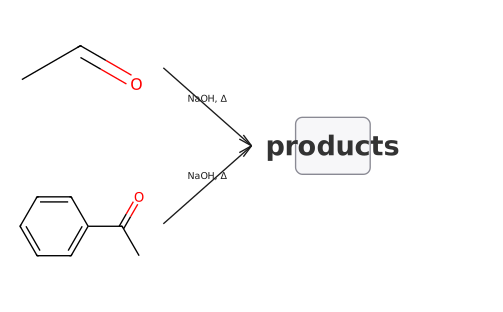
›Reveal solutionSolution
In a crossed-aldol reaction between acetaldehyde and acetophenone under basic, heated conditions, both self-aldol and crossed-aldol products form, but only the conjugated enones survive after dehydration; the total number of distinct products is 3.
The key idea here is that both aldehydes and ketones can act as enolate donors in the presence of a strong base like NaOH. Acetaldehyde (CH₃CHO) has α-hydrogens and can form an enolate; acetophenone (C₆H₅COCH₃) also has α-hydrogens on its methyl group. Under heat (Δ), the initial aldol addition products dehydrate to give α,β-unsaturated carbonyl compounds. We must count all distinct, stable products.
-
Identify possible enolate donors and acceptors
- Acetaldehyde: can be both donor (via its enolate) and acceptor (electrophilic carbonyl).
- Acetophenone: can also be both donor (enolate from the methyl group) and acceptor (carbonyl). This gives four possible combinations for the aldol addition step.
-
List all crossed and self-aldol combinations
- Self-aldol of acetaldehyde: Two molecules of CH₃CHO give 3-hydroxybutanal, which dehydrates to crotonaldehyde (CH₃CH=CHCHO).
- Self-aldol of acetophenone: Two molecules of C₆H₅COCH₃ give a β-hydroxyketone, which dehydrates to 1,3-diphenyl-2-buten-1-one (C₆H₅COCH=C(CH₃)C₆H₅).
- Crossed-aldol (acetaldehyde as donor, acetophenone as acceptor): Enolate from acetaldehyde attacks the carbonyl of acetophenone → 4-hydroxy-4-phenyl-2-butanone, which dehydrates to 4-phenyl-3-buten-2-one (C₆H₅CH=CHCOCH₃).
- Crossed-aldol (acetophenone as donor, acetaldehyde as acceptor): Enolate from acetophenone attacks acetaldehyde → 3-hydroxy-1-phenyl-1-butanone, which dehydrates to 1-phenyl-2-buten-1-one (C₆H₅COCH=CHCH₃).
-
Check for duplicates
The two crossed products are different:
- 4-phenyl-3-buten-2-one has the double bond between the phenyl and the carbonyl (conjugation with the ring).
- 1-phenyl-2-buten-1-one has the double bond between the carbonyl and the methyl group. They are not the same compound. So we have:
- Product A: crotonaldehyde (from acetaldehyde self-aldol)
- Product B: 1,3-diphenyl-2-buten-1-one (from acetophenone self-aldol)
- Product C: 4-phenyl-3-buten-2-one (crossed, acetaldehyde donor)
- Product D: 1-phenyl-2-buten-1-one (crossed, acetophenone donor) That’s 4 possible products.
-
Consider the reaction conditions: NaOH and heat …
-
🎓Unlock everything free for 14 days
- ✓Full step-by-step solutions
- ✓Concept-first explanations
- ✓Methods, shortcuts & mistakes
- ✓PYQ mapping + timed mock tests
Full access for 14 days. No credit card required.